


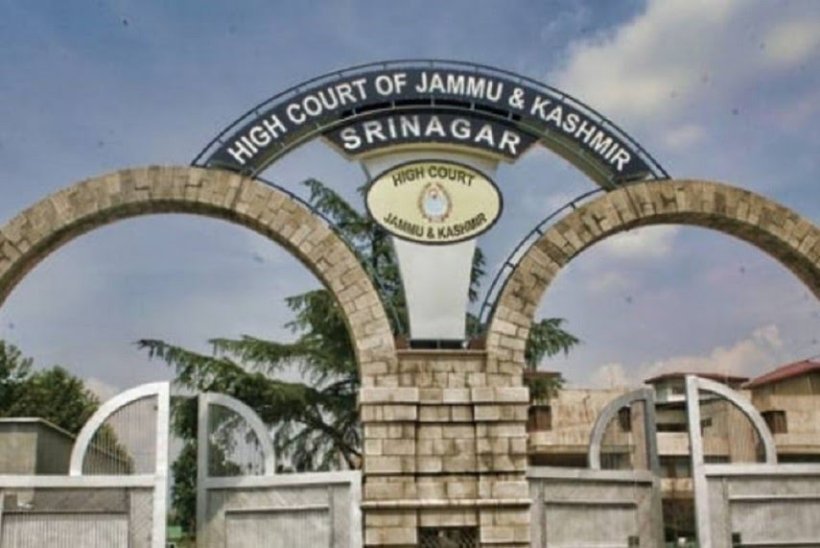
SRINAGAR: The High Court of Jammu, Kashmir and Ladakh has nullified the confiscation of 6,150 willow clefts and the truck transporting them, ruling that the proceedings were unlawful due to the absence of a prescribed procedure following the repeal of the Jammu and Kashmir Forest Act, 1987. The court emphasised that for non-government property, confiscation cannot be finalised without a conviction in the associated criminal case.
Information was available with The Chenab Times that Justice M.A. Chowdhary, in a judgment delivered on July 30, 2026, allowed two petitions filed by Mymoona, proprietor of M/S Mymoona Sports, and M/S Jammu Indore Roadways. The court ordered the final release of the 6,150 willow clefts and truck bearing registration number JK-21G/9603.
The High Court noted that there was “admittedly neither registration of criminal case, nor conviction of the offenders.” Consequently, the confiscation proceedings initiated by the Authorised Officer and later upheld by the Appellate Authority were deemed legally unsustainable.
The judgment stemmed from two connected writ petitions: WP(Crl) No.59/2025 filed by Mymoona, a resident of Chersoo, Awantipora, and WP(C) No.1985/2025 filed by M/S Jammu Indore Roadways, located in SIDCO Complex, Bari Brahmana, Samba. Both petitions were clubbed by the court as they originated from the same order and involved identical factual and legal circumstances.
The incident that led to the legal challenge occurred on December 12, 2023, when the truck, JK-21G/9603, was intercepted and detained at the Lakhanpur toll plaza. The vehicle was carrying a consignment of willow clefts bound for Meerut in Uttar Pradesh.
According to a report from the Forest Department, the accompanying bill and e-way bill indicated a total of 6,250 clefts. However, a physical verification, conducted in the presence of the driver, Kuldip Singh, revealed that only 6,150 willow clefts were present. The Forest Department also observed discrepancies in the No Objection Certificate (NOC) issued to M/S Mymoona Sports, which specified 7,000 Populus species, while the e-way bill pertained to willow clefts. The driver was reportedly unable to produce the necessary documentation for transporting the willow clefts out of Jammu and Kashmir, leading to the seizure of the clefts and the truck.
A Forest Office Report dated December 12, 2023, was registered under the provisions of the Jammu and Kashmir Willow (Prohibition on Export and Movement) Act, 2000, along with provisions of the Indian Forest Act, 1927, and Rule 7(3) of S.O. 81 of 2020, to initiate confiscation proceedings. The Authorised Officer, after informing the Chief Judicial Magistrate, Kathua, commenced proceedings and ordered the confiscation of the willow clefts and the vehicle on January 31, 2024.
The petitioners challenged this confiscation order before the Additional Sessions Judge, Kathua. On May 28, 2024, the court instructed the Authorised Officer to rehear the parties, cross-examine witnesses, and record their statements. Following this, the Authorised Officer reissued the confiscation order on October 14, 2024.
Subsequently, the petitioners filed separate appeals before the Principal Chief Conservator of Forests, Jammu and Kashmir. The Appellate Authority dismissed these appeals on June 28, 2025, upholding the confiscation order dated October 14, 2024. This prompted the filing of the two petitions before the High Court.
Advocate Jagpaul Singh, representing Mymoona and assisted by Nikhil Sharma, argued before the High Court that no criminal case had been registered under the Jammu and Kashmir Willow Act. He further contended that Section 55 of the Indian Forest Act mandates conviction prior to confiscation. Singh also raised questions about the jurisdiction of the Appellate Authority.
Singh further elaborated that the Jammu and Kashmir Forest Act, 1987, had been repealed following the Jammu and Kashmir Reorganisation Act, 2019, and replaced by the Indian Forest Act, 1927. However, he pointed out that the government had not issued a notification to replace SRO 308 of September 12, 2003, which prescribed the confiscation procedure under the erstwhile Jammu and Kashmir Forest Act.
He also argued that there was no evidence on record to suggest that the willow clefts were being transported with the knowledge or consent of the truck owner. Given that the vehicle was intercepted within the Union Territory, he asserted that the alleged export had not yet occurred, and at most, the driver’s actions could be construed as preparation for an offence.
Representing Jammu Indore Roadways, senior advocate K. Nirmal Kotwal, along with advocates Savesh Kotwal and Pawan Dev Singh, argued that the transport company was unaware that the consignment contained banned or contraband material. The company, he stated, had instructed its driver not to load or transport such items and had accepted the assignment in good faith, seeking the release of the truck.
The government’s case was opposed by Deputy Advocate General Meenakshi Slathia, who argued that the petitioners had introduced disputed questions of fact that were not suitable for adjudication in writ proceedings. She maintained that there were no procedural or jurisdictional errors in the orders issued by the Authorised Officer or the Appellate Authority and contended that the petitioners’ reliance on Section 55 of the Indian Forest Act was misplaced.
Slathia cited the Supreme Court’s judgment in State of Madhya Pradesh v. Kallo Bai, arguing that criminal prosecution and confiscation proceedings are independent and can run concurrently. According to the government’s stance, confiscation did not hinge on the registration, prosecution, or conviction in a criminal case, particularly as the willow clefts were allegedly being transported from Kashmir to Uttar Pradesh without a valid permit.
Justice Chowdhary examined Section 3 of the Jammu and Kashmir Willow Act, which prohibits the carriage and export of willow outside the erstwhile State without government orders or authorisation. Section 4 allows for the seizure of willow and its carrier if there is reason to believe that it is being transported or an attempt is being made to transport it in violation of the Act, with the seized material subject to confiscation through a procedure to be prescribed by the Government.
The court found that SRO 308 of September 12, 2003, had prescribed the confiscation procedure by referencing the Jammu and Kashmir Forest Act, 1987. However, this Act was repealed after the Jammu and Kashmir Reorganisation Act, 2019, and the Indian Forest Act, 1927, became applicable to the Union Territory.
Crucially, the court determined that the Government had not issued a new order to replace SRO 308 and prescribe the procedure for confiscation under the Willow Act. Therefore, the provisions of the Indian Forest Act could not be applied to the Willow Act without such a rule or standing order.
The court unequivocally stated that the confiscation proceedings against the truck and willow clefts were “illegal, ab initio, without any legal backing with regard to the procedure.” It concluded that both the confiscation order by the Authorised Officer and the Appellate Authority’s order affirming it were invalid.
The High Court also drew a distinction between government and private property. It held that an Authorised Officer could independently confiscate government forest property and the carrier involved in a forest offence without awaiting the conclusion of a criminal trial. However, when the seized property is non-government property, confiscation cannot be finalised until the offender is convicted by a Magistrate.
The court dismissed the government’s reliance on the Kallo Bai case, observing that the Madhya Pradesh law examined by the Supreme Court contained an independent statutory power allowing confiscation before guilt was established. The High Court found no comparable provision under the Jammu and Kashmir Forest Act, 1987, for non-government property.
It also referenced principles laid down in State of Madhya Pradesh v. Madhukar Rao and Principal Chief Conservator of Forests v. J.K. Johnson, noting that when criminal proceedings are pending, the final confiscation of a vehicle should not precede the conclusion of those proceedings.
The High Court ultimately ruled that, in the case of the private willow clefts involved, confiscation proceedings could not be finalised before conviction. As there had been neither a criminal case registration nor a conviction, the confiscation orders could not be sustained.
The court accordingly allowed both petitions, quashed the orders of the Authorised Officer and the Appellate Authority, and directed the final release of the 6,150 willow clefts and truck JK-21G/9603 in favour of the petitioners.
The judgment clarified that this ruling should not be interpreted as diminishing the legal protection afforded to forests. Justice Chowdhary acknowledged the constitutional obligations under Articles 48-A and 51-A(g) and stated that statutory interpretation must remain vigilant regarding environmental harm.
At the same time, the court noted that without a prescribed procedure for handling seized willow, confiscation proceedings could not be undertaken by Forest, Industries, or Police officials. It directed that if the Government intends to enforce the Willow Act, it should issue a notification or standing order detailing the procedure for dealing with seized property.
The court further instructed the Jammu and Kashmir Forest Department to submit a proposal to the Government for consideration within eight weeks from the date of the judgment. A copy of the order was also directed to be forwarded to the Administrative Secretary of the Forest Department for compliance.
The judgment was reserved on July 20, 2026, and pronounced on July 30, 2026.


The Chenab Times News Desk