


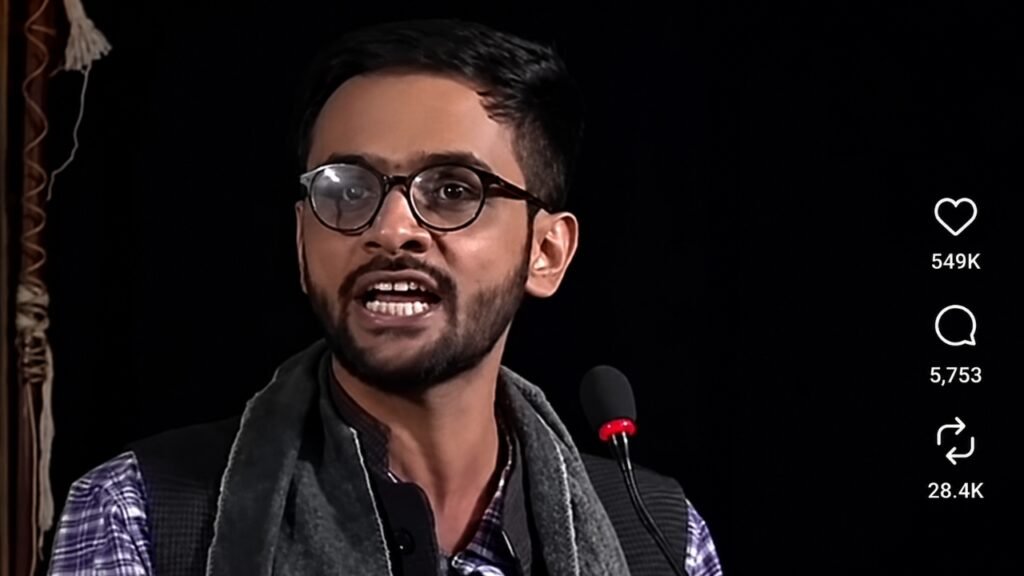
New Delhi, August 14: A seven-year-old speech by former Jawaharlal Nehru University (JNU) student leader Umar Khalid has gone viral on social media ahead of India’s 80th Independence Day, drawing millions of views and reigniting debates around nationalism, citizenship, dissent and the legacy of the anti-CAA movement.
The viral clip, widely shared across X, Instagram, Facebook and YouTube Shorts over the past week, features Khalid declaring, “Hum kahin nahi ja rahe hain. Hum Hindustan chhod kar nahi ja rahe hain” (“We are not going anywhere. We are not leaving India”). The statement, delivered during a speech in December 2019 amid nationwide protests against the Citizenship Amendment Act (CAA) and the proposed National Register of Citizens (NRC), has emerged as one of the most circulated political videos in the run-up to Independence Day celebrations.
The excerpt gaining traction online shows Khalid invoking the words of freedom fighter and India’s first Education Minister, Maulana Abul Kalam Azad, while responding to what he described as recurring demands by some political voices that Indian Muslims should “go to Pakistan”.
“The history of this country and the future of this country is incomplete without us. It will remain incomplete. We are not going anywhere. We are not leaving Hindustan. We were born in this soil and even after dying, we will be buried in this soil,” Khalid says in the viral segment.
Another portion of the speech that has been widely shared references Nathuram Godse and BJP MP Pragya Singh Thakur, with Khalid stating that those telling Muslims to leave India should be reminded of Azad’s message during the Partition era.
Millions of Views Across Platforms
While the speech itself dates back to December 2019, social media users began resharing excerpts of it in recent weeks, coinciding with discussions around India’s upcoming 80th Independence Day. Several versions of the video have collectively garnered millions of views across platforms, with users editing the speech into short-form reels, patriotic montages and Independence Day-themed content.
Many posts frame the speech as an assertion of belonging and citizenship, while others have highlighted its emphasis on constitutional values and India’s pluralistic identity. The viral clips are frequently accompanied by patriotic music, archival images of the freedom movement and visuals of the Indian tricolour.
The resurgence has also led to renewed visibility for the hashtag #FreeUmarKhalid, with supporters arguing that the speech reflects a commitment to India rather than hostility toward the nation. Numerous comments on viral posts describe the speech as patriotic and challenge allegations that Khalid is anti-national.
At the same time, critics continue to view Khalid through the lens of controversies and legal cases associated with him over the past decade. The renewed circulation of the speech has therefore triggered polarized reactions, reflecting broader ideological divisions that have long surrounded his public image.
Context: The Anti-CAA Movement
The speech was delivered during the nationwide protests that followed the passage of the Citizenship Amendment Act in December 2019.
At the time, protesters argued that the CAA, when viewed alongside proposals for a nationwide NRC, could discriminate against Muslims and undermine constitutional guarantees of equality. The Union government, however, consistently maintained that the CAA was intended to provide citizenship to persecuted religious minorities from neighbouring countries and had no impact on the citizenship rights of existing Indian citizens.
Khalid’s address reflected many of the concerns raised by anti-CAA protesters. Throughout the speech, he criticized the proposed NRC process, questioned the requirement for historical documentation, expressed concerns about the implications for poor and marginalized communities, and called for democratic opposition to policies he considered unconstitutional.
The speech also included criticism of the Bharatiya Janata Party (BJP), references to electoral politics, comments on communalism, and appeals for secularism and constitutional values. He invoked figures such as Mahatma Gandhi, Maulana Abul Kalam Azad and Dr. Kafeel Khan while arguing that minorities should assert their equal citizenship rights.
The now-viral “Hum kahin nahi ja rahe” passage appeared near the conclusion of his remarks and was framed as a response to narratives questioning the place of Muslims in India.
Why the Speech Is Resonating Again
Observers note that the speech’s renewed popularity appears linked to its themes of citizenship, national belonging and identity—issues that continue to resonate in public discourse years after the anti-CAA protests.
The specific lines being shared focus less on the political criticism contained in the broader speech and more on Khalid’s declaration that Indian Muslims are an inseparable part of the country’s past and future.
The references to soil, ancestry, belonging and commitment to remain in India have been interpreted by many social media users as expressions of patriotism. Several viral posts contrast these remarks with long-standing allegations against Khalid, arguing that the speech presents a different image than the one often portrayed by his political opponents.
Others, however, argue that excerpts shared online omit the wider political context of the speech, which included strong criticism of the BJP government and its policies. Some commentators have therefore urged viewers to consider the entire address rather than isolated clips.
Umar Khalid’s Legal Situation
The resurgence of the speech comes as Umar Khalid remains incarcerated in Delhi’s Tihar Jail.
Khalid was arrested by the Delhi Police Special Cell on September 13, 2020, under provisions of the Unlawful Activities (Prevention) Act (UAPA) in connection with the larger conspiracy case related to the 2020 northeast Delhi riots.
Investigating agencies have alleged that he was part of a conspiracy linked to the violence that erupted in parts of northeast Delhi in February 2020. Khalid has denied the allegations against him and has maintained that he is being targeted for his activism and political views.
The case remains under judicial consideration, with debates over bail and the merits of the allegations continuing through various legal proceedings over the years.
A Speech Revisited
As India marks eight decades of Independence, the unexpected revival of a speech delivered during one of the country’s most contentious political movements has once again placed Umar Khalid at the centre of public discussion.
Whether viewed as a powerful statement of patriotism, a reflection of the anti-CAA movement, or a politically charged intervention from a polarizing public figure, the viral clip has succeeded in reopening conversations about citizenship, nationalism and the place of dissent in Indian democracy.
For now, the phrase “Hum kahin nahi ja rahe hain” continues to echo across social media timelines, transforming a speech from December 2019 into one of the most discussed political videos of Independence Day week in 2026.


The Chenab Times News Desk