


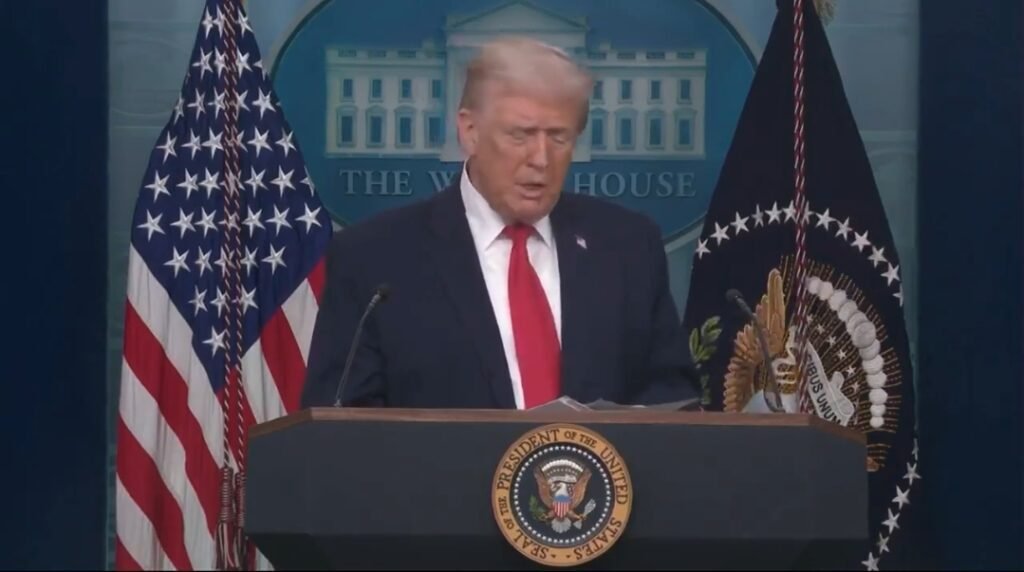
The U.S. Supreme Court has permitted President Donald Trump’s administration to proceed with implementing key components of an executive order aimed at tightening regulations for mail-in voting. The decision, which came via a 6-3 ruling, addresses an emergency appeal filed by the Trump administration seeking to lift a lower court’s injunction that had halted these measures in 23 Democratic-led states and the District of Columbia. The high court’s intervention clears a path for the Department of Homeland Security to develop lists of eligible voters in each state, a central element of the contested order.
The Supreme Court’s unsigned majority opinion stated that the states had filed their lawsuit prematurely, suggesting that the implementation of the executive order’s provisions had not yet caused demonstrable harm to the states. “The Court’s disposition of this application does not mean that any measure taken by the Government to implement the Order will necessarily be lawful,” the ruling cautioned, adding that “On that score, time will tell.” The court further elaborated that the executive order itself does not inherently harm the states, thus the district court lacked jurisdiction to prohibit the government from attempting to implement it.
The White House characterized the ruling as a significant victory for election security. A spokesperson for the administration emphasized that the measures are common-sense steps designed to protect the integrity of mail-in ballots and ensure that only eligible American citizens participate in electing national leaders. This decision allows the administration to advance its agenda concerning election safety and security.
The legal battle stems from an executive order issued by President Trump in March, which directed federal agencies, including the Department of Homeland Security and the U.S. Postal Service, to implement new federal regulations concerning mail ballots. The order’s provisions include requiring the Department of Homeland Security to compile lists of eligible citizen voters in each state and directing the U.S. Postal Service to restrict the processing of mail-in ballots to individuals appearing on these federally compiled lists. States that do not comply with these federal directives, particularly regarding the provision of voter lists, could face restrictions on the Postal Service’s delivery of mail-in ballots.
This executive order has faced considerable opposition from various quarters. Democratic officials in numerous states, alongside voting rights groups, have filed lawsuits challenging the order. Their arguments contend that election administration falls under the purview of states and Congress, not the President, and that such sweeping changes implemented close to an election could lead to chaos and partisan manipulation. Legal challenges have highlighted concerns that the rushed implementation of these new federal regulations could disrupt the upcoming midterm elections.
Prior to the Supreme Court’s intervention, lower courts had issued conflicting rulings. In one instance, a U.S. District Judge had blocked the Trump administration from implementing significant portions of the executive order for the upcoming November elections, deeming them unconstitutional. An appeals court subsequently upheld this decision, further preventing federal agencies from moving forward with the order’s implementation while litigation progressed. The Justice Department appealed these rulings, asserting that the states’ lawsuits were premature.
In response to the Supreme Court’s latest decision, California’s Attorney General has indicated the state’s intention to file a new lawsuit challenging the implementation of the order. Governor Gavin Newsom of California expressed strong opposition, stating that the Supreme Court’s ruling allows the Trump administration to proceed with a plan that could disenfranchise voters, and that California would take legal action to block these rules. Other state officials and voting rights activists have also voiced concerns, with some characterizing the ruling as a setback but vowing to continue legal fights to prevent the order’s implementation.
The U.S. Postal Service had previously outlined its plan for implementing the executive order, but the approaching midterm elections leave a limited timeframe for imposing substantial changes. With some states set to begin sending mail ballots to voters within weeks, the practical implications and the extent to which the Trump administration can successfully implement its directives remain uncertain. Legal experts suggest that further court challenges are possible, potentially leading to additional legal battles that could extend the uncertainty surrounding mail-in voting procedures ahead of the elections.
President Trump has consistently raised concerns about the integrity of mail-in voting, frequently asserting that it is susceptible to fraud. He has promoted the executive order as a necessary safeguard to prevent non-citizens from voting and to enhance election security. However, numerous studies have indicated that instances of non-citizen voting are infrequent, and that mail-in voting systems are generally secure when properly administered. The Supreme Court’s decision does not definitively rule on the legality of the executive order, but rather addresses the procedural aspects of the legal challenges, leaving the ultimate legality of the measures to be determined through ongoing litigation.


Global Affairs Desk at The Chenab Times covers international developments, global diplomacy, and foreign policy issues through fact-based reporting, explainers, and analytical pieces. The desk focuses on major geopolitical events, diplomatic engagements, and international trends, with an emphasis on verified information, multiple perspectives, and contextual understanding of global affairs.