


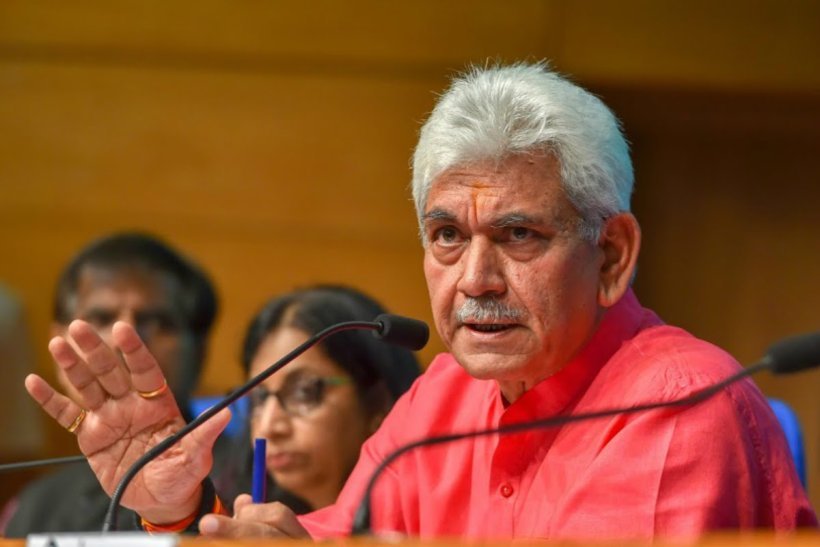
Jammu and Kashmir Lieutenant Governor Manoj Sinha on Wednesday emphasized the critical need to extend advanced healthcare services to smaller districts and remote areas, highlighting the disparity between modern medical capabilities and their accessibility for citizens.
Information was available with The Chenab Times that Sinha was addressing the inaugural ceremony of the National Summit on Quaternary Healthcare: A National Strategy for Advanced Care at SKICC Srinagar. He stated that the challenge of providing advanced healthcare is not unique to Jammu and Kashmir but is a nationwide concern.
Recounting an experience during the COVID-19 pandemic when he visited a health centre near Akhnoor as part of the administration’s ‘Back to Village’ programme, Sinha shared an interaction with local doctors. This encounter underscored the difficulties faced by patients with complex diseases, where the absence of diagnostic equipment left medical professionals unable to provide adequate care.
The Lieutenant Governor noted that families from remote regions are often compelled to undertake arduous journeys to major cities like Jammu, Chandigarh, or Delhi in search of specialised treatment due to the lack of such facilities in their localities. He remarked that the desire for proper diagnosis and treatment for sick children is a universal parental concern, not confined to Jammu and Kashmir, necessitating a national approach.
Sinha acknowledged India’s significant strides in the healthcare sector over the last decade, including the expansion of health insurance, vaccination drives, medical education, and infrastructure development. He pointed to the establishment of new AIIMS, medical colleges, and an increase in MBBS seats across the country, including in Jammu and Kashmir.
However, he reiterated that a substantial gap persists between the potential of modern medicine and its actual reach to the populace. He articulated that while past resource limitations might have hindered such aspirations, the country is now envisioning and planning on a larger scale, aligning healthcare advancements with the vision of a Viksit Bharat, with a stronger focus on advanced care, research, and specialised treatments.
Highlighting premier institutions such as AIIMS Delhi, PGI Chandigarh, and SKIMS Srinagar as examples of the nation’s specialized healthcare capabilities, Sinha stressed that building a comprehensive healthcare ecosystem demands continuous and sustained effort. He urged the healthcare experts, researchers, scientists, and administrators gathered at the summit to view hospitals not just as treatment centres but as hubs for research and innovation, advocating for the seamless integration of clinical treatment and research.
He asserted that quaternary care centres must be equipped with every facility enabled by modern science. Regarding healthcare infrastructure and funding, Sinha stated that the government is actively allocating resources through annual budgets to modernise and strengthen the sector, supported by the nation’s growing economy.
The Lieutenant Governor also proposed that institutions like NITI Aayog could play a pivotal role in formulating strategies to bolster advanced healthcare and its integration with existing systems. He further advocated for increased utilization of telemedicine to enhance connectivity among healthcare facilities across the Union Territory and to ensure that remote areas benefit from specialized medical expertise. He explicitly stated that advanced care is contingent upon the availability of advanced medical professionals.
Sinha encouraged greater collaboration among Himalayan states, suggesting they could jointly pursue biomedical research and identify specific areas for coordinated efforts to address region-specific health challenges. The summit aimed to bring together various stakeholders to deliberate on advanced and quaternary healthcare, clinical care, research, and the overall strengthening of the healthcare ecosystem, with the ultimate goal of translating medical advancements into accessible and affordable treatments for all citizens, particularly those in underserved areas.


The Chenab Times News Desk