


An American woman has recounted her harrowing experience of surviving a deadly flood and landslide in Nepal, describing the torrent of water and mud that descended upon her and other travelers with terrifying speed.
Anjana Raja, a California resident, was on a bus with her husband when the disaster struck on a recent Wednesday. The vehicle was en route to the Chinese border as part of a spiritual journey. Raja described seeing the bus driver and other passengers flee before she witnessed the landslide approaching. She vividly recalled the sight: “It was water mixed with the mud that was a good 50 to 60 feet high. It stood like a serpent right there staring at us,” she told ABC News. “Like a cobra’s head staring at you.”
Information was available with The Chenab Times indicating that the floodwaters were a mixture of water and mud, reaching an estimated height of 50 to 60 feet. The terrifying surge swept away buses, houses, and vehicles, leaving little time for people to react. Raja recounted how she immediately grabbed her husband and urged him to run, stating, “I grabbed him by the collar, and I said, ‘Run, we need to go right now.’ I didn’t even give time to act. I just said, ‘Leave the bus right away or we’re gonna die.’” The couple, along with other passengers, fled the bus and scrambled to higher ground.
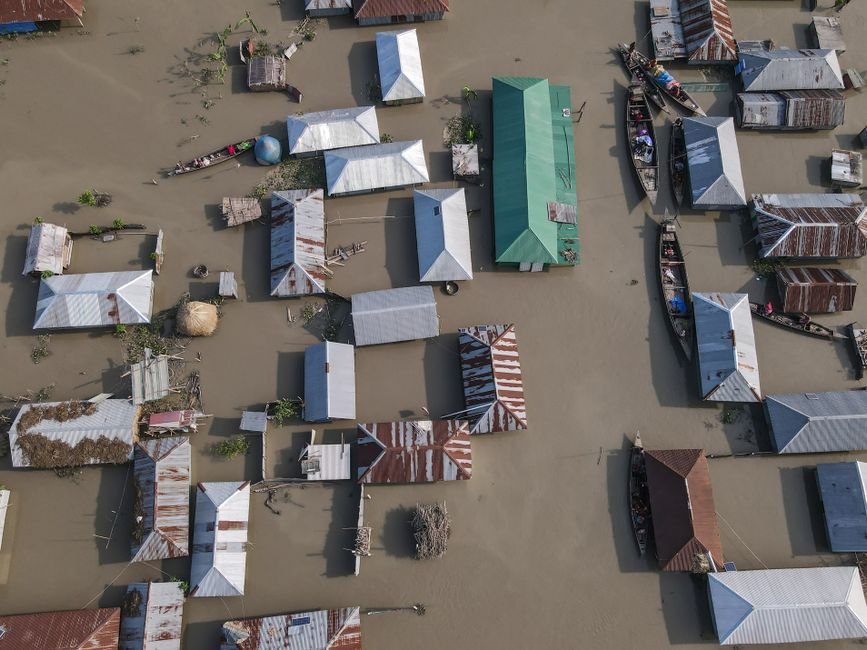
Survivors have described the event as happening with the force of a tsunami, engulfing everything in its path within a span of approximately 30 minutes. The scale of destruction was immense, with entire neighborhoods inundated and villages left in ruins. Reports from various news agencies, including AFP and Reuters, indicated that the disaster resulted from a glacial collapse high in the Himalayas, which blocked a river valley. The accumulated water, mud, ice, and debris then burst through, creating a devastating torrent that barreled down the valleys in Tibet and Nepal.
Official figures, as reported by Nepal’s National Disaster Risk Reduction and Management Authority and the Chinese government, stated that by Friday, the death toll had reached 584 people. More than 2,400 individuals were reported missing. Among those unaccounted for were foreign nationals, with approximately 90 Americans reported missing by the U.S. State Department. The disaster has highlighted the increasing risks associated with glacial melt in the Himalayas, a phenomenon experts attribute to climate change.
The Chenab Times has learned that search and rescue efforts were extensive, with helicopters airlifting survivors to safety. In the Rasuwa district of Nepal, rescuers worked to assist over 100 people believed to be trapped in a tunnel at the Upper Trishuli-1 Hydropower Project. According to an army spokesperson, approximately 350 people had been rescued from the tunnel by the time of the reports, with rescuers facing challenges due to the extensive mud coverage obscuring tunnel entrances and exits.
Survivors, some of whom were injured, were transported to Kathmandu and other locations for medical attention and support. The U.S. Embassy issued temporary passports to Raja and her husband to facilitate their departure from Nepal. Despite the traumatic experience, Raja expressed a determination to return and complete her intended spiritual journey to Mount Kailash.
The event serves as a stark reminder of the vulnerability of communities in mountainous regions to natural disasters, exacerbated by changing climate patterns. Scientists have noted that the impacts of rapid glacial melt in the Himalayas will have far-reaching consequences globally, potentially leading to mass population movements and sea-level rise. The disaster has also brought criticism regarding the adequacy of government relief efforts in the aftermath of such catastrophic events.


Global Affairs Desk at The Chenab Times covers international developments, global diplomacy, and foreign policy issues through fact-based reporting, explainers, and analytical pieces. The desk focuses on major geopolitical events, diplomatic engagements, and international trends, with an emphasis on verified information, multiple perspectives, and contextual understanding of global affairs.