


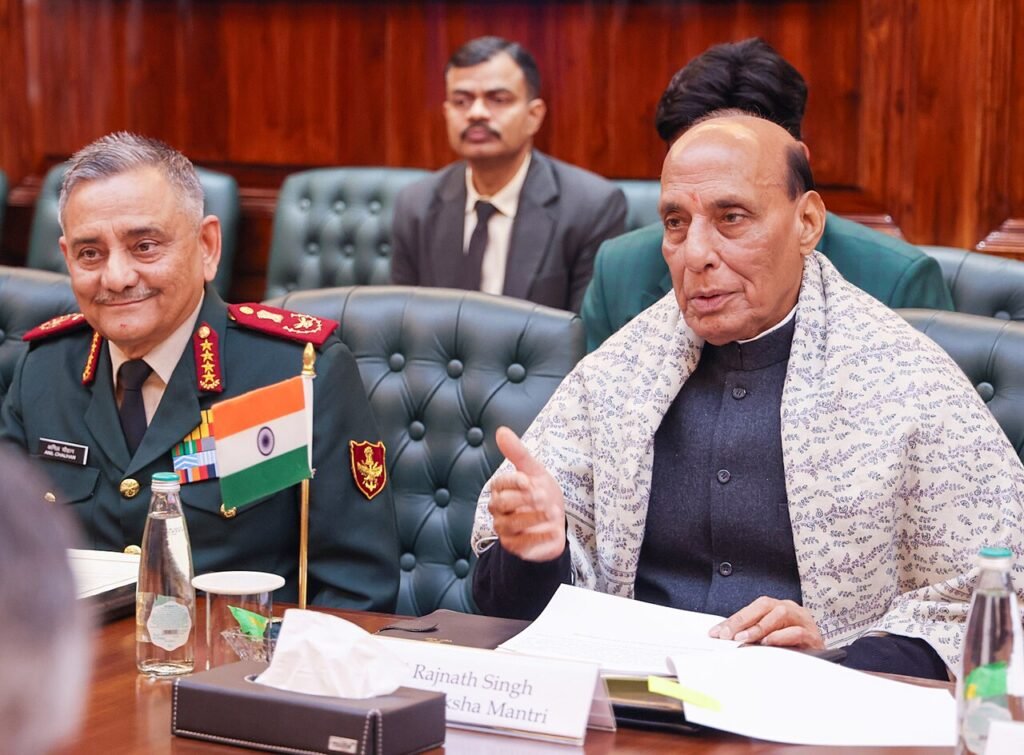
NEW DELHI, Sep 7: Defence Minister Rajnath Singh stated on Monday that India’s armed forces have been granted the necessary autonomy and resources to decisively counter threats, including the capability to strike adversaries within their own territory. He reiterated India’s commitment to peace and its disinclination towards war or territorial encroachment.
Information was available with The Chenab Times that the minister emphasised a crucial distinction between peace and vulnerability. He remarked, “Peace born of the fear of war is to be condemned, while war fought for the sake of peace is worthy of reverence. We’ve made it clear that if any country promotes terrorism against India, there will be no dialogue; instead, our defence forces will deliver a befitting response.”
Singh elaborated that the defence forces are equipped with both the freedom and the means to respond with full force to any threat, which includes the prerogative to engage adversaries on their own soil. He asserted that India is navigating the complex geopolitical landscape with a strong sense of independent agency and strategic autonomy.
The Defence Minister highlighted concerted efforts by adversaries to destabilize India’s security through various means, including the manipulation of youth in Jammu and Kashmir, the financing of anti-India activities, the promotion of violence and militancy, and attempts to foster internal divisions. He affirmed that the government has successfully countered these detrimental schemes by integrating misguided youth back into the mainstream, implementing rehabilitation and de-radicalisation programs, and creating avenues for employment and business opportunities.
Rajnath Singh pointed to significant progress witnessed in Jammu and Kashmir following the abrogation of Article 370, which has unlocked new opportunities for the region’s youth. He underscored India’s strategy of tackling militancy through decisive military actions, citing examples such as surgical strikes, the Balakot airstrike, and Operation Sindoor, all aimed at neutralizing militants and their supporters.
He further noted that the suspension of the Indus Waters Treaty served as a clear signal that India would not tolerate the dual flow of blood and water from the same source, implying a firm stance against cross-border hostility. The minister also detailed how attempts by adversaries to sow discord among the Indian populace have been effectively thwarted.
Commenting on the evolving nature of warfare, Singh identified space and cyberspace as new domains of conflict, alongside traditional land, air, and sea. He noted the transformative impact of technologies such as artificial intelligence, drones, autonomous systems, and precision weapons on the modern battlefield. The government, he stated, is prioritizing the development of a future-ready defence strategy and security apparatus, with the overarching goal of positioning India as a leader in indigenous advanced technology development.
India’s defence policy has transitioned from a reactive stance to a proactive approach. Singh credited Prime Minister Narendra Modi’s diplomacy and leadership for India’s induction into the Missile Technology Control Regime in 2016, a move that bolstered efforts to enhance the BrahMos missile’s range, proving critical during Operation Sindoor. The transformation within the defence sector, he emphasized, includes enhanced border security, modernization of forces, promotion of indigenous production, and revamping of ordnance factories.
These initiatives have fostered self-reliance and confidence in the nation’s defence capabilities. Defence production has surged from approximately ₹40,000 crore before 2014 to about ₹1.80 lakh crore, with defence exports experiencing a 56-fold increase, exceeding ₹38,000 crore. India is now moving from an import-dependent model to one centered on indigenous defence manufacturing and ‘Aatmanirbharta’ (self-reliance).
The nation’s armed forces are now equipped with indigenous systems like the Air Defence Control System ‘Akashteer’, the next-generation air defence missile ‘Akash’, the Pinaka Rocket Launcher, the ‘Astra’ air-to-air missile, indigenous helicopters such as ‘Prachand’ and ‘Dhruv’, the ‘Tejas’ fighter aircraft, the ‘Arjun’ tank, and advanced drone and counter-drone systems. Furthermore, India’s first indigenous aircraft carrier, INS Vikrant, has been commissioned into the Navy. The country is actively producing a wide array of defence equipment and developing sixth-generation fighter aircraft, with a target of exporting defence equipment worth ₹50,000 crore by 2029. The government’s objective is to achieve complete self-reliance in defence, cultivating an ecosystem that reinforces national security, stimulates economic growth, and elevates India’s standing in the global security framework. Singh expressed confidence that by 2047, India will not only achieve the status of a developed nation (‘Viksit Bharat’) but also emerge as a global leader in technology, economy, and defence.


The Chenab Times News Desk