


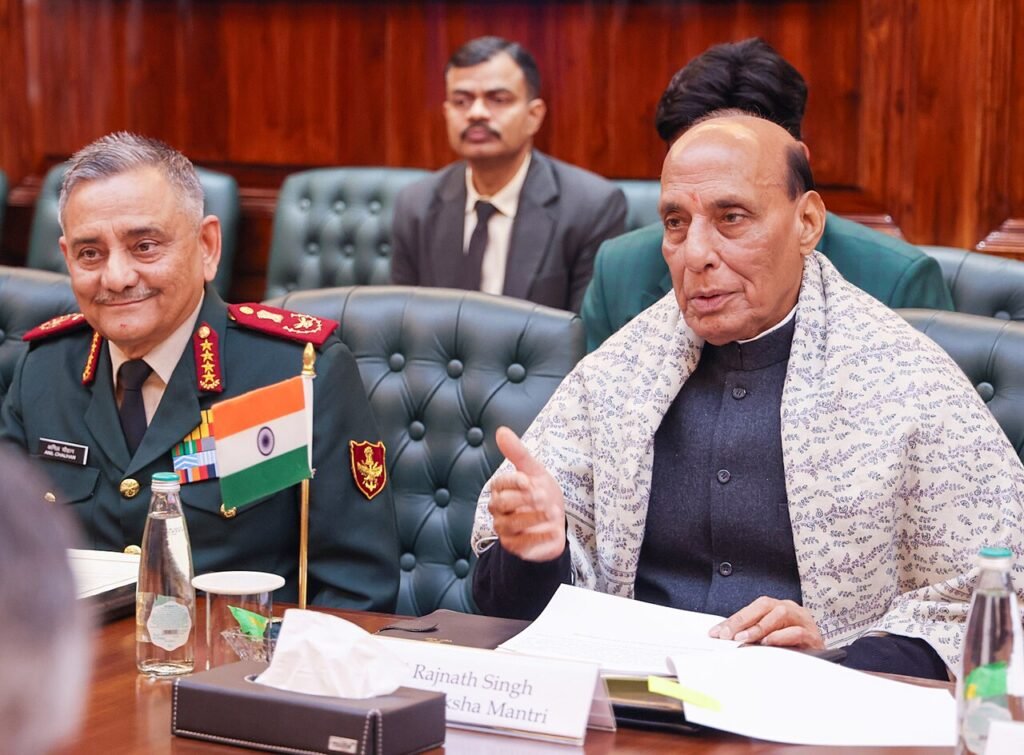
Defence Minister Rajnath Singh emphasised the critical importance of secure sea lanes, freedom of navigation, and adherence to international law for the economic prosperity of South Asia during a visit to Colombo. He stated that these elements should remain paramount priorities for regional growth.
The Chenab Times has learned that Singh, who met with Sri Lankan President Anura Kumara Dissanayake, reaffirmed the strong ties between India and Sri Lanka as civilisational partners and close neighbours. Both nations pledged to collaborate on ensuring regional safety, security, peace, and prosperity, particularly within the maritime domain.
Addressing a public event in Colombo on ‘India-Sri Lanka Maritime Cooperation in the Indian Ocean Region-Civilisational Partners with Intertwined Destinies,’ Singh highlighted the potential for Indian and Sri Lankan ports to become catalysts for shared economic development. He also suggested that their maritime industries could drive future prosperity for the entire region.
“Together, India and Sri Lanka are well positioned to serve as the closest partners in safeguarding peace, security and stability across the Indian Ocean Region,” Singh stated. He reiterated that secure sea lanes, freedom of navigation, respect for international law, and unhindered maritime trade and commerce are essential for regional progress.
The Defence Minister underscored the need for collaborative efforts to foster a secure maritime environment, anticipating and addressing emerging challenges before they escalate into significant threats to developmental interests and the region’s future. He noted Sri Lanka’s strategic location, which overlooks busy international trade routes vital for global commerce and regional development.
Singh described the Indian Ocean as more than just a waterway, but a critical arena for the region’s economic and strategic future. For both India and Sri Lanka, maritime nations sharing this ocean, these issues are not theoretical but a daily reality shaping their trade, security, and collective destinies. Sri Lanka’s position is central to any strategic discourse on maritime security in the Indian Ocean Region.
“In Sri Lanka, India sees a friendly neighbour, a longstanding friend and a reliable partner. India-Sri Lanka Maritime Cooperation is thus not only mutually beneficial but quintessential to our collective safety and security,” Singh remarked. He added that in a dynamic geopolitical landscape, the Indian Ocean’s relevance is immense, and as fellow democracies and emerging economies, India and Sri Lanka share a common future.
India expressed its readiness to share its expertise and work closely with Sri Lanka to further regional growth and prosperity, noting that development projects in Sri Lanka are tailored to the needs of the Sri Lankan people and the government’s priorities. As the Indian Ocean undergoes significant strategic and economic transformation, synergy and collaboration between the two nations are crucial to address emerging challenges.
Singh proposed that their ports could serve as engines of shared economic growth, and their maritime industries could drive prosperity for their populations and the wider region. He based this vision on the premise that proximity fosters interdependence, creating substantial opportunities for shared evolution, and termed Sri Lanka a trusted global friend.
Regarding the issue of fishermen, Singh acknowledged the need for a joint approach to resolve fisheries disputes amicably and in accordance with relevant laws and geographic jurisdictions. “We need to work together to strengthen our systems to avoid fisheries disputes, handle them with due care and concern as this is a livelihood issue, while at the same time ensure maritime law enforcement,” he said.
He envisioned a future where both countries develop an integrated maritime domain awareness system for real-time maritime information. This would involve cooperation among concerned agencies, navies, and coast guards to combat illegal fishing, track suspicious vessels, and address threats such as narcotics trafficking, smuggling, and militancy. India is prepared to assist Sri Lanka in capacity building and joint exercises.
Singh advocated for moving beyond traditional frameworks to build upon existing complementarities and develop new paradigms for a stronger maritime partnership. He referenced Prime Minister Modi’s vision for the Indian Ocean Region, MAHASAGAR, emphasizing the concepts of ‘Mutual’ and ‘Holistic’ cooperation.
Furthermore, the ministers discussed establishing a joint maritime Humanitarian Assistance and Disaster Relief (HADR) system, involving relevant agencies and scientific organisations for rapid response to natural and man-made disasters. Maritime cooperation should also encompass an institutionalised framework for economic collaboration in areas such as fisheries, aquaculture, marine biotechnology, ocean science, environmental protection, and tourism.


The Chenab Times News Desk