


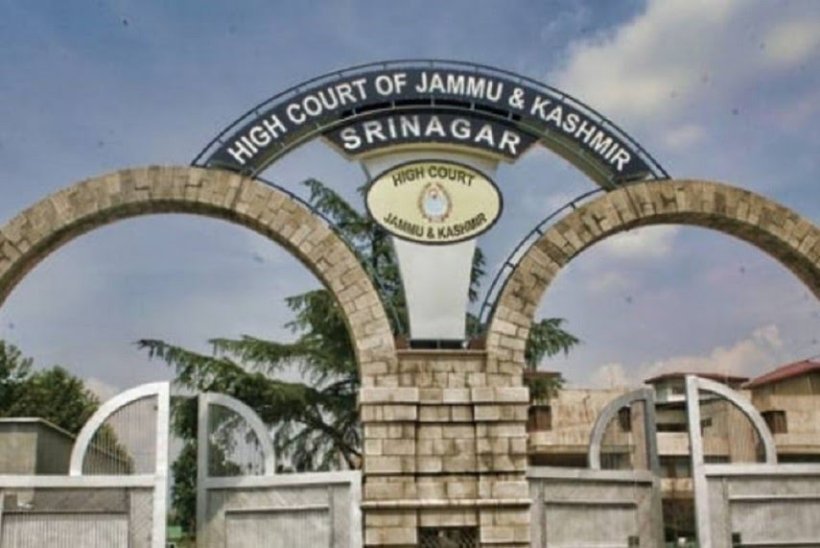
SRINAGAR: The High Court of Jammu and Kashmir and Ladakh has overturned a lower court’s order discharging an accused in a Unlawful Activities (Prevention) Act (UAPA) case, stating that secessionist slogans raised by a mob in the presence of a separatist leader prima facie constitute unlawful activity.
Information was available with The Chenab Times that a division bench, led by acting Chief Justice Sanjeev Kumar, set aside the discharge of Mohammad Yousuf Lone by the Additional District and Sessions Judge (Designated Special Court under NIA Act), Kupwara. The accused had been discharged in a 2013 UAPA case.
The court observed that “the sloganeering for secession, raised by an accused leading a mob in the company of the head of a proscribed separatist organisation, coupled with incitement of the public and violence against security forces, is capable, on a prima facie appreciation, of falling squarely within this definition.”
The case pertains to an incident on November 8, 2013, when a mob, reportedly led by Mohammad Yousuf Lone and the late Syed Ali Shah Geelani, chairman of the banned Hurriyat Conference, emerged from Jamia Masjid in Kupwara. According to the chargesheet, the mob raised anti-national slogans against the Government of India and pelted stones at police and security forces.
The prosecution alleged that the separatist leaders further incited the public against the sovereignty and territorial integrity of the Union of India.
The High Court found fault with the trial court’s discharge order, noting that it contained a single-sentence conclusion stating that the facts “do not fulfil the ingredients of Sections 2(o) of ULA(P) Act” without providing any reasoning or explaining how the specific statements and conduct attributed to the respondent were tested against the statutory definition. The court described this as a “bare conclusion rather than a reasoned finding.”
The bench emphasized that the material accompanying the chargesheet, including recorded slogans, the alleged leadership role of the respondent, and the ensuing violence, raised a strong suspicion sufficient to warrant a trial. The question of whether the charges are ultimately proven, the court stated, should be determined during the trial, not dismissed at the initial stage.
It is a well-established legal principle that an order of discharge must demonstrate the application of a judicial mind to the available evidence. While findings at the charge stage may be summary, they cannot be conclusory. The High Court found that the impugned order did not indicate that the specific contents of the chargesheet, witness statements, site plan, and other materials linking the respondent to incitement and violence were adequately assessed against the provisions of Section 13 read with Section 2(o) of the UAPA. Consequently, the court deemed the discharge order unsustainable.
The High Court clarified that it was not making any definitive pronouncements on the guilt or innocence of the respondent, nor was it expressing any opinion on the ultimate merits of the case. However, the court stressed that when prima facie evidence suggests the commission of an offence and the complicity of the accused, the trial court cannot arbitrarily deny a trial without valid legal grounds.
Allowing a criminal appeal filed by the state, the High Court directed that the chargesheet be reinstated and that the trial court proceed with framing the charge against the respondent afresh, after a thorough consideration of all the material placed on record by the appellant.


The Chenab Times News Desk