


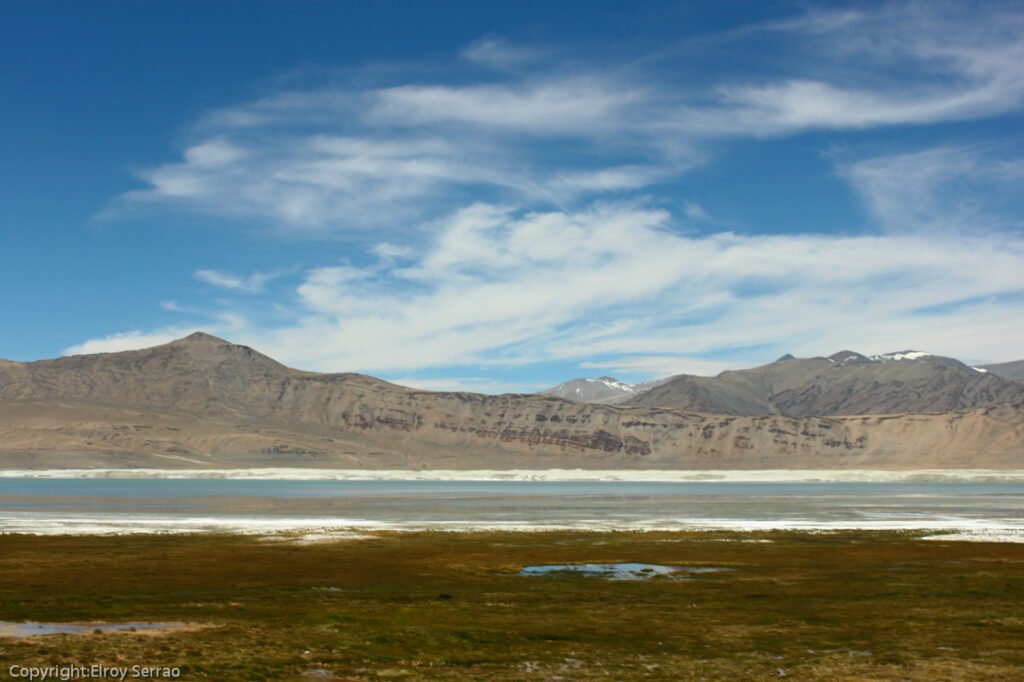
Leh: A significant initiative has been launched in Ladakh to restore the ecological balance of the Tso Kar Lake, which has experienced a drastic reduction in its water levels over the past decade. The project aims to channel approximately 320 million litres of water daily from a glacier-fed stream into the lake, marking a crucial step towards high-altitude ecological restoration and supporting local livelihoods.
The Chenab Times has learned that the mega project, initiated by the Lieutenant Governor of Ladakh, Vinai Kumar Saxena, involves redirecting meltwater from the Rupsho Kharnak stream, located at an altitude of 18,000 feet, into the rapidly drying Tso Kar Lake. This effort is expected to revive the lake, which has lost nearly 70 per cent of its water volume in the last ten years.
The project draws inspiration from a prior successful intervention where 90 million litres of water were channelised from the Stok Glacier to irrigate agricultural land in Leh’s vicinity, benefiting villages like Igoo-Phey and Chuchot. The current endeavour focuses on recharging Tso Kar by tapping into the untapped glacier meltwater from the Rupsho Kharnak stream. During summer, this stream’s peak discharge is estimated at around 132 cusecs, equating to approximately 320 million litres per day.
Lieutenant Governor Saxena emphasized the project’s importance as a blueprint for high-altitude ecological restoration. He stated that by converting untapped glacier water into permanent water sources, Ladakh is making strides towards agricultural prosperity, revitalising rural economies, and building long-term climate resilience. This initiative is intended to preserve iconic landscapes like Tso Kar and the life they support for future generations.
The conception of this project stemmed from a visit by the Lieutenant Governor to Tso Kar on August 10, where local villagers and the ‘nambardar’ informed him about the lake’s historical significance as a vast body of glacial water that supported centuries of local salt trade and a delicate ecological balance. In recent years, the lake’s recession has led to a decline in bird populations and a loss of grazing land, with extensive dry patches becoming visible where deep waters once existed.
Following these observations, the Lieutenant Governor directed the Public Health Engineering Department to conduct a comprehensive survey. After 15 days of intensive fieldwork, the department submitted a report on August 30, initially suggesting the construction of an 11-kilometre-long Reinforced Cement Concrete (RCC) channel. However, considering ecological sensitivities, Mr. Saxena proposed an alternative approach, advocating for the use of simple earthen channels to direct water to the first depression, thereby avoiding the construction of new RCC channels.
With the onset of winter necessitating immediate action, work commenced on a war footing on September 2 to channel water from the Rupsho Kharnak stream to the first large pond. The revival of Tso Kar is anticipated to have substantial benefits for the local communities, primarily Pashmina goat herders. The shrinking of the lake has diminished grazing grounds, forcing herders to relocate their livestock over considerable distances in search of pasture. The restoration of the lake is expected to recreate grasslands, generate livelihood opportunities, and enable herders to return to their ancestral homes.
Tso Kar, historically one of Ladakh’s most significant glacial lakes, once spanned approximately 11,000 acres but has now reduced to about 3,200 acres. This shrinkage has impacted its role as a habitat for migratory birds, including the Black-Necked Crane, with only a small number now visiting the site. The project aims to restore the lake to its original glory within a year by fully utilising available water resources.
The implemented plan involves utilising three natural depressions along the stream’s path from the glacier towards the lake. Glacial runoff from the Rupsho Kharnak stream is being channelised into the first depression, covering 270 acres, before being directed to a second depression of 24 acres, and subsequently to a third depression spanning 10 acres. At the outlet of each depression, a check dam equipped with three RCC pipes will be constructed to regulate water levels and control downstream flow. Finally, water from the third depression will be regulated to flow directly into Tso Kar Lake, situated approximately 400 metres away.
The diversion process utilises gravity flow through simple, low-cost earthworks, eschewing concrete channels. Since September 9, 20 cusecs of water from the glacier stream have been successfully diverted to the first depression, which is rapidly filling. This water is being channelised via an earthen channel and a concrete canal that has been defunct since 1995. Within four days, about 20 per cent of the first depression’s area has been filled.
This cascading system is designed to offer dual ecological advantages. Before the water reaches Tso Kar, the filling of the three depressions will create three new freshwater wetlands. These new water bodies, covering 270, 24, and 10 acres respectively, will hold approximately 1,230 million litres of water. Importantly, only pure water will be transferred to the main lake, as all sediments will settle in these newly formed wetlands. These wetlands, visible from the adjacent Leh-Manali Highway, are expected to significantly enhance the region’s ecological character while simultaneously contributing to the recharging of the main Tso Kar Lake.

.jpg)

The Chenab Times News Desk