


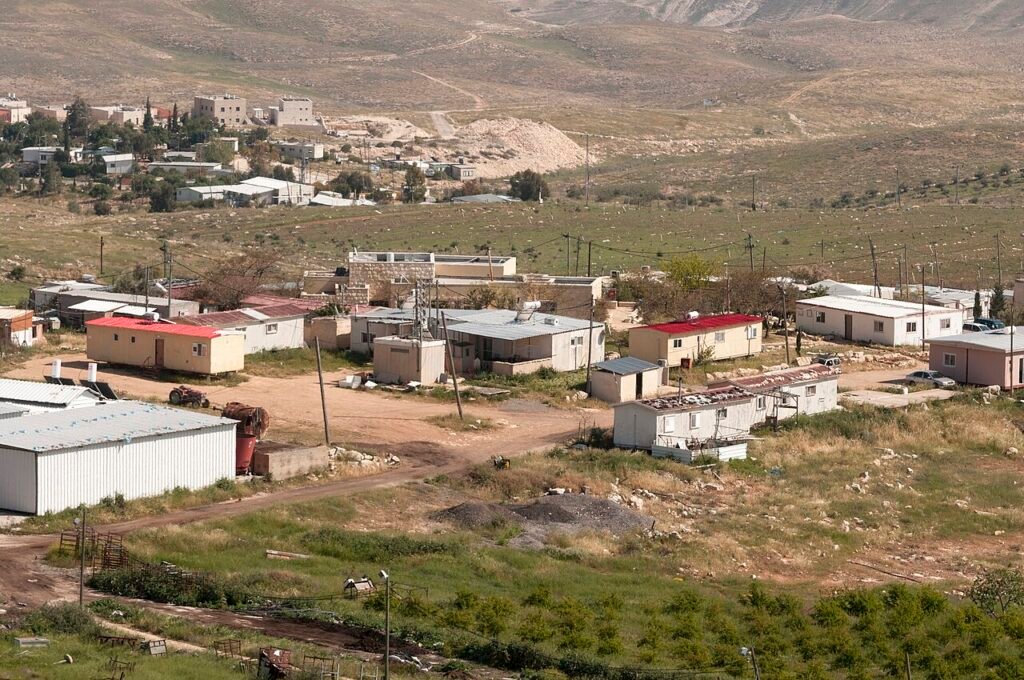
In the occupied West Bank, Israeli settlers have reportedly diverted a vital freshwater spring, traditionally used by Palestinian farmers in the village of Fasayil, to fill a swimming pool at an archaeological site known as “Herod’s Pool.” This action has led to severe water shortages for the Palestinian community, devastating their agricultural livelihoods and raising concerns about a broader pattern of resource appropriation and displacement.
Palestinians in Fasayil, located in the fertile Jordan Valley, have relied on the spring for generations to irrigate their crops and supplement their domestic water supply. However, since May, settlers have begun diverting the spring’s water into the pool, which is being developed into a tourist attraction with the backing of the Israeli government. Farmers report that their greenhouses and fields, once lush with produce like eggplant, zucchini, and watermelon, are now barren due to the lack of water. Some Palestinian families have been forced to leave the area as their ability to sustain themselves through agriculture has been eliminated.
The diversion of the spring is part of a larger trend of Israeli settler actions in the West Bank that Palestinian officials and rights groups describe as a “water war.” Reports indicate a significant increase in settler attacks on Palestinian water infrastructure, including wells, springs, and reservoirs. The United Nations Office for the Coordination of Humanitarian Affairs (OCHA) has documented numerous attacks, with some reports indicating that settlers target water sources at a rate of nearly one per day in recent periods. This systematic deprivation of water exacerbates existing water scarcity for Palestinians, who already consume significantly less water per capita than Israelis, even in settlements considered illegal under international law.
Israeli settlers, however, have claimed ownership of the spring, with some asserting that the pool belongs to the biblical-era King Herod. Videos posted by settler leaders show the pool filling with water, and the site is being promoted as an Israeli tourist destination. Israeli Finance Minister Bezalel Smotrich has reportedly pledged significant funding for the restoration and development of “Herod’s Pools,” with signs at the site advertising his support and bearing the logo of his political party. This government backing for the project has drawn criticism, as it appears to prioritize Israeli recreational use over the basic needs of the local Palestinian population.
Archaeologists and rights groups have raised concerns about the development of the site. While some settlers claim historical ties to the pool, Israeli archaeologist Alon Arad of the rights group Emek Shaveh has noted that the pool’s origins are unclear and that filling it with water may be damaging the archaeological site. Arad also stated that such actions are sometimes used to promote a narrative of exclusive Jewish presence in the West Bank. Reports indicate that Israeli families have been seen using the pool, while Palestinians are largely excluded.
The situation in Fasayil is indicative of wider issues concerning water access and resource management in the West Bank. According to Amnesty International, water consumption by Israelis is at least four times that of Palestinians. Military orders established in 1967 grant Israeli authorities complete control over water resources in the occupied territories, making it exceedingly difficult for Palestinians to obtain permits for new water infrastructure or to maintain existing sources. Reports from organizations like B’Tselem highlight a stark disparity, with Israelis using nearly three times more water per person daily than Palestinians, and in some communities, Palestinian water consumption is as low as 20 liters per day, well below the World Health Organization’s recommended minimum.
Palestinian field researchers estimate that settlers may have seized control of a significant percentage of springs in the northern Jordan Valley, displacing communities. The systematic seizure of water resources by settlers, often with governmental support or inaction, is seen by Palestinians as a deliberate strategy to make their lives unsustainable and force them off their land. The United Nations and the majority of the international community consider Israeli settlements in the West Bank to be illegal under international law. Israel, however, maintains that the territory is disputed rather than occupied.
The diversion of the Fasayil spring and its transformation into an Israeli-backed tourist pool underscores the ongoing conflict over natural resources in the West Bank and its impact on Palestinian communities. The situation highlights the challenges faced by Palestinians in accessing water for agriculture and daily life, while Israeli settlements continue to expand and develop, often with government backing.



Global Affairs Desk at The Chenab Times covers international developments, global diplomacy, and foreign policy issues through fact-based reporting, explainers, and analytical pieces. The desk focuses on major geopolitical events, diplomatic engagements, and international trends, with an emphasis on verified information, multiple perspectives, and contextual understanding of global affairs.