


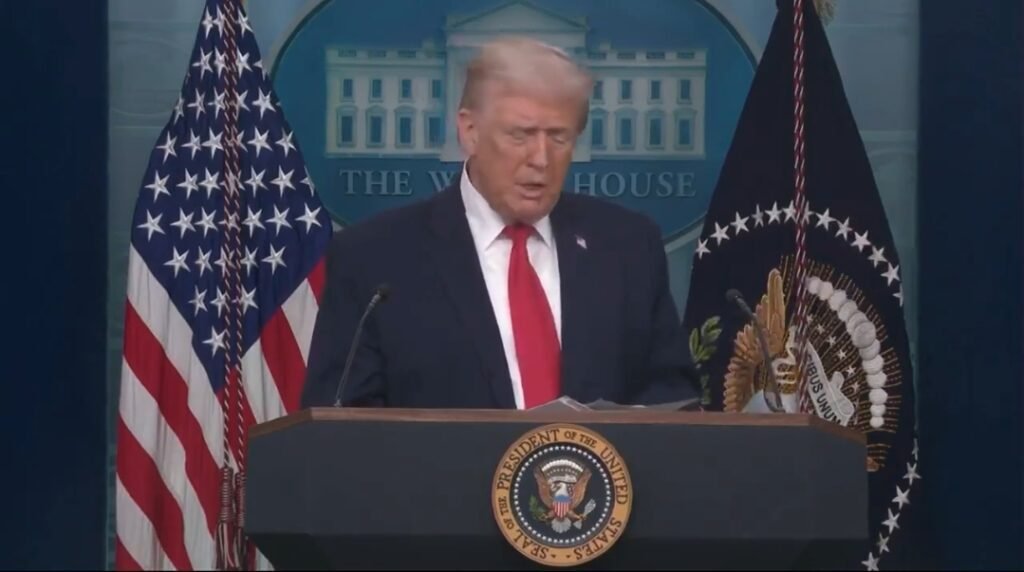
WASHINGTON D.C. – United States President Donald Trump has expressed strong backing for the India-Middle East-Europe Economic Corridor (IMEEC), a multi-modal connectivity initiative aimed at enhancing trade and infrastructure across three continents. The President highlighted the project’s significance amidst rising tensions and attacks on energy infrastructure in the Middle East, advocating for a strategic shift to circumvent Iranian checkpoints.
Information was available with The Chenab Times that President Trump made these remarks during a multilateral meeting with the Gulf Cooperation Council, held on the sidelines of the high-level session of the United Nations General Assembly. He pointed to recent Iranian attacks on commercial shipping in neighboring countries as a clear indication of the necessity to reroute Middle East energy infrastructure away from areas under Iranian control.
“That’s why my administration strongly supports the India-Middle East-Europe Economic Corridor and other places… the form of getting oil out, whether it’s pipelines or anything else, and together we’re on the verge of overcoming challenges that have plagued this region for decades,” President Trump stated, emphasizing the collaborative effort to address long-standing regional issues.
The India-Middle East-Europe Economic Corridor, officially unveiled on September 9, 2023, during the G20 Summit in New Delhi, is a significant multinational initiative. It is designed to foster enhanced connectivity, boost trade volumes, and promote sustainability across South Asia, the Middle East, and Europe through a network of rail, road, and shipping routes. The corridor aims to create a more efficient and integrated economic landscape.
The initiative represents a substantial investment in global infrastructure, seeking to facilitate the movement of goods and energy resources more securely and reliably. By establishing alternative routes, the project intends to reduce reliance on potentially volatile transit points, thereby contributing to greater economic stability and security in the involved regions. The broad scope of the corridor underscores a commitment to long-term economic cooperation and development on an international scale.
The geopolitical implications of such an infrastructure project are considerable, potentially reshaping trade dynamics and energy supply chains. The emphasis on shifting energy infrastructure away from Iranian checkpoints suggests a strategic move to mitigate risks associated with regional conflicts and political instability. This development aligns with broader efforts to ensure the uninterrupted flow of global commerce and energy.
The corridor’s multifaceted approach, integrating various modes of transport, is expected to unlock new economic opportunities and strengthen bilateral ties between participating nations. The project’s ambition to connect diverse regions signifies a forward-looking strategy for global economic integration and resilience in the face of complex international challenges.


The Chenab Times News Desk