


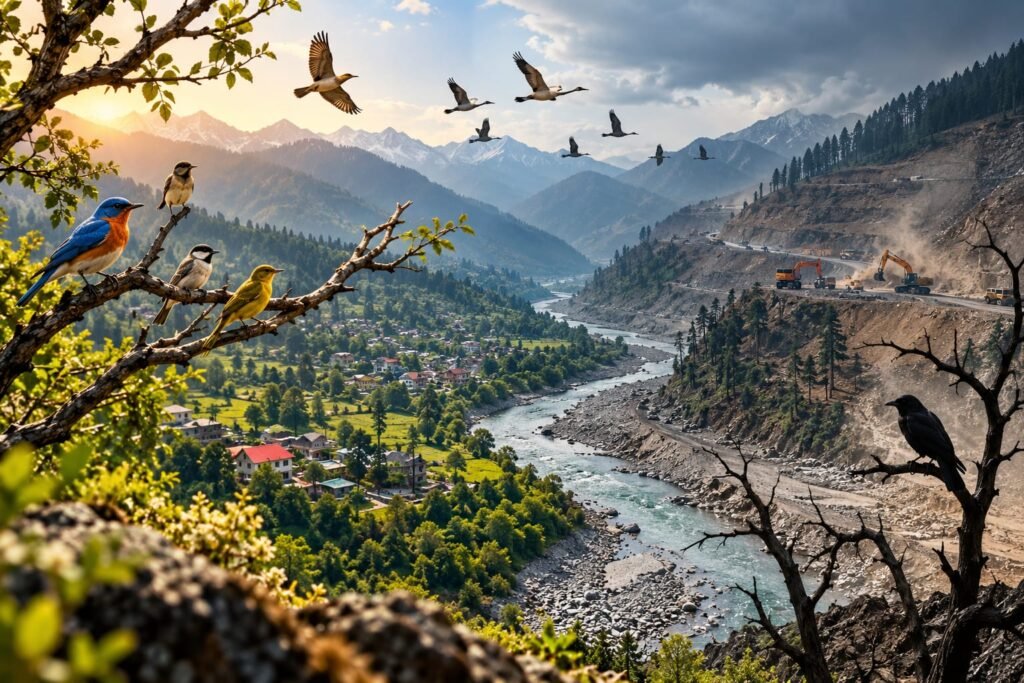
The Chenab Valley is more than mountains, rivers, and forests. It is a living ecosystem where birds, wildlife, vegetation, and human communities have coexisted for generations. For many residents, the calls of birds were once an ordinary part of daily life—the morning chorus around villages, birds moving through orchards and forests, and migratory species arriving with the changing seasons.
The upper Chenab region is known for its rich avian diversity. Scientific research covering the Bhot, Marusudar, Kalnai, and Neeru watersheds recorded 251 bird species, including both resident and migratory birds. This highlights the ecological importance of the region and the variety of habitats that support its birdlife.
However, the landscape supporting these species is changing. Road construction, expanding settlements, infrastructure development, deforestation, changing agricultural practices, and increasing human activity are altering mountain habitats. Development is essential for remote communities, but it must be planned with careful attention to the ecological systems on which the region depends.
Habitat loss and fragmentation can affect birds by reducing feeding grounds, nesting sites, and breeding areas. The removal of mature trees, disturbance of forest patches, and changes in natural vegetation may have consequences that are not immediately visible but can gradually influence local biodiversity.
The rivers are equally important. The Chenab and its tributaries connect different ecosystems across the valley and provide habitats for species associated with riverine environments. Changes to riverbanks, water flow, vegetation, and surrounding land use can affect these habitats and the species that depend on them.
Climate change is another emerging pressure. Birds rely on seasonal patterns for migration, breeding, and feeding. Changes in temperature, rainfall, and food availability can disrupt these natural cycles and influence the timing and movement of different species.
At the same time, claims of widespread bird decline require careful scientific verification. There is a need for more consistent, long-term monitoring across the Chenab Valley to determine which species are increasing, declining, or changing their distribution.
Local residents, birdwatchers, students, photographers, and researchers can contribute to this effort by documenting sightings, nesting locations, and seasonal movements. Regular bird counts and systematic record-keeping could provide valuable information about the changing ecological conditions of the valley.
Birds are not merely part of the scenery. They are an important component of healthy ecosystems and can serve as useful indicators of changes in forests, rivers, vegetation, and insect populations.
The Chenab Valley is developing rapidly, and the challenge is to ensure that this development does not unnecessarily damage the natural habitats that sustain its biodiversity. Protecting these habitats is not a choice between development and conservation; it is part of ensuring that development remains environmentally sustainable.
The question we should ultimately ask is simple:
What are we changing in the places that birds call home?

