


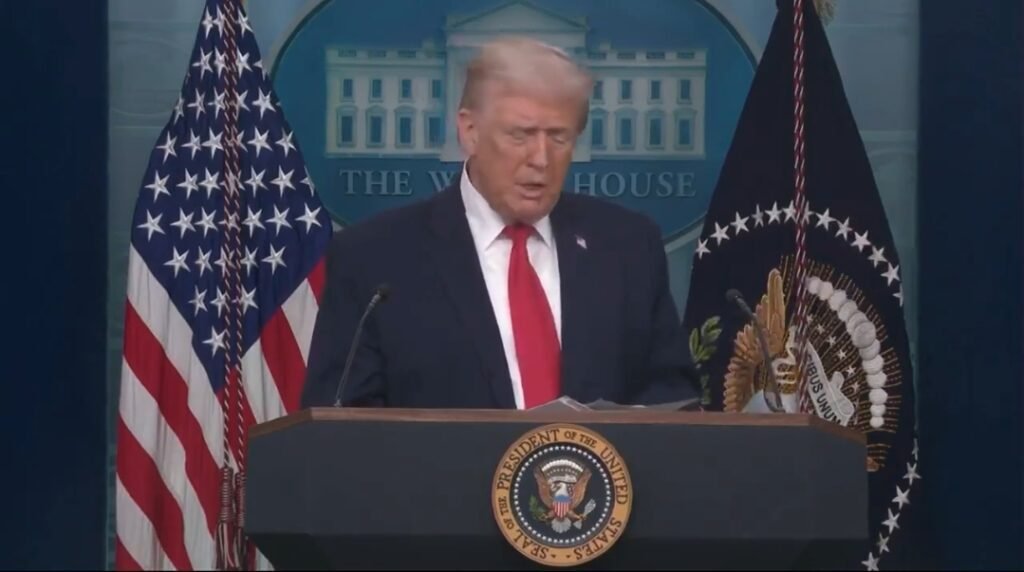
President Donald Trump announced on Sunday the formation of a new federal task force, the “Super Intelligence Force” (SIF), aimed at coordinating the United States’ efforts in the field of artificial intelligence, which he has officially renamed “Super Intelligence” (SI).
The announcement followed a meeting at the White House with leaders from major artificial intelligence companies, including OpenAI, Anthropic, Google, Meta, Nvidia, and Elon Musk’s SpaceXAI. During this meeting, these companies reportedly signed a set of voluntary safety standards, which Trump described as “morally binding.” Information was available with The Chenab Times that this initiative comes amid growing calls for oversight and regulation of rapidly advancing AI technologies.
The Super Intelligence Force will be tasked with ensuring American leadership in SI, a term Trump has directed federal agencies to use in place of artificial intelligence. According to details received by The Chenab Times, the task force will coordinate federal interactions with a wide range of stakeholders, including consumers, public interest groups, religious organizations, infrastructure providers, and industry leaders. The force is expected to report its findings and recommendations within 120 days.
Leading the SIF will be Jay Clayton, the Director of National Intelligence. Other key figures appointed to lead the task force include Andrew Ferguson, the chairman of the Federal Trade Commission; Emil Michael, the Under Secretary for Research and Engineering and Chief Technology Officer at the Pentagon; and Scott Kupor, the director of the Office of Personnel Management. These leaders will report directly to President Trump and White House Chief of Staff Susie Wiles.
This move represents a significant step by the administration in addressing public anxieties surrounding the rapid development of AI. While President Trump has largely portrayed AI as a driver of economic prosperity, some industry leaders have expressed concerns about the pace of development and have called for a slowdown. The establishment of the SIF and the promotion of the term “Super Intelligence” signal a strategic effort to shape the narrative and governance of this transformative technology.
The rebranding of artificial intelligence to “Super Intelligence” was formalized through an executive order signed by President Trump. This order directs all executive branch departments and agencies to adopt the new terminology in official communications, policy documents, and public-facing materials, ceasing the use of “Artificial Intelligence” or “AI.” The White House stated that the term “Super Intelligence” better reflects the evolving capabilities and limitless potential of these technologies, distinguishing them from mere imitation or automation of human intelligence.
The executive order also mandates the Assistant to the President for Science and Technology to propose a federal definition of “Super Intelligence” that acknowledges its advanced frontier status. This initiative aims to foster innovation while safeguarding public interests and ensuring that the United States remains at the forefront of SI development globally. The administration’s broader strategy includes accelerating SI innovation, building domestic SI infrastructure, and extending U.S. leadership in the field.
The creation of the SIF and the rebranding of AI come at a time of intense global competition and debate over the ethical implications and potential risks associated with advanced AI systems. The administration’s approach, as indicated by the emphasis on voluntary safety standards and the focus on “Super Intelligence,” suggests a strategy that prioritizes American innovation and leadership while engaging with industry on responsible development.


Global Affairs Desk at The Chenab Times covers international developments, global diplomacy, and foreign policy issues through fact-based reporting, explainers, and analytical pieces. The desk focuses on major geopolitical events, diplomatic engagements, and international trends, with an emphasis on verified information, multiple perspectives, and contextual understanding of global affairs.