


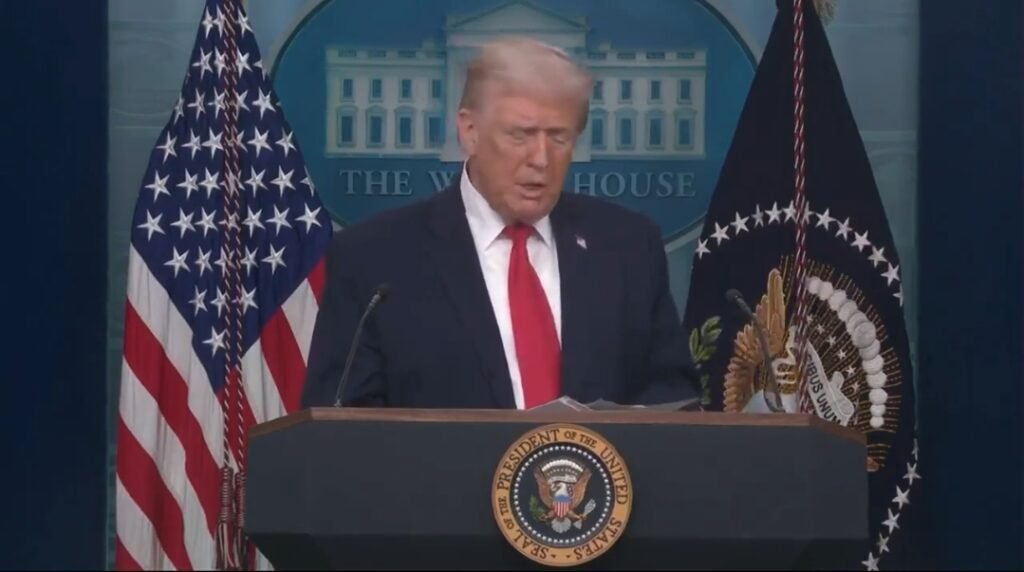
Former President Donald Trump has canceled his planned in-person rallies in Iowa and Kansas for the upcoming weekend, opting instead to conduct “tele-rallies” to engage with voters in the final days before the midterm elections. The Republican National Committee (RNC) announced the shift in strategy, stating that these virtual events would allow for broader reach across nearly 20 states. This decision comes as the Republican Party faces a critical juncture in its effort to maintain control of Congress, with several key Senate races proving to be highly competitive.
The cancellations mark an abrupt change from Trump’s typically extensive in-person campaigning. He had previously committed to a rigorous schedule of rallies throughout October to galvanize support for Republican candidates. While Trump has participated in 25 rallies this month, he had reportedly set a goal of over 30. Recent public appearances have seen him sounding hoarse, and he even remarked in Mississippi on October 28 that “God didn’t make your vocal cords to do a rally every day.” Despite these observations, Trump dismissed suggestions that his health was a factor in the rally cancellations, asserting to reporters, “I feel perfect.” He also suggested that his presence was not as crucial in Kansas due to the incumbent Republican Senator Roger Marshall’s strong polling.
The RNC has framed the tele-rallies as a more efficient method of voter outreach, with Chairman Joe Gruters asserting that the virtual format will provide a “huge boost in the closing days” by reaching more voters nationwide. These tele-rallies are scheduled to be broadcast to states including battleground areas like Michigan, Alaska, Texas, and Iowa, where significant Senate races are underway. The RNC indicated that further events might be announced. Trump is still expected to hold an in-person rally in Daytona Beach, Florida, on Friday, October 30.
The shift in campaign strategy also occurs against a backdrop of national political challenges for the Republican Party. Concerns over the economy, rising gas prices, and the ongoing war in Iran have contributed to voter frustration, placing the GOP on the defensive in several traditionally competitive territories. In South Carolina, for instance, Republican Senate candidate Darline Graham faces a robust challenge from Democrat Annie Andrews, a race that has tightened considerably. Republicans have not lost a Senate seat in South Carolina in nearly three decades.
Election forecasters have suggested that Democrats are increasingly favored to gain a majority in the House of Representatives, and several Senate races have also seen a shift in favor of Democratic candidates. The midterm elections on November 3 will determine the composition of both the House and the Senate, as well as numerous state and local offices. Trump has reportedly urged his party to “pretend I’m on the ballot” to encourage maximum turnout, despite his own historically low approval ratings.
While Trump’s participation in rallies has been a hallmark of his political career, the RNC’s endorsement of tele-rallies suggests a strategic adaptation to maximize reach in the final campaign stretch. The effectiveness of this virtual approach in influencing election outcomes remains to be seen as Election Day approaches.


Global Affairs Desk at The Chenab Times covers international developments, global diplomacy, and foreign policy issues through fact-based reporting, explainers, and analytical pieces. The desk focuses on major geopolitical events, diplomatic engagements, and international trends, with an emphasis on verified information, multiple perspectives, and contextual understanding of global affairs.