


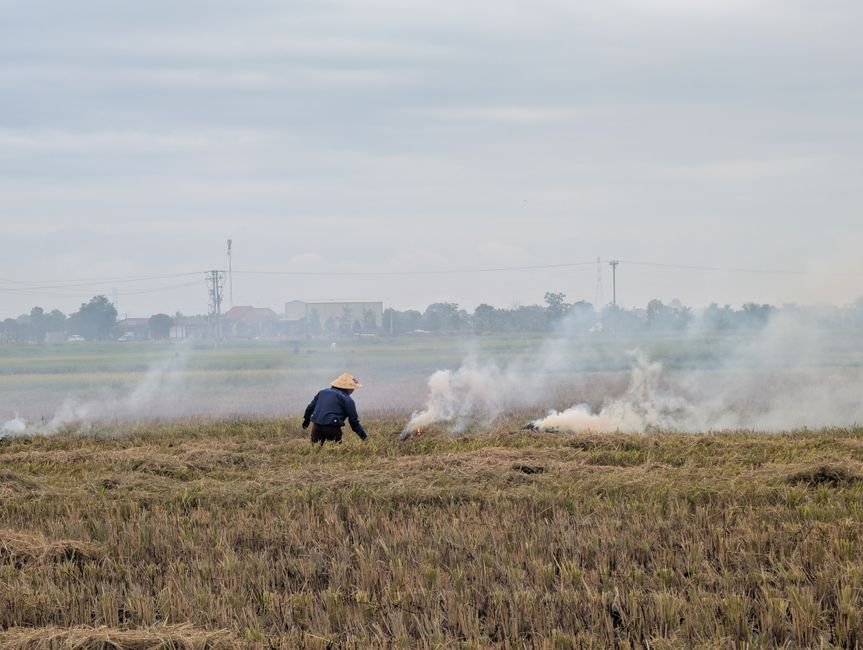
A high-level team from the Commission for Air Quality Management (CAQM) conducted an on-site review in Patiala, Punjab, to assess the district administration’s preparedness and the effectiveness of measures implemented for the management of paddy straw and the prevention of stubble burning during the current harvesting season.
Information was available with The Chenab Times that the two-member CAQM delegation, which included SD Attri, member-technical, and Vijay Kumar, scientist-C, made a detailed inspection of M/s SPS Ecofriendly Fuels, a paddy straw pellet manufacturing unit situated in Badanpur village within Samana tehsil. Accompanied by officials from the Punjab Pollution Control Board (PPCB) and the district administration, the team thoroughly examined the operational aspects of the facility. Their assessment focused on the utilization of paddy straw for the production of biomass pellets, which are subsequently utilized as an alternative fuel source by industries and thermal power plants.
Rantej Sharma, Executive Engineer at the PPCB, provided the CAQM team with an overview, highlighting the crucial role of such pellet manufacturing units in promoting ex-situ management of paddy straw. He explained that these units offer a vital alternative avenue for paddy straw utilization, thereby assisting farmers in their efforts to avoid the practice of crop residue burning.
Following the inspection of the pellet unit, the CAQM team proceeded to visit Duttal and Gulhar villages, located in Patran tehsil. In these villages, the team evaluated the ground-level implementation of both in-situ and ex-situ paddy straw management strategies. During their interactions with local farmers, the officials reviewed the arrangements that have been put in place for the provision of Crop Residue Management (CRM) machinery, which is essential for facilitating scientific residue management practices.
Kala Ram Kansal, Sub-Divisional Magistrate (SDM) of Patran, in conjunction with officials from the Agriculture Department, presented a comprehensive briefing to the CAQM team. The briefing detailed the district administration’s preparedness for the harvesting season and underscored the availability of CRM machinery. The administration emphasized that this machinery is crucial in enabling farmers to adopt in-situ methods for managing paddy straw, a key strategy for mitigating stubble burning.
Farmers present during the visits expressed their appreciation for the administration’s proactive efforts, particularly noting the timely availability of CRM machinery. They conveyed that this provision has significantly aided them in adopting scientific methods for paddy straw management, thereby reducing their reliance on traditional stubble burning practices.
The CAQM team commended the synergistic and coordinated efforts demonstrated by the district administration, the Agriculture Department, and the PPCB in promoting both in-situ and ex-situ management approaches for paddy straw. The commission urged the concerned departments to sustain their collaborative work and maintain rigorous monitoring to ensure the continued and effective prevention of stubble burning incidents across the district.
In a separate but related development concerning environmental management in the district, Anuprita Johal, Additional Deputy Commissioner (General) and Additional District Magistrate of Patiala, has issued orders to regulate the bursting of firecrackers and the manufacture, storage, purchase, and sale of fireworks throughout the district. These directives are applicable during the upcoming festive season.
The orders, issued under Section 163 of the Bharatiya Nagarik Suraksha Sanhita, 2023, specify designated time slots for the bursting of green crackers during major festivals such as Diwali, Gurpurb, Christmas, and New Year. These timings are in strict adherence to the guidelines previously issued by the Supreme Court of India and the National Green Tribunal (NGT). The regulations mandate that only green crackers are permitted for use, while the use of any prohibited types of firecrackers has been explicitly banned. Furthermore, the administration has issued directives to implement measures aimed at preventing the manufacture, storage, sale, and use of illegal explosive materials, including those reportedly brought from abroad.
According to the issued orders, the specific timings for bursting firecrackers on Diwali, scheduled for November 8, are between 8:00 PM and 10:00 PM. For Gurpurb on November 24, the permitted timings are from 4:00 AM to 5:00 AM and again from 9:00 PM to 10:00 PM. On Christmas Eve, extending into Christmas Day (December 24-25), crackers can be burst between 11:55 PM and 12:30 AM. Similarly, for New Year’s Eve transitioning into New Year’s Day (December 31-January 1), the permitted time slot is also from 11:55 PM to 12:30 AM. The authorities have made it clear that bursting crackers outside these prescribed time slots will be strictly prohibited, and any violations of these orders will result in appropriate legal action being taken against the offenders.


The Chenab Times News Desk