


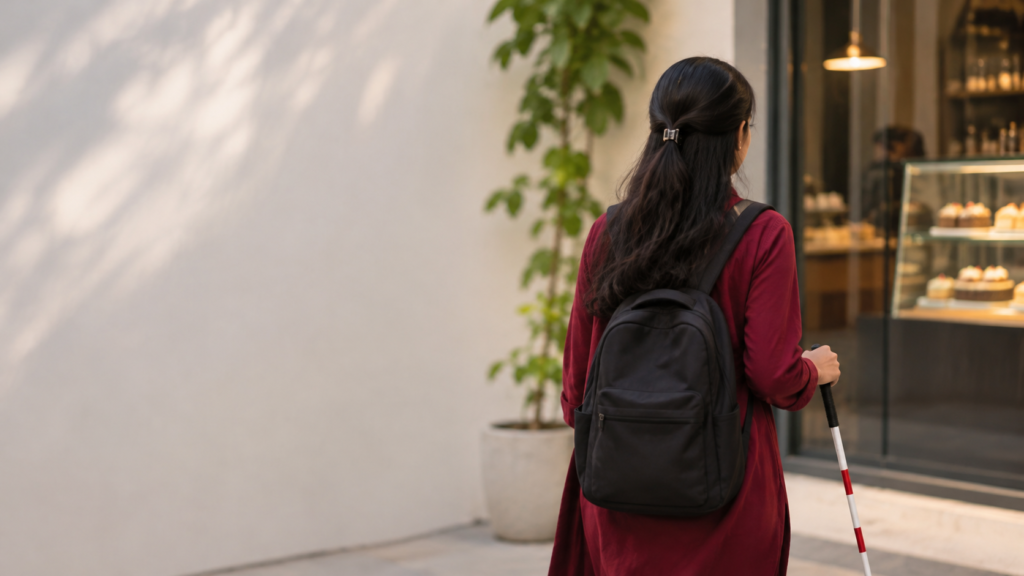
I wanted a pastry.
The shop was not new to me. I had been there three or four times with a friend, and I wanted to go again. This time, I wanted to go alone.
I was afraid of taking a wrong turn. The destination was familiar, but I could not be sure I would find my way there without difficulty. I also did not want to ask anyone for help. I wanted to prove to myself that I could manage the journey on my own.
What should have been a small errand began to feel like a test. If I made it to the shop, perhaps I could believe I was becoming independent. If I struggled, I worried it would mean something larger about my ability to manage my life.
I did not realise how much pressure I had attached to buying a pastry.
The freedom I was afraid of losing
Growing up blind, I came to know the gap between wanting to do something and being allowed to try it. My parents worried about my safety. At school, I was not allowed to move independently, even between nearby buildings. Their concerns were real, even when the restrictions were hard to live with.
University changed my circumstances. Within about six months, I was moving from one block to another and doing things that had once seemed out of reach. My parents were happy to see me becoming more independent.
But freedom brought a fear I had not expected. My parents had never threatened to restrict me again if I struggled. That possibility lived only in my own mind. I worried that any difficulty would confirm the doubts that had once limited me, and that I would lose the freedom I had only just begun to experience.
I wanted to show my parents that I could manage. More than that, I wanted to show myself. Yet I sometimes cared more about what a struggle might appear to prove than about what I could learn from it.
That pressure followed me into ordinary decisions. I would think about going somewhere, imagine getting lost or having to ask for help, and hesitate. I wanted to practise independence, but I was also afraid of failing at it. Sometimes I avoided the outing altogether.
When I did push myself, I was not kind to myself. I would think: “If you do not go, you will stay stuck like this. Why are you scared? You are useless. If you will not go, you are dependent. Do you want your school life back?”
I believed this was motivation. Looking back, I can see that I was also making every attempt carry the weight of my entire future. A wrong turn would not be just a wrong turn; in my mind, it risked becoming evidence that I could not manage.
Learning, rather than proving
Eventually, I went to the shop and bought the pastry. Later, I went to other shops for pizza and coffee. Each outing made going out on my own a little more familiar.
I cannot say that one successful trip transformed my confidence. It may have been completing the journey, the repetition, growing familiar with the area, or some mix of all three. What changed was the meaning I attached to going out. I began to go because I wanted something, not because each journey had to prove what I could do.
Psychologist Albert Bandura’s work on self-efficacy is useful here. In his 1977 paper, Self-Efficacy: Toward a Unifying Theory of Behavioral Change, he examines how people’s beliefs about their ability to manage a task can shape whether they attempt it and keep going when it gets hard, and how successful experiences can strengthen those beliefs. It helps me think about my experience, but it cannot tell me exactly why my confidence changed. Nor can confidence alone make a route accessible or a journey safe.
A 2021 qualitative study by Alexandra Robertson, Valerija Tadić and Jugnoo Rahi interviewed 17 young people with visual impairment, aged 16–19, in the United Kingdom. They described a process of “testing the waters” as young people built autonomy, including by gradually being allowed or encouraged to visit places such as local cafés and shops. The study cannot explain my experience, and a small UK sample cannot speak for every young person with visual impairment. But it helped me see why ordinary trips matter: they are chances to learn what works, find strategies and build confidence.
When success becomes another expectation
There is a trap in trying to prove you are independent. Once you start measuring yourself by what you can do alone, asking for help can feel like defeat, even when help would be sensible. Autonomy starts to look like self-sufficiency, as though making your own decisions means never needing anyone.
But going alone is not always the right choice, and asking for help does not make a person less capable. For someone who is blind, even a familiar route can be difficult. Streets can be confusing, obstacles change, and accessible navigation is not something willpower can supply. Telling disabled people to be braver is no substitute for safe environments, mobility skills and appropriate support.
My parents’ concerns did not become meaningless because I wanted more freedom. Their worry and my wish to decide for myself can both be real. I do not need to turn my family into villains to acknowledge that being restricted shaped how I approached independence later. Nor can I know how much of my self-pressure came from those restrictions, how much from my own expectations, and how much from the practical uncertainty of travelling alone.
I can only describe what I noticed: I had begun to treat difficulty as a verdict on my capability. Over time, repeated attempts helped me replace that verdict with a more useful question: “What can I learn from this, and what support or strategy would help me next time?”
Recently, I have been busy and have had fewer chances to go out, and some of the nervousness has returned. It is a reminder that confidence is not a permanent achievement. Practice matters, and a break from it can make a familiar challenge feel unfamiliar again.
I still want to keep going. I just do not want every trip to become a test of whether I am independent enough.
Independence without an examination
I once thought I needed to prove I could do things on my own. Now I am trying to learn something less dramatic and more useful: I can try, I can struggle, I can ask for help, and I can try again. None of that needs to decide my worth or settle whether I deserve freedom.
For families, teachers and universities, the challenge is not to choose between protecting a disabled young person and leaving them to manage alone. It is to create chances to practise, talk honestly about risk, make room for mistakes, and offer support without taking every decision away. What that looks like will differ from person to person and situation to situation.
For me, buying a pastry was never only about the pastry. It was about the pressure I had placed on myself to make each small success prove I could be trusted with a larger freedom. I am still learning to separate the two.
An outing can be a chance to learn. A difficult moment can show me where I need more practice, better information or support. It does not have to be a verdict. And independence, I am beginning to understand, is not something I should have to prove every time I leave the door.

Kiran Harisinghani is a writer and psychology student based in Guwahati, Assam.