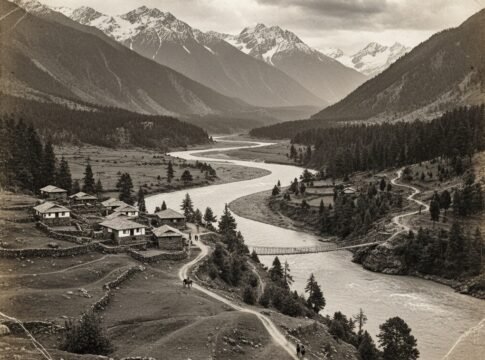
As a child in 2004, at just five years old, I visited relatives in a village in Jammu and Kashmir’s Anantnag district—now part of Kulgam district. The journey meant crossing a shallow river on foot, with my father carrying me on his shoulders as my feet skimmed the water. We headed to Qazigund and then Janglatmandi, where I first noticed the subtle differences in Kashmiri dialects. That moment ignited a lifelong curiosity about languages, identities, and the deep connections between regions like the Chenab Valley and the broader Kashmir story. Today, amid ongoing debates about regional ties in Jammu and Kashmir, it’s worth exploring the Chenab Valley through its rich history and natural origins, rather than just current politics.
The Chenab Valley—covering the districts of Doda, Kishtwar, and Ramban—often finds itself pulled between Kashmir and Jammu. From my research and observations, its cultural, linguistic, and historical links point more strongly to Kashmir than to Jammu, a view shared by many locals and experts. Much of the area is home to ethnic Kashmiris who speak a dialect of Kashmiri, setting it apart from the Dogri of the Jammu plains. Yet, some dismiss the Chenab Valley as a political label or even claim it doesn’t exist, calling it part of a “Greater Kashmir” plot. These views overlook centuries of evidence showing it as a unique geographical and cultural space.
Geologically, the Chenab Valley’s story stretches back thousands of years. As senior geologist Professor G.M. Bhat explains, the Chenab River once flowed much higher, creating a wide valley with raised riverbanks—now visible as terraces along its sides. Over time, rising mountains and earth movements caused the river to cut deeper into the land, turning what was once an open basin into the steep, rugged terrain of today. These changes, driven by the Himalayas’ slow uplift and the river’s constant erosion, shaped wider flat areas in some spots and narrow gorges in others, often influenced by ancient glaciers. Place names like “Chenab Valley” stick around long after the landscape shifts, used by locals and scholars for the upper Chenab basin.
Historically, “Chenab Valley” has been a recognized term for centuries, long before modern politics. In his 1852 book Western Himalaya and Tibet, British traveler Thomas Thomson described the region during his 1847–48 journey, calling it the “Chenab Valley” in chapters on its passes, camps, and plants. He placed Kishtwar within it and separated it from the Tawi River valley near Trikota Debi, noting the river’s ancient higher flow that formed a clear valley from Kishtwar to Banihal—matching today’s Doda, Kishtwar, and Ramban districts. Other 19th-century works, like Routes in Jammu and Kashmir (1870–71), list it as a key route. Islamic scholars and historians have long used the name for this upper river basin, distinct from the lower Chenab in Punjab.
These natural and historical features built strong political and cultural bonds with the Kashmir Valley. In the 14th and 15th centuries, under the Kashmir Sultanate, Sultan Shihab-ud-Din expanded to include Kishtwar, Chamba, and Jammu, weaving the Chenab area into Kashmir’s social and political fabric. Historian Mohibbul Hassan details these efforts in Kashmir Under the Sultans, showing how they strengthened the sultanate by linking hill regions like Kishtwar to Kashmir. Later, in the Mughal era, Kishtwar joined Emperor Jahangir’s empire, deepening these valley ties. Shared language, customs, and history endure, even across administrative lines.
That said, the Chenab Valley’s administrative reality ties it closely to Jammu, where Doda, Kishtwar, and Ramban fall under the Jammu province in the union territory of Jammu and Kashmir. Before 2007, these areas formed a single Doda district, sometimes still called the erstwhile Doda district. With limited local resources for education and jobs, many from the region head to Jammu for schooling, while others seek work in Jammu, Ladakh, or Himachal Pradesh. These practical connections highlight Jammu’s role in daily life and deserve recognition alongside the valley’s Kashmiri roots—no criticism intended, as Jammu’s people and landscapes are truly welcoming.
In May 2025, India advanced four hydropower dams on the Chenab—Pakal Dul (1,000 MW), Kiru (624 MW), Kwar (540 MW), and Ratle (850 MW)—after pausing parts of the Indus Waters Treaty with Pakistan. These efforts promise energy and jobs but raise concerns about environmental impacts in the Chenab Basin, amid climate challenges like changing river flows.
The Chenabi people seek real progress—better roads, schools, healthcare, and opportunities—yet often face political sidelining. Dismissing its identity as “propaganda” only stalls growth. By honoring the valley’s geological past and historical bonds, leaders can drive fair development that respects all sides.
My childhood river crossing reminds me: borders change, but history’s current flows on. Let’s tell the Chenab Valley’s full story—for its people and a more connected Jammu and Kashmir.
❤️ Support Independent Journalism
Your contribution keeps our reporting free, fearless, and accessible to everyone.
Or make a one-time donation
Secure via Razorpay • 12 monthly payments • Cancel anytime before next cycle


(We don't allow anyone to copy content. For Copyright or Use of Content related questions, visit here.)

Anzer Ayoob is the Founder and Chief Editor to The Chenab Times