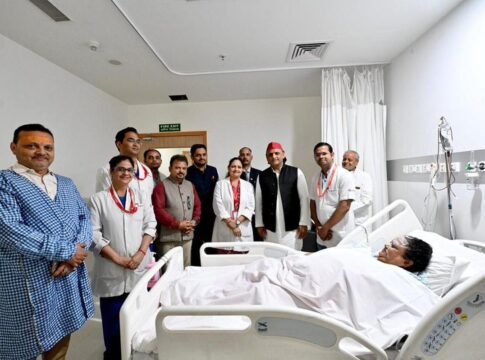
Samajwadi Party (SP) chief Akhilesh Yadav visited Bharatiya Janata Party (BJP) MLA Vinod Kumar Sonkar, who sustained burn injuries while attempting to burn an effigy of Mr. Yadav, in a gesture aimed at fostering social harmony and promoting constructive politics in Uttar Pradesh.
The Chenab Times has learned that the visit, which took place on Tuesday, saw Mr. Yadav expressing his concerns over the incident and emphasizing the need for a shift towards positive political discourse. The SP leader stated, “We don’t want a fire to ignite within society. We want a spark of harmony in society. Our healthy tradition of positive politics has taught us this.” Mr. Sonkar, the MLA from Lalitpur Sadar constituency, reportedly suffered injuries when the effigy he was trying to set ablaze backfired.
Mr. Yadav’s visit to the hospital where Mr. Sonkar was undergoing treatment underscored his call for an end to escalating political animosity. He interacted with the injured MLA, inquiring about his well-being and health condition. The act was widely interpreted as an effort to de-escalate political tensions that have been rising in the state, particularly in the run-up to upcoming political events.
The incident involving the burning of Mr. Yadav’s effigy and the subsequent injury to the BJP MLA highlights a concerning trend of aggressive campaigning and personal attacks in Indian politics. Political parties across the spectrum often resort to such symbolic protests, which can sometimes lead to unintended consequences and escalate into confrontations. The SP chief’s visit appears to be a deliberate attempt to counter this narrative and steer political engagement towards more constructive channels.
Sources within the Samajwadi Party indicated that Mr. Yadav’s initiative is part of a broader strategy to reorient the party’s image and appeal to a wider electorate by focusing on development issues and governance rather than engaging in mudslinging. This approach aims to distinguish the SP from parties perceived to be engaging in divisive or overly aggressive political tactics. The emphasis on “positive politics” suggests a desire to project the party as a responsible and forward-looking political force.
Mr. Yadav’s outreach to a political rival, particularly after an incident that stemmed from a protest against him, is a significant move. It signals a willingness to engage across party lines on issues of societal well-being and political civility. This gesture could set a precedent for other political leaders and parties to adopt a more restrained and respectful approach in their political campaigns, thereby contributing to a healthier democratic environment.
The political climate in Uttar Pradesh has often been characterized by intense competition and sharp rhetoric between major parties, including the ruling BJP and the SP. Such incidents, while not entirely uncommon, draw attention to the need for greater political maturity and adherence to democratic norms. The SP chief’s call for harmony and positive politics seeks to address this challenge by promoting a culture of dialogue and mutual respect among political actors.
Political analysts suggest that Mr. Yadav’s move is also a strategic attempt to gain public sympathy and project an image of statesmanship. By visiting his injured rival, he positions himself as a leader concerned with the welfare of all, irrespective of political affiliation. This narrative could potentially resonate with voters who are weary of constant political conflict and are looking for leaders who prioritize national interest and social cohesion.
The incident at Lalitpur, where the effigy burning went awry, serves as a stark reminder of the potential dangers inherent in confrontational political tactics. It underscores the responsibility that political leaders and their cadres bear in ensuring that protests and demonstrations remain peaceful and do not pose risks to individuals or public safety. The prompt response from Mr. Yadav, advocating for peace and harmony, is seen by many as a necessary intervention to prevent further escalation of such incidents.
As the political landscape of Uttar Pradesh continues to evolve, the emphasis placed by leaders like Akhilesh Yadav on positive politics and social harmony is crucial. Such initiatives, if embraced by other political factions, could contribute to a more mature and responsible political culture, where debates are focused on policies and public welfare, rather than personal animosity and symbolic aggression. The Samajwadi Party chief’s visit and statements indicate a potential shift in political strategy, aiming to foster a more inclusive and less acrimonious political environment.
❤️ Support Independent Journalism
Your contribution keeps our reporting free, fearless, and accessible to everyone.
Or make a one-time donation
Secure via Razorpay • 12 monthly payments • Cancel anytime before next cycle


(We don't allow anyone to copy content. For Copyright or Use of Content related questions, visit here.)

The Chenab Times News Desk