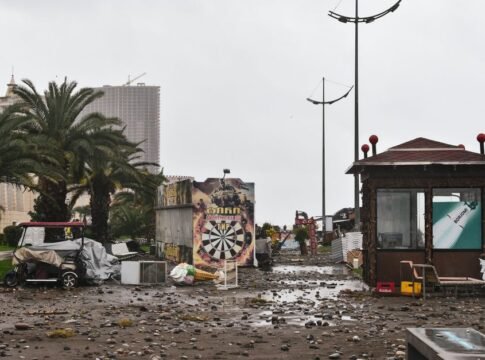
Hurricane Lala made landfall on Hawaii’s Big Island on Saturday, bringing with it torrential rainfall, destructive winds, and significant coastal flooding. The Category 1 storm, the first hurricane to make direct landfall on the Big Island in 155 years, lashed the islands with sustained winds of up to 80 miles per hour, causing widespread power outages and forcing residents to shelter in place.
The National Hurricane Center reported that Lala’s eyewall passed near South Point on the Big Island in the early hours of Sunday morning. While the storm was forecast to weaken as it moved northwest away from the islands, its impacts were felt across the entire Hawaiian archipelago, with Maui County, Oahu, and Kauai County under Tropical Storm Warnings. Heavy rainfall, with localized amounts up to 20 inches on the Big Island and Maui, and widespread rainfall of at least 4 to 6 inches across the state, led to life-threatening flash floods and landslides, particularly in areas with steep terrain. The storm also generated high surf nearing 30 feet and storm surge up to 3 feet, causing coastal erosion and beach damage.
As of Saturday evening, nearly 40,000 customers across Hawaii were without electricity, with the overwhelming majority of outages reported on the Big Island. Hawaii County reported 28,941 customers without power, while Maui County had 7,046 outages. These numbers surged significantly as the storm progressed, with reports indicating over 80,000 customers in the dark by Sunday morning, largely on the Big Island.
Governor Josh Green had declared a state of emergency on Friday, mobilizing state and county emergency teams and federal partners to ensure resources were available. The National Guard was on standby, and numerous events were canceled. Airports, including Hilo International Airport and Ellison Onizuka Kona International Airport, were closed, with operations expected to resume on Sunday. Residents and visitors were strongly advised to stay off the roads due to hazardous conditions, including high winds and potential flash flooding. Many tourism sites, including Hawaii Volcanoes National Park, Puʻuhonua o Hōnaunau National Historical Park, and Haleakalā National Park, were closed until further notice.
The Big Island, which had not experienced a direct hurricane landfall in 155 years, bore the brunt of the storm. Tropical storm-force winds extended outward for as much as 220 miles, impacting Oahu and Kauai by Sunday morning. While Lala was not expected to make landfall on Oahu or Kauai, these islands were still subjected to damaging winds and heavy rainfall. The potential for destructive flooding and even wildfires, fueled by strong winds, was also a concern across the islands.
The storm’s path was influenced by a high-pressure feature typically situated northeast of the islands, which usually deflects storms. However, a particularly strong El Niño pattern in the Pacific this year contributed to increased hurricane activity and altered weather patterns. Historically, Hawaii has seen few direct hurricane strikes, with Hurricane Iniki in 1992 being the most significant, causing billions of dollars in damage and fatalities. Earlier significant storms include Hurricane Iwa in 1982 and Tropical Storm Iselle in 2016, which caused widespread damage and power outages on the Big Island.
Officials stressed the importance of storm preparations, urging residents to secure homes, gather essential supplies, and review family emergency plans. The Hawaiian Emergency Management Agency advised people to stay away from coastal areas due to rough surf and rip currents. The National Weather Service Central Pacific Hurricane Center provided continuous updates and advisories throughout the event, working with local authorities to manage the crisis and disseminate critical safety information.
❤️ Support Independent Journalism
Your contribution keeps our reporting free, fearless, and accessible to everyone.
Or make a one-time donation
Secure via Razorpay • 12 monthly payments • Cancel anytime before next cycle


(We don't allow anyone to copy content. For Copyright or Use of Content related questions, visit here.)

Global Affairs Desk at The Chenab Times covers international developments, global diplomacy, and foreign policy issues through fact-based reporting, explainers, and analytical pieces. The desk focuses on major geopolitical events, diplomatic engagements, and international trends, with an emphasis on verified information, multiple perspectives, and contextual understanding of global affairs.