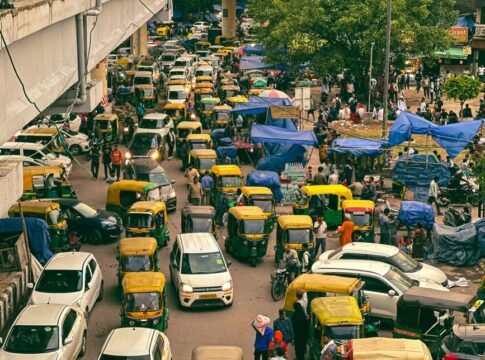
New Delhi: Commuters in the national capital are experiencing significant traffic congestion on the recently inaugurated Barapullah Phase-III elevated corridor, with several days of operation revealing a substantial bottleneck near the older section of the flyover. Motorists have reported lengthy delays and extended journey times, with traffic queues extending for several kilometers on the Mayur Vihar-AIIMS stretch since the corridor opened to the public.
The Chenab Times has learned that the primary cause of the persistent traffic jams is a structural bottleneck on the old Barapullah flyover, where traffic converging from multiple approach roads is forced to merge into a significantly narrower carriageway. This design flaw, coupled with delays in the project’s completion, has led to a situation where a modern elevated corridor is struggling to cope with current traffic demands.
The Barapullah Phase-III corridor, intended to ease traffic flow between East Delhi and South Delhi, has faced considerable challenges since its inauguration on September 29. Within days of its opening, commuters began reporting severe traffic snarls, with delays reaching up to 55 minutes and tailbacks extending for nearly three kilometers. The congestion has been particularly acute during morning rush hours, impacting thousands of daily commuters.
According to reports from The Indian Express, the core issue lies in the merging point near Sarai Kale Khan. Traffic originating from approximately eight to nine lanes across different approach roads—including the new Phase-III corridor from Mayur Vihar, the Sundial loop, and the DND side—converges into the older Barapullah flyover, which has only three lanes. This drastic reduction in road capacity at a single point creates a severe bottleneck, slowing down vehicles on both the new corridor and surrounding roads.
A joint inspection by the Delhi Traffic Police and the Public Works Department (PWD) has identified this sharp merger and the disparity in road capacity as immediate reasons for the congestion. Officials have noted that the design of the merger is abrupt, forcing vehicles to transition into fewer lanes over a very short distance, thereby exacerbating the problem. Hindustan Times has reported that traffic personnel have been deployed at these merging points to manually regulate vehicle movement and try to alleviate the situation.
Compounding the problem is the fact that the Barapullah Phase-III project suffered significant delays. Originally scheduled for completion in 2017, the corridor finally opened in 2026. During this nearly decade-long delay, traffic patterns in Delhi and the surrounding National Capital Region (NCR) have evolved considerably. The eastward expansion of Delhi’s suburbs, including Noida and Ghaziabad, has led to a substantial increase in vehicle registrations and population growth. This increase in traffic volume and altered commuting patterns means the infrastructure, planned more than a decade ago, is now serving a significantly different and more demanding traffic environment. The Indian Express highlighted that the project was conceived when traffic movement between East Delhi, Noida, Ghaziabad, and South Delhi was markedly different.
Adding to the frustration of commuters, digital navigation platforms, including Google Maps, have been criticized for failing to accurately reflect the real-time traffic conditions on the Barapullah corridor. Commuters have reported that these navigation systems often display green signals, indicating smooth traffic flow, even when severe congestion is present. This lack of accurate real-time information hinders drivers’ ability to choose alternative routes effectively, further contributing to the gridlock.
In response to the persistent congestion, traffic authorities are exploring various measures. The Delhi Traffic Police have stated that traffic from Barapullah Phase-III is being diverted towards NH-24/DND when necessary to manage flow. Officials are also examining the possibility of introducing traffic control measures at the merging points, such as installing signals to regulate the volume of vehicles entering the older flyover section. Changes to the geometry of the merging point to create a smoother, more gradual transition are also under consideration, although these may require more extensive engineering work.
The Barapullah elevated road project, initially conceived in the mid-2000s to create a signal-free corridor and ease pressure on existing roads, has seen its phases completed over many years. While Phase I (Sarai Kale Khan to Jawaharlal Nehru Stadium) was completed in 2010, and Phase II extended it towards INA, Phase III’s completion faced hurdles, including land acquisition issues for the final stretch. The extensive delays have meant that a project designed for earlier traffic projections is now operating in a vastly changed urban landscape. The delayed opening of Phase III, in particular, has meant that the intended benefits of a seamless connection are undermined by downstream congestion.
The situation underscores a broader challenge in urban infrastructure development: the need for projects to remain adaptable to evolving traffic volumes and commuting patterns, even as construction timelines extend. While authorities are working on immediate traffic management solutions, the long-term effectiveness will depend on addressing the fundamental capacity mismatch at the merging points and ensuring future infrastructure plans are based on current and projected traffic realities.
❤️ Support Independent Journalism
Your contribution keeps our reporting free, fearless, and accessible to everyone.
Or make a one-time donation
Secure via Razorpay • 12 monthly payments • Cancel anytime before next cycle


(We don't allow anyone to copy content. For Copyright or Use of Content related questions, visit here.)

The Chenab Times News Desk