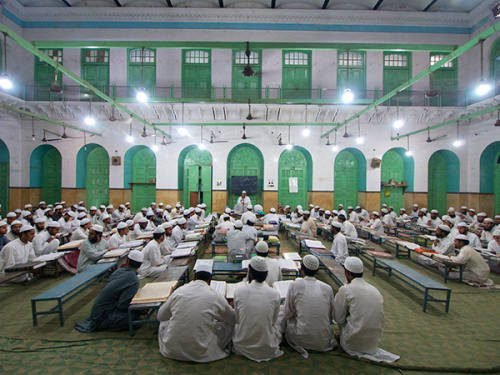
Studying the history of the traditional curriculum of the Indian Muslims famously known as ‘dars-e-nizāmī’, we find that it was once an amalgam of several academic disciplines. Time to time, it underwent changes and there remained few limited subjects of scope in it. This is what is now known as dars-e-nizāmī and if we were to compare it with what it used to be, we won’t find any big similarities and we would hesitate calling it with this name for the name dars-e-nizāmī is the absolute name of the academic curriculum that Mullā Nizāmuddīn Sihālwī had designed. It included subjects as vast as medicine and mathematics.
Discourses in the Muslim academia facilitated disconnection of knowledge from religion and few subjects that remained in the “erstwhile” dars-e-nizāmī were hugely defended by a plethora of scholars. Mawlānā Zayn al-‘Abidīn Sajjād Meerthī, a well known scholar, historian and author, who was among the students of ‘Allāmā Anwar Shah Kashmīrī makes a note on this and says, The supporters of “dars-e-nizāmī” curriculum say that the likes of Allāmā Kashmīrī, Mawlānā Madanī & Allāmā Usmānī attained “popularity & admiration” studying the same syllabus & thus there is no necessity to change it. But they are in “misconception”. The reality is that the people of mind & brain don’t need a specific syllabus. A strong man gets his due power even after having little bit of food but a weak person would require some dietary supplements to gain the same power. The issue is of middle-way students, and it is necessary to prepare for them, an easy & better curriculum aka “nisāb-e-tālīm” and the way of imparting education be decided on the basis of earlier experiments.
Mawlānā Manāzir Aḥsan Gīlānī proposes similar ideas in his magnum opus “Hindustān mai MusalmānoN ka nizam talīm-io-tarbiyyat”, and ‘Alī Miyān Nadwī shares similar ideas in a number of his discourses. It is necessary for the Muslim academics and scholars that they consider the traditional curriculum for change and bring it on par with contemporary age. The way the “old dars-e-nizāmī” was edited and changed, changing and revising the contemporary one would not be heresy. However, it is necessary that the changes be made in the primary educational setup. The colleges where students specialize in specific subjects don’t need to be changed. The requirement of the age is that every Muslim becomes a “Mulla” first and then a scholar, doctor, scientist, economist or a sociologist, as Mawlānā Gīlānī suggests.
❤️ Support Independent Journalism
Your contribution keeps our reporting free, fearless, and accessible to everyone.
Or make a one-time donation
Secure via Razorpay • 12 monthly payments • Cancel anytime before next cycle


(We don't allow anyone to copy content. For Copyright or Use of Content related questions, visit here.)

The author is a biographical researcher and scholar… Read More