



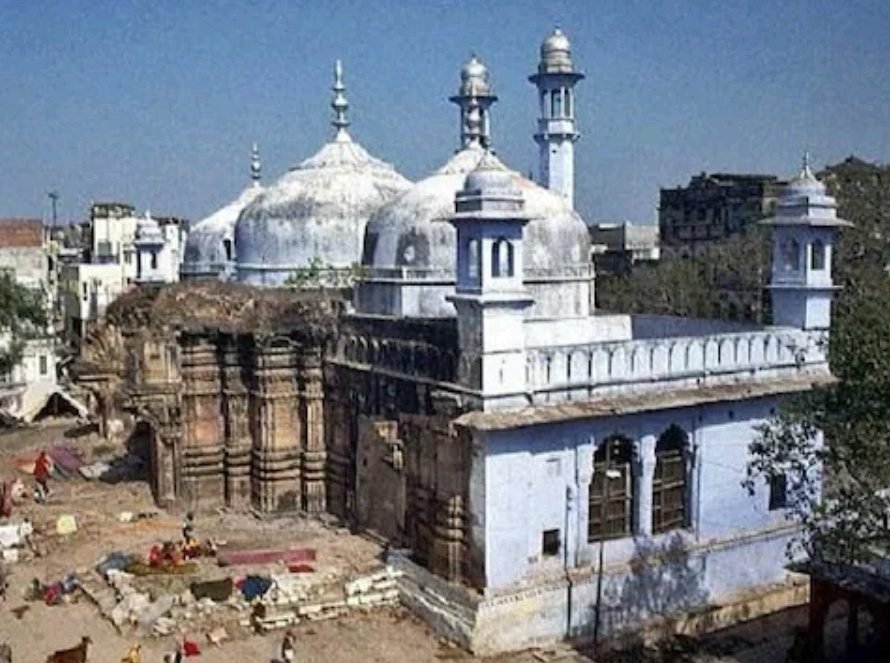
Located in Banaras, Uttar Pradesh, the Gyanvapi Mosque was built by Aurangzeb in 1669 by demolishing an old Shiva temple. Apparently, the location had a Vishweshwar temple which was dedicated to Lord Shiva and was built by a courtier of Mughal emperor Akbar, ‘Todar Mal’. The temple attracted a lot of devotees and contributed to different religious establishments. It also served as a site for advocating various religious disputes concerned with Hindu religious law. The mosque was originally known as Alamgir Mosque, after the name of Aurangzeb but was later changed to Gyan Vapi (meaning, ‘Well of Knowledge’). There are various claims which contradicts the history and are the matter of debates.
What existed before the temple is still a topic of debate according to Hindu religious scholars. There are different perceived theories and chronicles about what existed before the temple but nothing has a strong proof base, these all are theories merely existing on perceptions of scholars or stories of history. The temple was demolished by different Mughal leaders in the history but was also reconstructed a few times by different people like a Gujrati merchant or by Raja Man Singh during Akbar’s rule only to be demolished again by Aurangzeb.
Though a lot of deities, idols, religious carvings from the temple etc. are found but the argument here is not only based on historical facts or what happened in the history but whether or not the Gyanvapi mosque will sustain itself and its religious character in the future.
The Conflict
The conflict arose when local priests and petitioners sought permission to worship in the Gyanvapi mosque. The permission was eventually denied saying it’s a mosque and was built after demolishing a temple on the orders of Aurangzeb during his reign. After the incident, a petition was filed by the same local priests and petitioners in the court for the same reasons.

Thirty years later, the case still hangs in court, and a permission for an archaeological survey was also denied by the Varanasi court. Recently, the controversy was ignited once again when a group of five women sought permission to worship Shringar Gauri and other idols in the Gyanvapi mosque complex. A petition was filed in the court after which the court finally ordered an archaeological survey of the mosque under tight security. The survey report was to be submitted on May 10 but was challenged by the committee which runs the Mosque, i.e., Anjuman Intezamia Mosque Committee, and the Sunni Waqf Board of Varanasi. The survey report was finally submitted to the court on May 16.

Findings of the Survey
- The archaeological – video survey found a ‘Shivling’ inside the Wazukhana in the mosque, which the Muslim side argues was only a fountain.
- According to the report and the Hindu side, other figures of Hindu idols, Swastik, and other symbolic engravings were found on walls.
- Temple bells, Trishul and other inscriptions were also found.

The Arguments from both sides

The Muslim side has raised the issue of ‘Maintainability’ of the case in the court, i.e., they said that the case should be dismissed right away as it is not maintainable in the court. The Anjuman Intezamia Committee says it is not maintainable as it violates the The Places of Worship Act, 1991.
- The law was passed during the P.V Narsimha Rao Government, in September 1991. The law prohibits places of conversion of worship like churches, gurudwaras, temples, mosques, etc. to a place of worship of different religions.
- It also says that any suit, appeal, or proceeding with respect to the conversion of the religious character of any place of worship, existing on 15th August 1947 is pending before any court, tribunal, or any other authority.
- The law also reserves the religious character of any place of worship.
- This is the law that the Muslim side relies on for their arguments in court.
- Now if we talk about the Hindu side, they are relying on the exceptions under section 4 (3) of this law, the sub-section lists five reasons or situations under which the law won’t apply.
One of the exceptions under this sub-section is that:
The law won’t apply to any place of worship which is an ancient historical monument or an archaeological site or remains covered by the ancient monuments and the archaeological site remains act, 1958.
Since both the Kashi Vishwanath and Shringar Gauri temple (sthal) fall under the 1958 act so the bar under the Places of Worship act is not applicable.
On May 26 the court heard the arguments of the Muslim side’s plea seeking to reject the civil suit of the Hindu side seeking a claim on the Gyanvapi Mosque. Whereas, the Hindu side argued that, the survey report and its findings should be considered. The next much-awaited hearing on the maintainability issue of the Gyanvapi mosque will be on July 4, to see whether this suit is even eligible for further hearings or not.
The Bhartiya Janata Party President, J.P Nadda on Monday, May 30, said that the party will take its position on the Gyanvapi mosque controversy in accordance with the constitution and decisions made by the court.
He said, “We have always been talking about cultural development. But these issues are dealt with in accordance with the constitution and the ruling of courts. So, the court and constitution will decide on it and the BJP will follow it in letter and spirit,” Nadda said while addressing the press on the eve of the Narendra Modi government’s eighth anniversary.
Whereas, on the other side the governing body of Jamiat Ulama-i-Hind on Sunday said that, “‘Ranking Up’ controversies of old places of worship like Gyanvapi Mosque in Varanasi and Shahi Idgah in Mathura will only disturb the peace, order, and integrity of our country.”
Congress on the whole backs up the Places of Worship Act, 1991 as on Saturday, in a Press Conference in Udaipur, former Union Minister, P. Chidambaram said, “Any attempt to change the status of a place of worship will lead to “a huge conflict”.
Similarly, Asaduddin Owaisi also said, reiterating his statement over “‘Gyanvapi was a mosque and will remain a mosque till Qayamat’ told ANI, it was decided in the parliament that worship’s religious character must remain the same as it was on August 15, 1947.”
The statement by J.P Nadda is very ‘neutral’ as it gives a message that, the conversion of the mosque again to a temple is not BJP’s resolution, only the Ram Bhumi and Babri Masjid case was taken as the political party’s resolution. BJP despite its, Hindutva thinking and approach wants to follow the constitution and law this time, whereas a lot of people on the Muslim side see it as an attack on their religion and culture, as a lot of tweets, about suppressing the Muslim minority by targeting their places of worship are trending. On the other side, similar opinion tweets by different members of the Hindu community are trending about how their religion has always been suppressed by political leaders and people in general. At the same time, the sentiments of Hindus are also involved as the historical facts back up their claims on these places of worship.
A similar case about the Shahi Idgah mosque and Sri Krishna Janmabhoomi Sthal is going in Mathura, where the Mathura court has allowed the plea seeking ownership of Shahi Idgah Mosque land.
The debate is not about what is right and wrong or about which side or religion is superior. The main point of thinking here is, what is in the present because if we technically see, sentiments of both Muslims and Hindus are attached with the place, as, a mosque is built now which consists of a lot of Hindu idols, inscriptions, etc.
So, who should get it? Or what is the solution?
Fighting such a suit will somehow hurt the religious sentiments of both sides and will eventually disturb the peace and harmony of a country as diverse as India, which is already vulnerable to communal violence because of such diversity and a difference in thoughts and opinions. This also gives another hot topic to all the political parties for doing their dirty politics as all their allegations and blames on each other will get a new basis.
Though emotions and sentiments of people from both sides are always attached, a more practical approach should be taken in sensitive cases like these. Both sides need to have a certain level of mutual understanding and maturity, in order to solve issues like these and our media, which has a big role in shaping people’s opinions should behave sensibly in such matters, especially when it comes to television debates etc. The media rather than instigating strong emotions or viewpoints against each other, should follow a more sensible and neutral approach in forming and shaping people’s viewpoints and opinions and should try to present both sides of the story rather than just siding with left or right.
❤️ Support Independent Journalism
Your contribution keeps our reporting free, fearless, and accessible to everyone.
Or make a one-time donation
Secure via Razorpay • 12 monthly payments • Cancel anytime before next cycle


(We don't allow anyone to copy content. For Copyright or Use of Content related questions, visit here.)



payday loans online
penis enlargement
Las Vegas escort
payday loans online
Las Vegas escort
penis enlargement
penis enlargement
penis enlargement
在线博彩
在线博彩
online porn video
online porn video
penis enlargement
penis enlargement
penis enlargement
在线赌博
在线博彩
在线博彩
penis enlargement
penis enlargement
penis enlargement
在线博彩
在线博彩
在线博彩
在线博彩
penis enlargement
penis enlargement
penis enlargement
payday loans online
保育士辞
保育士辞
penis enlargement
penis enlargement
penis enlargement
老虎机
老虎机
在线赌博
在线博彩
penis enlargement
Buy Drugs online
penis enlargement
penis enlargement
AV女优发牌
博彩网
在线博彩
博彩网
penis enlargement
penis enlargement
penis enlargement
online sex us
penis enlargement
penis enlargement
penis enlargement