In the wake of a controversial incident involving the burning of the Quran outside a mosque in Stockholm, netizens from various Muslim-majority countries, including India and Pakistan, have taken to social media to express their outrage and call for a boycott of Swedish brands. The incident, which took place during the Muslim holiday of Eid ul Adha, has sparked widespread condemnation and calls for action.
Background of “Qur’an Burning Incident”
The incident unfolded when a Swedish court granted permission for two individuals to burn the Islamic holy book outside Stockholm’s central mosque. As a result, a 37-year-old Iraqi refugee tore out pages from the Quran, wiped them on his shoe, and proceeded to set some of them on fire. Approximately 200 people, including both onlookers and counterprotesters, gathered to witness the event. The burning of the Quran, a highly revered religious symbol, occurred on one of the holiest days for Muslims.
Sweden, known for its liberal approach to freedom of expression, rarely bans protests, even when they may be considered incitement in other countries. While the Quran burning was deemed legal, Swedish Prime Minister Ulf Kristersson expressed his disapproval, stating that it was “legal but not appropriate.” Previous attempts to burn copies of the Quran in Sweden have resulted in riots, prompting the police to reject similar protest applications. However, courts have subsequently ruled in favor of allowing such demonstrations on the grounds of freedom of expression.
Boycott calls against Swedish Brands
In response to the Quran burning incident, social media users launched a widespread campaign to boycott Swedish brands. The hashtag #BoycottSwedishBrands quickly gained traction, with netizens sharing screenshots and screen recordings of themselves uninstalling apps like Spotify and Truecaller. The reasoning behind targeting these specific apps stems from their connections to Sweden.
Spotify, a popular music streaming platform, also faced previous controversy in May 2023 when Mohammed Assaf’s song “My Blood is Palestinian” was removed from the platform, along with Apple Music. Assaf, a Palestinian pop singer and vocal critic of the Israeli occupation, gained popularity during the 2021 Palestinian protests in Sheikh Jarrah. The removal of the song led to accusations of anti-Semitism, which further fueled public outcry. However, Spotify eventually relisted the song, debunking claims that its removal was driven by anti-Semitic motives.
Truecaller, another app being targeted in the boycott, is a Swedish company founded in 2009 in Stockholm. Social media influencers in India have called for its boycott based on its Swedish origin, linking it to the Quran burning incident. Truecaller provides caller identification services and has a substantial user base in India.
The boycott movement has gained significant traction, particularly in Pakistan, where the hashtag #BoycottSwedishBrands reached the top trend on Twitter. The president of the Istehkam-e-Pakistan party (IPP), Abdul Aleem Khan, and his social media team were among those voicing their concerns about the desecration of the Holy Quran and calling for a boycott of Swedish brands.
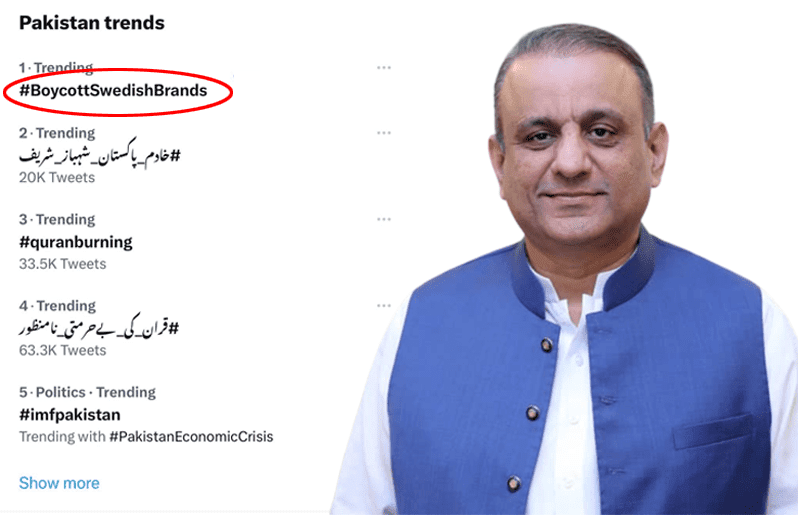
According to a statement released by Shehbaz Sharif’s party, the Pakistan Muslim League-Nawaz (PML-N), the Prime Minister of Pakistan addressed the Sweden incident during a meeting and made the decision to observe July 7 as Yaum-i-Taqaddus Quran, a day dedicated to upholding the sanctity of the Holy Quran. In addition, a nationwide protest is planned to condemn the Quran-burning incident. This response from the Pakistani government reflects the deep concern and outrage felt by the country’s leadership and their determination to stand against acts that disrespect the sacredness of the Quran. The decision to observe a national day and hold protests demonstrates the significance of the incident and the resolve of the Pakistani government to protect the honor and sanctity of the Holy Quran.
Response
In response to the growing backlash, Sweden’s foreign ministry has condemned the Quran burning as an “Islamophobic” act and emphasized that it does not reflect the views of the Swedish government. The Organisation of Islamic Cooperation (OIC) has also called for collective action to prevent similar incidents from occurring in the future.
As the boycott movement gains momentum, it remains to be seen how Swedish brands, particularly Spotify and Truecaller, will respond to the public outcry and whether this controversy will have lasting implications for their reputation and user base.
The incident serves as a stark reminder of the power of social media in mobilizing public sentiment and demanding accountability from global brands, while also highlighting the challenges faced by societies in balancing freedom of expression with respect for religious sensitivities.
❤️ Support Independent Journalism
Your contribution keeps our reporting free, fearless, and accessible to everyone.
Or make a one-time donation
Secure via Razorpay • 12 monthly payments • Cancel anytime before next cycle


(We don't allow anyone to copy content. For Copyright or Use of Content related questions, visit here.)

The Chenab Times News Desk