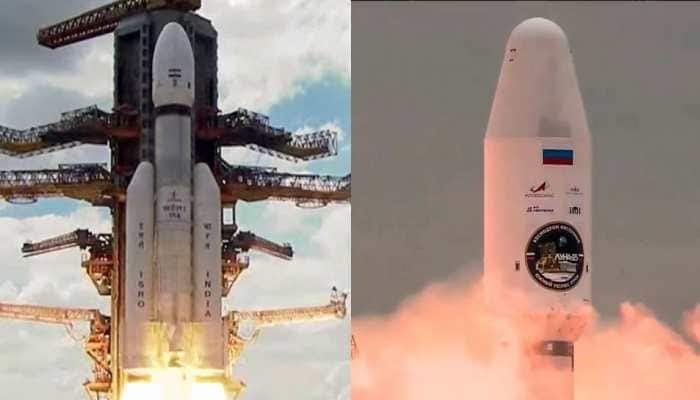
The competition to reach the uncharted south pole of the moon is intensifying as India’s Chandrayaan-3 and Russia’s Luna-25 gear up for their upcoming lunar landings next week. Both missions carry significant implications beyond the thrilling rivalry in the cosmos.
Chandrayaan-3, the third installment in India’s lunar exploration series, embarked on its journey on July 14 and successfully entered lunar orbit on August 5. With meticulous adjustments to its orbit, it’s preparing for a soft landing attempt within 40 days of launch. On the other side, Russia is making a momentous return to lunar exploration with Luna-25, its first such mission in nearly five decades since the iconic Soviet-era Luna-24 mission in 1976. Luna-25 was launched on August 10 and is on a direct trajectory to the moon, potentially allowing for a landing as early as August 21, just about 11 days after launch.
The rapid journey of Luna-25 can be attributed to its lightweight design and efficient fuel storage, enabling it to take a shorter path to its destination. Dr. K Sivan, former chairperson of India’s space agency ISRO, explained that Luna-25’s leaner lift-off mass of only 1,750 kilograms compared to Chandrayaan-3’s 3,800 kg gives it the advantage of accelerated efficiency. Additionally, Luna-25’s surplus fuel storage eliminates fuel efficiency concerns, allowing for a more direct route.
While the order of arrival in the grand scope of cosmic exploration may not drastically alter the lunar landscape, experts emphasize that the knowledge gained from each mission will greatly enrich our understanding of the moon’s history and potential. Chrisphin Karthick, a scientist at Bangalore’s Indian Institute of Astrophysics, commented, “The value lies in the sum of our combined efforts.”
A crucial element affecting the timing of the spacecraft landings is the path of the sun across the sky. The sun must be rising over the designated landing spots for these probes. Dr. K Sivan expressed his satisfaction with Russia’s involvement in lunar exploration, stating, “Global participation in space exploration amplifies the human spirit of curiosity and discovery.”
As anticipation builds, the proximity of their landing dates, August 21-23 for Luna-25 and August 23-24 for Chandrayaan-3, has garnered heightened global attention. The race to the moon’s south pole not only showcases the advancements in space technology but also demonstrates the collaborative nature of scientific exploration.
(Inputs from news agency PTI)
❤️ Support Independent Journalism
Your contribution keeps our reporting free, fearless, and accessible to everyone.
Or make a one-time donation
Secure via Razorpay • 12 monthly payments • Cancel anytime before next cycle


(We don't allow anyone to copy content. For Copyright or Use of Content related questions, visit here.)

The Chenab Times News Desk