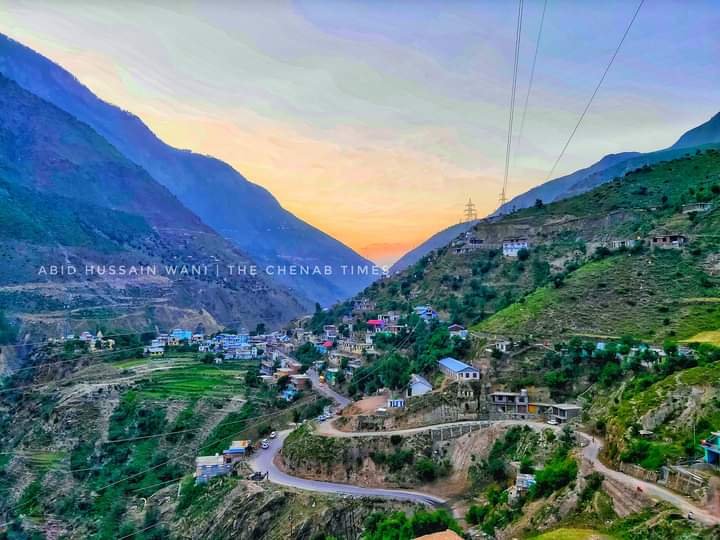
Nestled in the Himalayan region of Jammu and Kashmir, the Chenab Valley is a serene and captivating river valley formed by the mighty Chenab River. This valley, a term that collectively refers to the districts of Doda, Kishtwar, and Ramban in the Jammu Division, was once a single district called Doda.
Geographical and Administrative Landscape
Spanning an impressive 11,885 square kilometers, Chenab Valley is home to approximately 924,345 residents, resulting in a modest population density of 78 people per square kilometer. Bordered by Anantnag and Kulgam districts to the north, Kargil district to the east, Rajouri district to the west, and Udhampur, Kathua districts, and Himachal Pradesh to the south, the region is traversed by National Highway 244, weaving through its breathtaking landscapes.
Origins and Etymology
The name “Chenab Valley” derives from the Chenab River, a lifeline that carves through the valley. The term was first reportedly introduced by Erik Norin in a 1926 journal article, and has since been embraced by residents and activists to emphasize the region’s distinct cultural and geographical identity. Meanwhile, the people of Chenab Valley are referred as “Chenabis” or simply “Chenabi“.
A Historical Tapestry
Historically, the Chenab Valley has been a confluence of various cultures and rulers. The Doda region, initially inhabited by the Sarazi population, saw migrations from the Kashmir Valley and other areas. The principalities of Kishtwar and Bhadarwah were significant historical entities, governed by a succession of Ranas, Rajas, and independent chiefs until their conquest by Maharaja Gulab Singh in 1822.
Economic Foundations
The economy of Chenab Valley is shaped by its challenging terrain and limited access to resources. Industrial presence is sparse, with a few registered factories and small industries. Yet, the region is abundant in forest resources, covering approximately 6,226 square kilometers and yielding valuable timber. Agriculture and horticulture are pivotal, with significant cultivation of saffron, zeera, and Marsheela. Livestock farming, particularly sheep and goat rearing, also plays a crucial role.
Demographic Diversity
According to the 2011 census, Muslims constitute about 60% of Chenab Valley’s population, while Hindus make up around 40% approximately. The region is a mosaic of ethnic groups, with multiple languages spoken, including Kashmiri, Gojri, Bhaderwahi, Sarazi, Kishtwari, and Padari. The overall sex ratio stands at 913 females per 1,000 males.
Administrative Structure
Chenab Valley boasts its own administrative setup, featuring a separate Deputy Inspector General of Police (DIG) for the Doda-Kishtwar-Ramban (DKR) Range, along with distinct zones for the Public Works and Forest Departments. The Village Defence Guards, established here in 1996, continue to play a critical role in countering militancy.
Tourism and Natural Beauty
The valley is home to several tourist attractions, such as Bhaderwah, Jai Valley, Padri Pass, Sinthan Top, Lal Draman, and Jantroon Dhar. Its hydroelectric potential is harnessed by significant dams like Baglihar Dam, Dulhasti Dam, and Salal Dam.
Calls for Divisional Status
The demand for separate administrative division status for Chenab Valley has been a persistent issue. Major protests and political backing in 2014, 2018, and 2019 underscored claims of developmental neglect under the Jammu division. Despite opposition from the Bharatiya Janata Party, which argues for maintaining the status quo, proponents, including the Jammu and Kashmir National Conference, assert that independent status is crucial for the region’s growth.
Hill Development Council Proposal
In 1996, then Chief Minister Dr. Farooq Abdullah promised administrative autonomy for Chenab Valley. Although a bill for a Hill Development Council was introduced in 2000, it did not come to fruition. In 2015, Chief Minister Mufti Mohammad Sayeed announced the Chenab Valley Development Fund to foster the development of Doda, Kishtwar, and Ramban districts.
Chenab Valley, with its rich history, diverse demographics, and unique geographical features, remains a vital and intriguing part of Jammu and Kashmir. Despite its economic and developmental challenges, the valley’s cultural heritage and natural resources continue to underscore its significance within the union territory.
❤️ Support Independent Journalism
Your contribution keeps our reporting free, fearless, and accessible to everyone.
Or make a one-time donation
Secure via Razorpay • 12 monthly payments • Cancel anytime before next cycle


(We don't allow anyone to copy content. For Copyright or Use of Content related questions, visit here.)

Haseena Ayoob is a regular contributor of The Chenab Times.