


KISHTWAR, SEPTEMBER 4, 2025 – In the wake of devastating flash floods that claimed over 70 lives across Jammu and Kashmir’s Chenab Valley last month, a government-commissioned report on Glacial Lake Outburst Floods (GLOFs) in Kishtwar district has emerged as a stark reminder of unaddressed vulnerabilities in this Himalayan region. Prepared by the District Disaster Management Authority (DDMA) Kishtwar and quietly uploaded to the district administration’s website in November 2024, the 23-page document outlines a comprehensive risk management plan for GLOFs—sudden and catastrophic floods triggered by the bursting of glacial lakes. Yet, its limited dissemination has raised questions about why such critical warnings were not more widely shared, especially as climate-induced glacier melting accelerates and endangers downstream communities and major infrastructure projects.
The report gained renewed attention this week following the deadly events of August 2025, which many news outlets have linked to the broader hazards detailed in the study, though without specifying its exact publication date. On August 14, a cloudburst in Chashoti village, Padder tehsil, unleashed a flash flood that killed 67 people and left many missing, primarily affecting pilgrims en route to the Machail Mata Yatra. Homes were swept away, roads severed, and rescue operations stretched thin in the remote Chenab Valley hamlet, underscoring the precariousness of life in these high-altitude areas. Barely two weeks later, on August 26, heavy rainfall triggered another flash flood in the region, claiming four lives in neighbouring Doda district, damaging over a dozen houses, and forcing school closures amid warnings of further landslides and cloudbursts. These incidents, while not explicitly confirmed as GLOFs, mirror the cascading risks described in the DDMA plan, including rapid water surges from unstable glacial formations exacerbated by erratic weather patterns.
At the heart of the report is Kishtwar’s unique susceptibility to GLOFs, driven by its rugged terrain and the highest concentration of glacial lakes in the Union Territory of Jammu and Kashmir—197 in total, accounting for over a third of the region’s glacial water bodies. Drawing on data from the Central Water Commission’s Glacial Lake Atlas and inputs from institutions like the National Remote Sensing Centre and IIT Bombay, the document identifies key lakes such as Mundiksar and Hangu as high-risk, prone to expansion due to accelerated glacier retreat amid global warming. It details how these lakes, often dammed by fragile moraines of ice, sand, and debris, could release millions of cubic metres of water in minutes, devastating downstream valleys. The plan classifies lake types, from moraine-dammed to ice-dammed, and assesses triggers like earthquakes, avalanches, and human activities, emphasizing the district’s location in Seismic Zone IV as a compounding factor.

The DDMA’s analysis extends to vulnerability mapping, pinpointing tehsils like Padder, Machail, Dachhan, Marwah, and Warwan as particularly exposed, along with the Kishtwar High Altitude National Park. These areas, often referred to as “shadow zones” due to their isolation and limited disaster preparedness, house low-lying settlements, agricultural lands, and essential infrastructure such as roads, schools, hospitals, and government buildings. The report warns of potential environmental degradation, including soil erosion, habitat loss, and water contamination, which could exacerbate public health crises in these remote pockets. Critically, it highlights the threat to ongoing hydroelectric developments, noting that projects like Pakal Dool, Kiru, Kwar, and Dangduru could face operational disruptions or structural failures from sudden flood surges, given their proximity to glacial-fed rivers.
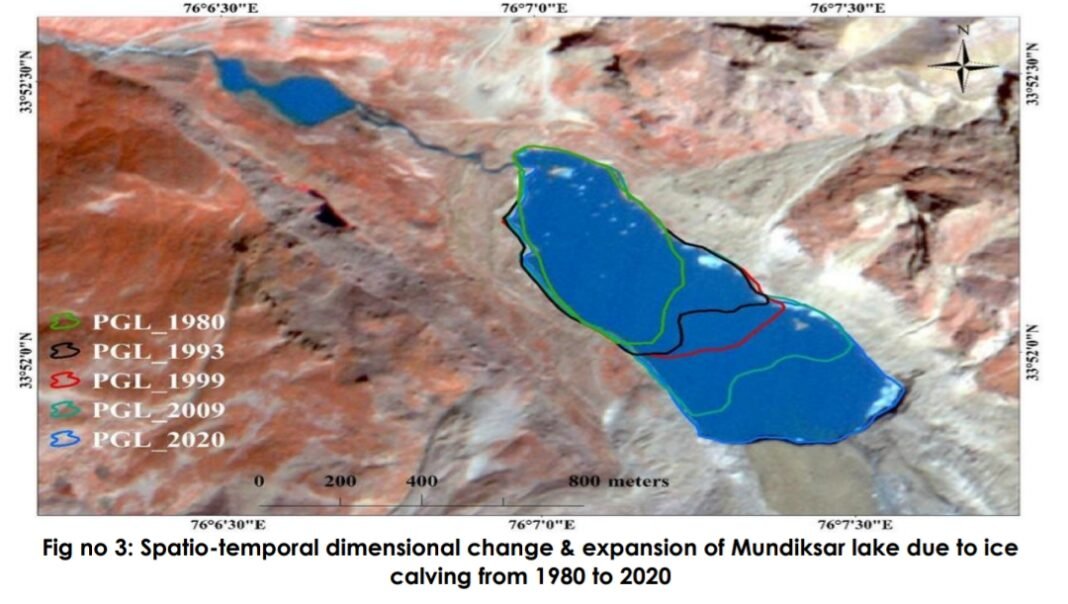
This concern is amplified by the district’s burgeoning role as a hydropower hub, with around eight major projects either under construction or operational, including Kirthai, Dul Hasti, Ratle, Choudhary, and Lower Kalnai, alongside the aforementioned ones. Collectively, these initiatives aim to harness the Chenab River’s flow for thousands of megawatts of energy, positioning Kishtwar as a key contributor to northern India’s power grid. However, the report underscores how expanding glacial lakes, such as Mundiksar which has grown significantly over the past four decades due to ice calving and meltwater accumulation, heighten the risk of GLOFs that could overwhelm dams, disrupt river courses, and trigger cascading failures. Recent media coverage has echoed these alarms, with reports questioning the long-term feasibility of such projects in a warming climate, where hydrological changes could render investments unsustainable.
The study’s path to public scrutiny reveals a troubling gap in communication. Uploaded to the Kishtwar administration’s website on November 29, 2024, it was archived on the Internet Archive by February 2025, but remained largely inaccessible to the general public, known only to those familiar with the portal. Foreworded by the then Deputy Commissioner Rajesh Kumar Shavan and framed as a 2024-25 action plan, it calls for enhanced monitoring through collaborations with national bodies like the National Disaster Management Authority and the Indian Meteorological Department, alongside community training and early warning systems. Yet, critics argue that its subdued release meant it failed to influence timely interventions, even as warnings about GLOF risks reached the administration over a year ago. This oversight is particularly poignant given the August tragedies, which have prompted calls for greater transparency and proactive dissemination of such reports to avert future losses.
Beyond immediate mitigation strategies—like reinforcing moraine dams, controlled lake drainage, and risk mapping—the document advocates long-term climate adaptation, including afforestation, resilient infrastructure design, and capacity-building programs for volunteers and residents. It proposes allocating district development funds for GLOF schemes and fostering research on glacier dynamics, with consultants embedded in disaster management frameworks. In a region where the Chenab River’s sensitivity to glacial melt already strains local ecosystems, these measures could bridge the preparedness deficit in shadow areas, where evacuation routes are scarce and response times protracted.
As Kishtwar grapples with the aftermath of the floods, the DDMA report serves as a blueprint for resilience, urging a shift from reactive relief to preventive action. With climate change intensifying the frequency of such events, stakeholders must heed its insights to safeguard not just hydroelectric ambitions but the very fabric of community life in this fragile Himalayan enclave. Failure to do so, as recent headlines attest, could invite more preventable calamities in an already vulnerable landscape.
❤️ Support Independent Journalism
Your contribution keeps our reporting free, fearless, and accessible to everyone.
Or make a one-time donation
Secure via Razorpay • 12 monthly payments • Cancel anytime before next cycle


(We don't allow anyone to copy content. For Copyright or Use of Content related questions, visit here.)
Anzer Ayoob is the Founder and Chief Editor to The Chenab Times


