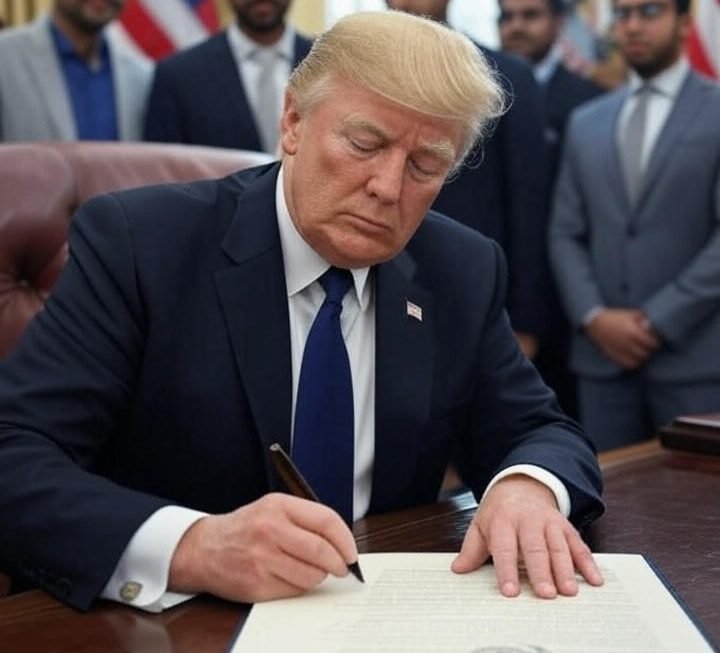
New Delhi, September 20 — In a move that has sent shockwaves through the Indian diaspora and the global technology sector, U.S. President Donald Trump has signed a presidential proclamation imposing a steep $100,000 annual fee on all H-1B visa applications and extensions, effective from 12:01 a.m. ET on September 21, 2025. The abrupt policy shift, aimed at curbing the “overuse and misuse” of the H-1B programme, has sparked immediate chaos, with Indian professionals scrambling to return to the U.S. and Indian IT firms bracing for significant financial strain.
The H-1B visa, a non-immigrant work permit, enables skilled professionals—predominantly in technology, engineering, and medicine—to work in the U.S. for up to three years, renewable to a maximum of six. With India accounting for over 70% of the 400,000 H-1B visas issued in fiscal year 2024, the new fee is poised to disproportionately impact Indian workers and companies. The U.S. administration claims the measure will prioritise high-wage “specialty occupation” workers and reduce reliance on lower-cost foreign labour, aligning with its “America First” agenda.
Immediate Fallout
The announcement, made late on September 19, triggered a frenzy. U.S. airports reported instances of passengers—many Indian tech workers—deplaning mid-flight to avoid being stranded outside the country. Flight prices from India to the U.S. surged by 200-300% as professionals rushed to return before the deadline. Major U.S. tech firms, including Microsoft and Amazon, issued urgent advisories to H-1B employees, urging immediate re-entry to secure their status.
Indian IT giants like Tata Consultancy Services (TCS), Infosys, and Wipro, which collectively sponsored over 9,000 H-1B visas in 2025, face a potential $1.34 billion cost to maintain current staffing levels—a figure equivalent to 10% of their U.S. revenues. Shares of these firms dipped 2-5% in after-hours trading, reflecting market unease. The industry body Nasscom warned of “significant disruptions to business continuity” and urged companies to facilitate the swift return of affected employees.
Implications for India
The fee hike compounds existing challenges for Indian H-1B holders. A Blind survey conducted in August 2025 revealed that 45% of Indian professionals on H-1B or L-1 visas would return home if faced with job loss, a scenario now looming large for early-career workers earning median salaries of $90,000-$100,000. The prohibitive fee could force layoffs or non-renewals, threatening remittances that exceed $100 billion annually and support countless families in India.
India’s Ministry of External Affairs (MEA) responded cautiously, stating it is “assessing the full implications in consultation with industry stakeholders.” The ministry underscored the mutual benefits of U.S.-India talent mobility, warning that the policy risks straining bilateral ties and disrupting families. “The U.S. tech ecosystem thrives on Indian talent, just as India benefits from knowledge transfer,” an MEA spokesperson said.
A Silver Lining?
Amid the disruption, some experts see potential long-term gains for India. The fee hike could accelerate a reverse brain drain, with skilled professionals opting to stay or return to bolster India’s burgeoning tech ecosystem in cities like Bengaluru and Hyderabad. “This is a self-goal for the U.S.,” said Sandeep Parekh, a Bengaluru-based venture capitalist. “It frees our talent from the H-1B lottery trap, channeling their expertise into domestic innovation.”
Indian IT firms may also pivot to offshore models, leveraging Global Capability Centers (GCCs) that already employ thousands for U.S. multinationals like Google and Goldman Sachs. This shift could reduce dependence on U.S. revenues—down from 80% in 2010 to roughly 50% today—and spur growth in markets like Europe and the UAE, where visa policies are less restrictive. Analysts project that India’s $250 billion IT export sector could see a new wave of growth, potentially adding $130 billion to pharma and tech by 2030.
Broader Context
The fee hike follows earlier U.S. policy shifts, including an August 2025 wage-based H-1B selection system that replaced the lottery, and a 43.5% drop in Indian student visas from October 2024 to March 2025. These measures reflect the Trump administration’s broader immigration clampdown, which critics argue undermines U.S. competitiveness in AI and technology—sectors reliant on Indian talent.
As the September 21 deadline looms, Nasscom and Indian officials are exploring legal and diplomatic avenues to seek exemptions or relief. However, with the U.S. framing the policy as a national interest measure, negotiations may prove challenging. For now, the Indian diaspora and IT industry face an uncertain road ahead, caught between immediate hardship and the promise of a more self-reliant future.
❤️ Support Independent Journalism
Your contribution keeps our reporting free, fearless, and accessible to everyone.
Or make a one-time donation
Secure via Razorpay • 12 monthly payments • Cancel anytime before next cycle


(We don't allow anyone to copy content. For Copyright or Use of Content related questions, visit here.)

The Chenab Times News Desk