


In the early days of 2026, Iran finds itself at a crossroads of unrest and resilience. What began as economic grievances in late December 2025 has grown into one of the most significant challenges to the Islamic Republic’s authority in years. Nationwide protests, driven by skyrocketing inflation, a collapsing rial, and broader demands for political change, have clashed with a heavy-handed security response, resulting in hundreds of reported deaths and thousands of arrests. Yet amid this chaos, another reality exists: large-scale pro-government demonstrations organized by the regime, showing public support for Supreme Leader Ayatollah Ali Khamenei and the Islamic Republic.
This article examines a specific flashpoint—a widely circulated image posted by Khamenei’s official social media account—while looking at the reality of these pro-government rallies. It also addresses claims that Western media outlets are engaging in propaganda by disproportionately highlighting anti-regime activities and portraying Iran in a consistently negative light. While the situation in Iran is serious, with credible reports of violence against civilians that must be condemned, a closer look shows a media landscape filled with selective framing from multiple sides. Drawing on recent reports, visual analyses, and available evidence, this piece aims to provide international readers with a balanced, fact-based overview.
The Spark: Economic Collapse and Escalating Protests
Iran’s economy, already weakened by years of U.S. sanctions, regional conflicts, and internal mismanagement, reached a breaking point in late 2025. The rial fell to historic lows, inflation surged past 50% in some estimates, and basic goods became unaffordable for many. Shopkeepers in Tehran closed their businesses in protest, and localized strikes quickly spread to more than 40 cities across 19 provinces. By early January 2026, the demonstrations had shifted from purely economic complaints to open calls for regime change, reportedly with chants of “Death to the Dictator” and the burning of portraits of Khamenei.
Human rights groups and opposition sources have reported a severe crackdown. Estimates of deaths range from over 500 to more than 600, including protesters, security personnel, and bystanders. Live ammunition has been used in several documented cases, and widespread internet blackouts have limited the flow of information. Internationally, U.S. President Donald Trump has increased pressure through new tariffs on Iran’s trading partners and strong rhetoric, while leaving open the possibility of negotiations.
Every loss of innocent life in these events—whether a protester shot by security forces, a bystander caught in clashes, or a member of the security services killed—deserves clear condemnation. The excessive use of force against peaceful demonstrators violates basic human rights standards, and international calls for accountability are entirely appropriate. At the same time, the full picture includes a regime actively working to demonstrate its own base of support.
A Viral Image: New or Recycled Propaganda?
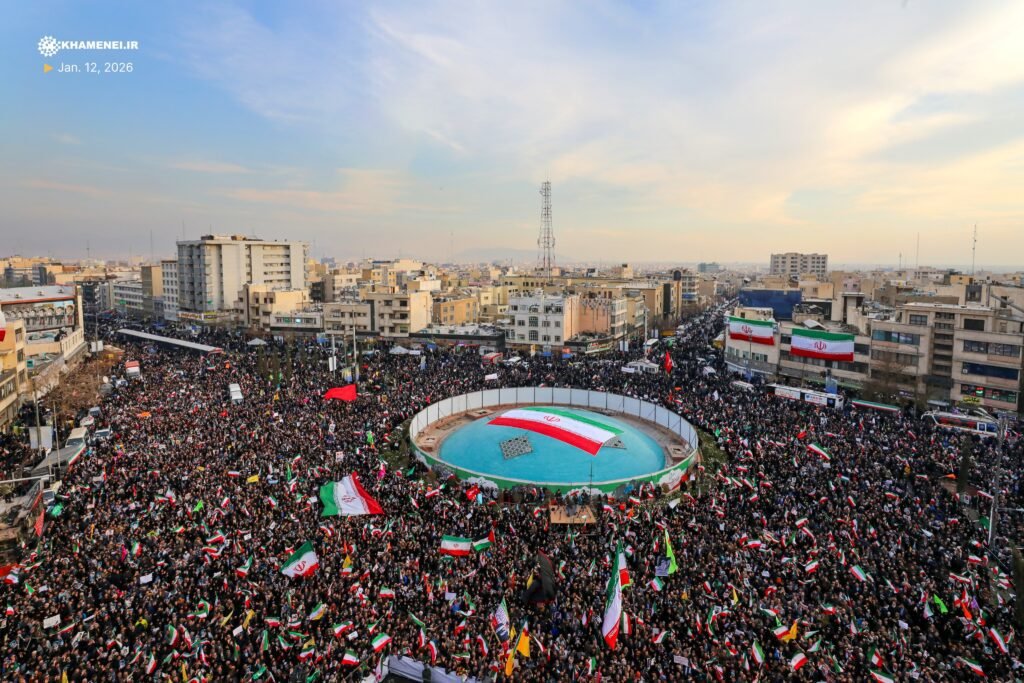
On January 12, 2026, Khamenei’s official X account posted an aerial photograph of a huge crowd in Tehran’s Azadi Square. Iranian flags covered the central fountain area, and the image was accompanied by a caption describing the gathering as a warning to foreign enemies and proof of national unity.
Within hours, opposition activists and some fact-checkers called the image recycled, claiming it came from older events such as the January 2020 funeral of Qasem Soleimani or the June 2025 state funeral for IRGC commanders and scientists killed in Israeli strikes. Community notes on X and social media posts pointed to the shared location—Azadi Square—and accused the regime of using old footage to exaggerate support during a time of crisis.
However, a careful visual comparison shows important differences that indicate the photograph is recent:
- The barriers around the central pool lack the large portraits and decorations visible in the 2025 summer funeral images, which also showed greener trees and brighter summer lighting. The January 2026 photo has a simpler fencing setup and bare winter trees consistent with the current season.
- The positioning, folds, and overlaps of the large Iranian flag draped over the fountain do not match exactly with archived images from 2020 or 2025. Crowd patterns extend into side streets in unique ways, and details like vehicle placement and building signage differ from older photographs.
- The hazy winter sky and barren landscape align with January conditions, ruling out a direct copy from warmer months. No obvious signs of digital manipulation were found.
Independent news reports from agencies like Reuters and AP have confirmed that new photos and videos from the January 12 rallies were shared by state media. While the regime has reused images in the past, this particular photograph appears to be genuine and taken during the 2026 event.
Pro-Government Demonstrations: Orchestrated but Real
Contrary to claims that Iran is experiencing only anti-regime unrest, pro-government rallies took place on January 12, 2026, in Tehran, Kerman, Arak, and several other cities. State television aired live coverage of crowds waving flags, chanting in support of Khamenei, and condemning foreign interference and “rioters.” Khamenei publicly praised the turnout as evidence of the Islamic Republic’s strength and popularity.
These gatherings were largely organized by the state, drawing on groups such as the Basij militia, government employees, and committed supporters of the regime. Attendance figures reported by state media reached tens of thousands in some locations, though independent observers have noted that participation was often encouraged or required for certain segments of society. Even so, the events represent a real counter-presence, even if not spontaneous or fully grassroots. In a population of more than 80 million, segments of society continue to support the Islamic Republic, particularly in rural areas and among those aligned with its ideological and economic framework.
Media Narratives: Bias, Blackouts, and Propaganda Accusations
Critics frequently accuse Western media—outlets such as CNN, BBC, The New York Times, and others—of pushing propaganda against Iran. They argue that coverage focuses almost exclusively on anti-regime protests, amplifies opposition voices, and largely ignores or downplays pro-government activities. This selective emphasis, they say, creates an image of Iran as a failing dictatorship on the verge of collapse, while overlooking legitimate support for the system and the complexity of the economic and political situation.
There is some basis for these concerns. Internet restrictions in Iran make on-the-ground reporting difficult, forcing many outlets to rely on exile sources, social media videos, and opposition-affiliated accounts that may carry their own biases. Misinformation has emerged as a key trigger in these unfolding events. Earlier, The Chenab Times fact-checked a widely shared image depicting a woman using a burning photograph of Supreme Leader Ayatollah Ali Khamenei to light a cigarette. The image was promoted by Western media outlets and anti-regime activists as a courageous act of defiance inside Iran. However, our investigation revealed that the photo did not originate from Iran at all—it was taken during a solidarity demonstration in Toronto, Canada.
Western propaganda efforts have also targeted through videos of women removing their hijabs and chanting anti-Khamenei slogans, often presented as authentic acts of defiance inside Iran. In several widely circulated clips, visible Israeli flags among the crowds have raised questions about external orchestration, suggesting these demonstrations may have been amplified or influenced by Israeli interests to undermine the Iranian regime. Such misinformation and anti-Khamenei narratives are not new; the United States and Israel have long engaged in similar information campaigns to portray internal unrest as solely foreign-driven or to escalate tensions.
Coverage sometimes omits context about regime-organized counter-events or attributes all unrest solely to foreign plots without fully addressing domestic grievances.
At the same time, Iranian state media engages in its own form of selective reporting, greatly inflating rally sizes, framing all protests as foreign-orchestrated conspiracies, and rarely acknowledging the scale of public discontent. The result is a polarized information environment where both sides present incomplete pictures.
Balanced reporting from sources like Al Jazeera has attempted to cover both protest activity and regime responses, but access limitations remain a challenge for all international journalists.
A Call for Nuance and Accountability
The current situation in Iran is deeply troubling. Violence that harms innocent people—on any side—must be condemned without hesitation. Excessive force against demonstrators, arbitrary arrests, and loss of life require serious investigation and accountability.
At the same time, it is important to recognize that pro-government demonstrations are taking place, and at least one widely shared image from Khamenei is recent rather than recycled. Media bias exists in many directions, but accusations of outright propaganda should be weighed carefully against the available evidence.
For people outside Iran watching events unfold, the most responsible approach is to seek out multiple sources, support independent verification from human rights organizations, and avoid falling into one-sided narratives. Iran’s future will depend not on viral images or competing headlines, but on whether the underlying economic and political issues can be addressed in a way that reduces violence and builds stability.

Anzer Ayoob is the Founder and Chief Editor to The Chenab Times