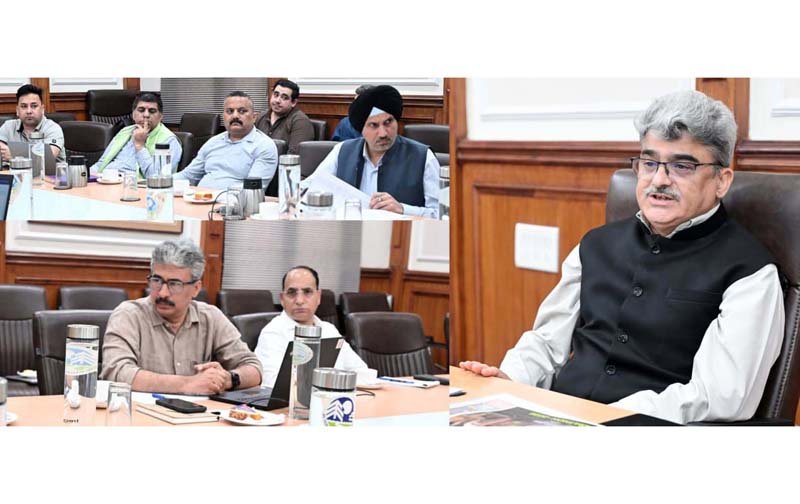
Jammu and Kashmir Chief Secretary Atal Dulloo on Sunday chaired two significant review meetings focusing on the progress of the MSME Health Clinic under the RAMP scheme and the roadmap for strengthening disaster management mechanisms across the Union Territory.
According to details received by The Chenab Times, the meetings underscored the administration’s commitment to bolstering the industrial sector and enhancing preparedness for natural calamities.
In the first meeting, Chief Secretary Dulloo emphasized a result-oriented approach for the MSME Health Clinic, designed to revitalize stressed and sick industrial units. He directed the Industries and Commerce Department to optimally leverage available institutional and human resources, including expertise from the Indian Institute of Management (IIM) Jammu, Functional Managers, the Entrepreneurship Development Institute (EDI), and university faculty and students.
The Chief Secretary stressed the importance of setting realistic daily and monthly targets for outreach to Micro, Small, and Medium Enterprises (MSMEs). He advocated for a systematic evaluation of each unit, categorizing them as stable, stressed, or sick, followed by the provision of appropriate advisory and financial assistance in coordination with the Jammu & Kashmir Bank. These insights are to be aligned with the evolving Industrial Policy of Jammu and Kashmir.
Director IIM Jammu, B S Sahay, suggested the development of comprehensive informational material, such as pamphlets detailing standard operating procedures, dos and don’ts, and key diagnostic parameters for MSME assessment.
Commissioner Secretary, Industries & Commerce, Vikramjit Singh, reported that 3,968 MSMEs have registered on the Health Clinic portal. Phases I and II of the initiative are complete, with 1,238 enterprises digitally assessed. Of these, 994 units were found stable, 237 were identified as stressed, and 7 were categorized as sick.
In a separate high-level review, the Chief Secretary assessed the roadmap for strengthening disaster management mechanisms in Jammu and Kashmir. He directed concerned departments to effectively plan and utilize the Rs 3,340 crore earmarked for disaster management, mitigation, and risk reduction across all districts.
The meeting was attended by Additional Chief Secretary Finance Shailendra Kumar, Additional Chief Secretary PWD Anil Kumar Singh, Principal Secretary DMRR&R Chandraker Bharti, Divisional Commissioners of Jammu and Kashmir Ramesh Kumar and Anshul Garg respectively, Director CD & SDRF, CEO ERA, and other senior officers. Deputy Commissioners from all districts participated via video conferencing.
Chief Secretary Dulloo highlighted the need for a focused approach across six key verticals of disaster management: Early Warning Systems, Risk Reduction, Relief & Response, Rehabilitation, Reconstruction, and Capacity Building & Training. He called for sustained efforts to build a disaster-resilient Jammu and Kashmir through long-term, evidence-based planning.
With the monsoon season approaching, the Chief Secretary instructed Deputy Commissioners to identify vulnerable areas in advance and implement preventive measures based on past experiences. He also emphasized strict enforcement of disaster management laws, the formulation of Standard Operating Procedures (SOPs), and their effective implementation at the district level.
Additional Chief Secretary Finance, Shailendra Kumar, stressed safeguarding critical connectivity infrastructure alongside life and property. He advocated for modern, technology-driven early warning systems and recommended detailed studies of vulnerable regions, particularly the Chenab basin, to guide mitigation strategies.
Additional Chief Secretary PWD, Anil Kumar Singh, detailed the department’s efforts in the permanent restoration of damaged infrastructure and the implementation of mitigation measures to minimize connectivity disruptions during disasters.
Principal Secretary DMRR&R, Chandraker Bharti, informed that comprehensive mitigation guidelines have been issued and urged departments to formulate projects accordingly to secure funding. He also noted that fresh allocations would soon be released to districts for emergent situations.
Divisional Commissioner Jammu, Ramesh Kumar, emphasized training and capacity building for volunteers, especially in remote areas, to reduce response times. Divisional Commissioner Kashmir, Anshul Garg, called for strengthening early warning mechanisms, flood zoning, and modelling, alongside the early operationalization of the Emergency Operations Centre (EOC) at Budgam.
❤️ Support Independent Journalism
Your contribution keeps our reporting free, fearless, and accessible to everyone.
Or make a one-time donation
Secure via Razorpay • 12 monthly payments • Cancel anytime before next cycle


(We don't allow anyone to copy content. For Copyright or Use of Content related questions, visit here.)

The Chenab Times News Desk