


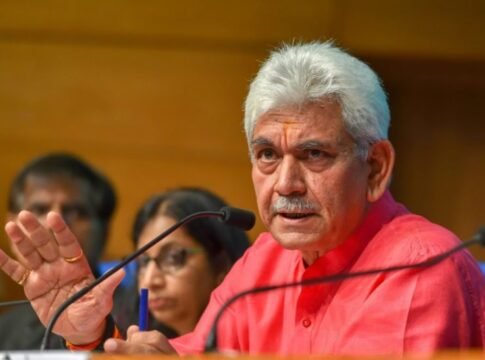
The annual pilgrimage to the holy cave shrine of Amarnath in south Kashmir is scheduled to begin on July 3 and conclude on August 28, spanning a period of 57 days. Lieutenant Governor Manoj Sinha announced that registration for the pilgrimage will open on April 15, with pilgrims aged between 13 and 70 eligible to participate.
Amarnath Yatra Dates and Registration Details Announced
Information was available with The Chenab Times that the dates for this year’s Amarnath Yatra were finalized during a meeting of the Shri Amarnath Ji Shrine Board (SASB), presided over by Lieutenant Governor Manoj Sinha. The pilgrimage, a significant event for devotees, will commence on July 3 and conclude on August 28, marking a slightly longer duration of 57 days compared to previous years. A mandatory registration process will be in place, with applications opening on April 15. The minimum age requirement for pilgrims has been set at 13 years, and the maximum age limit is 70 years.
Advance registration for the Amarnath Yatra can be completed through approximately 556 designated bank branches located across the country. Additionally, online registration will be facilitated via the official website of the Shri Amarnathji Shrine Board. Major banking institutions, including Yes Bank, ICICI Bank, Punjab National Bank, State Bank of India, and Axis Bank, will be involved in processing registrations at their respective branches. The first puja, marking the spiritual commencement of the pilgrimage season, is scheduled for June 29, coinciding with the occasion of Jyeshtha Purnima.
Route Information and Enhanced Pilgrim Facilities
The pilgrimage will proceed along two distinct routes: the traditional 48-kilometre Nunwan-Pahalgam route in the Anantnag district and the shorter, steeper 14-kilometre Baltal route in the Ganderbal district. In recent years, the administration has focused on enhancing facilities for pilgrims. These improvements include the mandatory implementation of Radio Frequency Identification (RFID) cards for all participants and an increase in group accidental insurance cover from Rs 5 lakh to Rs 10 lakh. Furthermore, an additional Rs 50,000 will be provided in cases of natural or accidental death of pony operators (ponywalas).
The integration of technology has been a key aspect of these enhancements, with RFID systems being extended to various services offered to pilgrims. Lieutenant Governor Sinha noted that while usage was lower initially, approximately 70 percent of pilgrims utilized these services last year, indicating a significant success in their adoption. Infrastructure upgrades have also been undertaken, with both the Baltal and Nunwan routes being widened considerably to facilitate smoother movement. Sections of the routes, particularly vulnerable stretches and bridges, have undergone substantial improvements by the Border Roads Organisation (BRO).
Security, Medical Support, and Infrastructure Upgrades
To accommodate a larger number of pilgrims, especially during adverse weather conditions, holding capacities at various locations have been increased. Several shelters have been established to provide comfortable accommodation for a significant number of people when weather becomes challenging. Yatri Niwas facilities have also been expanded at Chandanwari, Baltal, and Srinagar. The Nunwan facility is expected to become operational this year, and the Jammu facility is also slated to open soon.
Stringent security measures have been implemented at vulnerable points along the pilgrimage routes. Multi-layered security arrangements involve a substantial deployment of personnel from the Jammu and Kashmir Police, National Disaster Response Force (NDRF), State Disaster Response Force (SDRF), and the Central Reserve Police Force (CRPF). The Army also maintains positions at higher altitudes to bolster security. Advanced weather prediction capabilities have been enhanced with the installation of Doppler radar, providing more precise real-time weather forecasts compared to previous years.
For medical support, a 100-bed hospital has been established at Baltal, with another similar facility set up in Chandanwari to ensure adequate medical assistance for pilgrims. To maintain seamless communication, all major service providers, including BSNL, Reliance, and Airtel, have been engaged to ensure connectivity, even during heavy rainfall when pilgrims might face disruptions or get stranded. The Lieutenant Governor emphasized that the smooth conduct of the yatra is a result of coordinated efforts among multiple stakeholders, and systems are in place to gauge pilgrim satisfaction.
❤️ Support Independent Journalism
Your contribution keeps our reporting free, fearless, and accessible to everyone.
Or make a one-time donation
Secure via Razorpay • 12 monthly payments • Cancel anytime before next cycle


(We don't allow anyone to copy content. For Copyright or Use of Content related questions, visit here.)

The Chenab Times News Desk

