


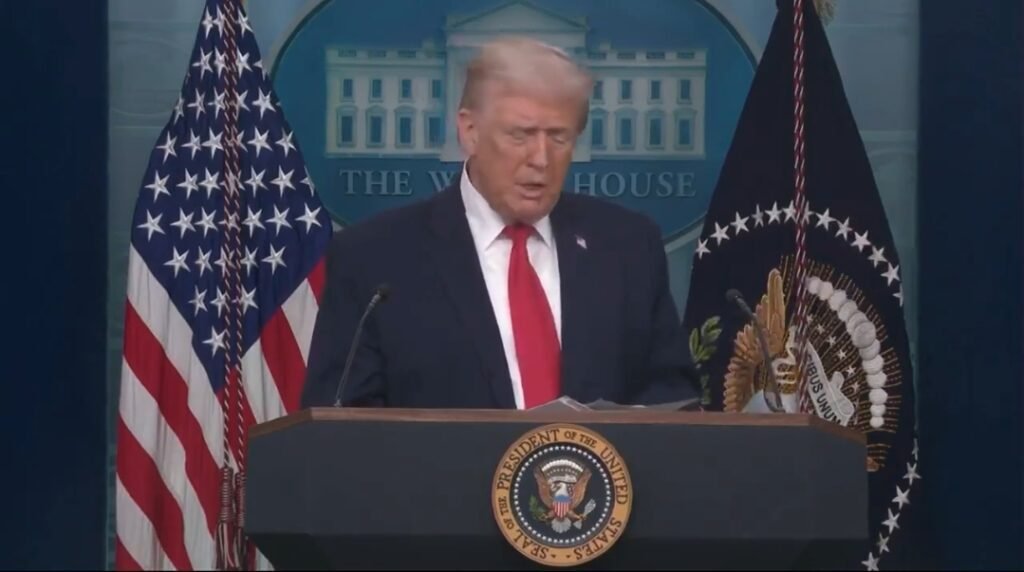
The United States is reportedly on the cusp of a significant agreement with Iran, with President Donald Trump indicating that a deal is “very close” and that Tehran has agreed to relinquish its stockpile of enriched uranium. This development unfolds against a backdrop of heightened tensions, marked by the U.S. naval blockade of Iranian ports in the strategically vital Strait of Hormuz.
According to details received by The Chenab Times, President Trump has expressed optimism about the progress, stating that Iran has “totally agreed” to the terms necessary to prevent it from obtaining nuclear weapons. [10] He has even suggested a willingness to travel to Pakistan to finalize any agreement, a nation that has played a role in brokering talks between the two countries. [10] The White House is reportedly discussing a second round of negotiations, which would likely occur in Pakistan, following previous discussions led by Vice President JD Vance that concluded without a definitive agreement. [10]
The implementation of the U.S. naval blockade of the Strait of Hormuz, which commenced at 10 a.m. Eastern Daylight Time, represents a significant escalation in maritime pressure. [3] This action follows the collapse of recent U.S.-Iran ceasefire talks. [2, 4] The blockade’s objective is to prevent ships from transiting the Strait of Hormuz, a critical chokepoint for global oil supplies. [4] President Trump has issued a stern warning, asserting that any Iranian vessels targeting the blockade would be “immediately eliminated.” [3] The immediate economic impact of this blockade has been felt in global markets, with oil prices, including Brent crude, rising above $100 per barrel. [3]
The current diplomatic maneuvering and military actions are set against the historical context of the U.S. withdrawal from the Joint Comprehensive Plan of Action (JCPOA), commonly known as the Iran nuclear deal, in May 2018. [11] At the time of the withdrawal, President Trump characterized the agreement as “a horrible one-sided deal that should have never, ever been made,” asserting that it had failed to bring calm or peace. [11] Despite the U.S. departure, key international signatories, including European allies, have continued to support the JCPOA. [9] Earlier reports from May 2025 suggested a convergence of terms, with the U.S. and Iran seemingly nearing an accord. [8] At that time, Iran reportedly signaled its willingness to forgo the development of nuclear weapons and restrict uranium enrichment to civilian-use levels, under international supervision, in exchange for the immediate lifting of economic sanctions. [8]
The Strait of Hormuz blockade’s implications extend beyond the immediate U.S.-Iran dynamic, significantly impacting major oil consumers like China. [5] Chinese President Xi Jinping has voiced concerns, cautioning against adherence to a “law of the jungle.” [5] The unilateral nature of the U.S. action in the Strait of Hormuz, a waterway governed by international navigation rights under the United Nations Convention on the Law of the Sea (UNCLOS), raises broader questions about the precedence of national security over established maritime norms. [5] Under UNCLOS Article 38, the Strait of Hormuz is recognized as a vital passage for international navigation, where the right of transit passage is considered immutable, even during times of conflict. [5]
The regional geopolitical landscape continues to be shaped by the broader context of the Israel-Hamas War, which has introduced considerable instability across the Middle East. [7] The U.S. military’s role in enforcing the blockade, including potential de-mining operations, aims to establish safe passage routes, although Iran has maintained its control over the strait and warned of strong responses to any blockade enforcement. [2]


Global Affairs Desk at The Chenab Times covers international developments, global diplomacy, and foreign policy issues through fact-based reporting, explainers, and analytical pieces. The desk focuses on major geopolitical events, diplomatic engagements, and international trends, with an emphasis on verified information, multiple perspectives, and contextual understanding of global affairs.