


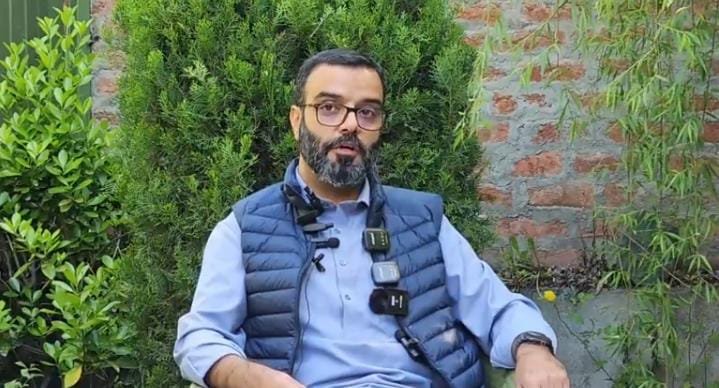
SRINAGAR: National Conference Member of Parliament Aga Syed Ruhullah Mehdi stated on Sunday that a recently defeated constitutional amendment bill would have concentrated legislative power in five Hindi-speaking states, had it been passed.
Information was available with The Chenab Times that Mehdi, speaking to reporters during a constituency visit in Srinagar, asserted that while the Women’s Reservation Bill was unanimously passed by Parliament in 2023, an opposition-backed bill that could have led to a flawed delimitation process, disguised as an effort to implement the women’s quota, has been defeated.
“The Women’s Reservation Bill is still alive. What has been defeated is a so-called delimitation bill that would have led to gerrymandering as they did in Jammu and Kashmir. They changed the boundaries of parliamentary constituencies as well as assembly segments along communal lines,” Mehdi said.
The Member of Parliament for the Srinagar Lok Sabha seat further elaborated that the delimitation process the government intended to pursue would have resulted in an increased number of seats in states such as Uttar Pradesh, Bihar, Gujarat, Madhya Pradesh, and Rajasthan. He argued that these states, with potentially 400 seats, could then dictate decisions for the entire country, drawing a parallel to the abrogation of Article 370, which he stated was not done with the concurrence of the people of Jammu and Kashmir. He added that the defeated bill would have disenfranchised regions including South India, Bengal, and the northeastern states.
Addressing the functioning of the Jammu and Kashmir administration, Mehdi expressed that the current dispensation, which had campaigned on a promise to fight for the restoration of the region’s special status, now appears to have ceased efforts even for statehood. “People did not vote for restoration of statehood. We got the mandate for restoration of constitutional guarantees that were taken away from us. Even if we accept that argument of fighting for the achievable first, this government does not seem to be fighting for even statehood now,” he stated, calling it an injustice to the mandate of the people of Jammu and Kashmir.
The constitutional amendment bill, identified as the 131st Amendment Bill, saw 298 members vote in its support and 230 against it. Out of the 528 members who participated in the vote, the bill required a two-thirds majority, which equates to 352 votes, to pass.
According to the bill’s provisions, it proposed to increase the total number of Lok Sabha seats to 816 from the current 543. This increase was intended to “operationalise” the women’s reservation law before the 2029 parliamentary elections, following a delimitation exercise based on the 2011 Census data.


The Chenab Times News Desk