


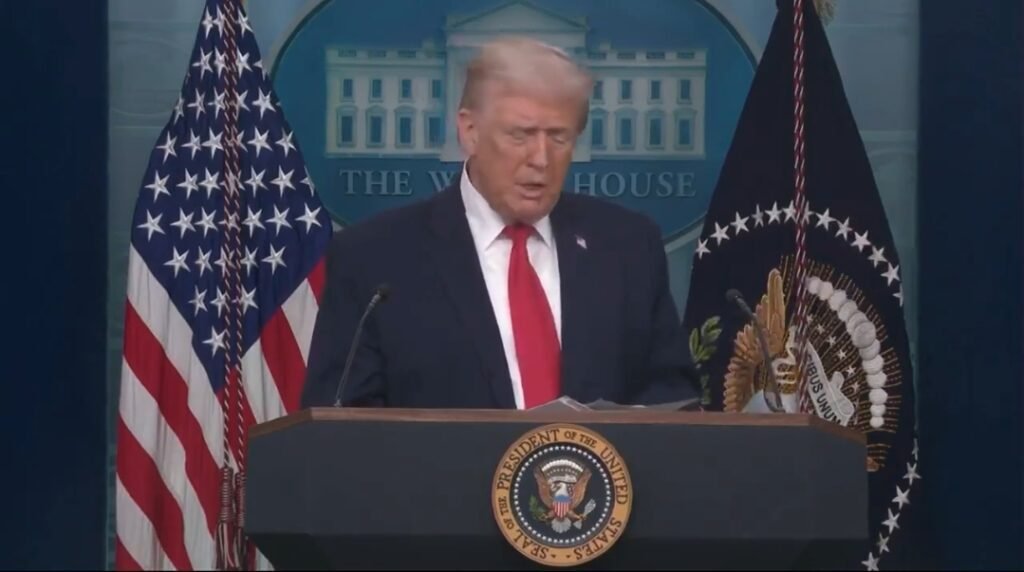
BEIJING, May 14: United States President Donald Trump and his Chinese counterpart Xi Jinping commenced extensive discussions in Beijing, with President Trump describing the meeting as the “biggest summit ever.” The high-level talks aimed to address a spectrum of critical issues, including the ongoing conflict in West Asia and persistent bilateral trade frictions between the two global economic powers.
Information was available with The Chenab Times that President Trump, who arrived in the Chinese capital the previous night, conveyed to President Xi during their initial meeting that he anticipated a “big discussion.” He further characterized the gathering as potentially the “biggest summit ever” during his opening remarks at the Great Hall of the People.
This visit marks the first by a US president to China in nine years. President Trump was himself the last American leader to visit China, undertaking the trip in 2017 during his first term in office. During their discussions, President Trump expressed optimism about future relations, stating, “When there were difficulties, we worked it out.” He added, “We’re going to have a fantastic future together,” highlighting his three-day state visit to China.
State-run Xinhua news agency reported that President Trump repeatedly referred to President Xi as a great leader. The initial session between the two leaders lasted over two hours. President Xi, in his remarks, emphasized the importance of partnership over rivalry, advocating for mutual success and shared prosperity. He suggested that both nations should find a constructive way for major countries to coexist harmoniously.
Accompanying President Trump on his trip were prominent American business leaders, including Jensen Huang of Nvidia, Tim Cook of Apple, Elon Musk of Tesla and SpaceX, and Larry Fink of BlackRock. President Trump indicated his intention to ask President Xi to “open up” China to facilitate the work of these business leaders, aiming to elevate the People’s Republic of China to a higher level. He described this as his “very first request” and expressed that the relationship between China and the USA was poised to become “better than ever before.”
President Xi, who accorded President Trump a ceremonial guard of honour, projected that 2026 could be a “historic, landmark year” that initiates a new chapter in China-US relations. He observed that the two countries share more common interests than differences and stated unequivocally, “There is no winner in a trade war.”
The visit occurs amidst increasing economic and geopolitical uncertainties, amplified by conflicts in West Asia and the resulting global energy shock, which has particularly impacted Asia. Beyond West Asia, the leaders were expected to deliberate on trade and tariffs, advancements in Artificial Intelligence and technology, the status of Taiwan and US arms sales to Taipei, and the critical rare earths supply chain, among other key issues.
President Trump’s visit follows months of heightened trade friction, stemming from the US administration’s imposition of substantial tariffs on various Chinese goods. Tensions have also escalated over export controls, advanced technology, and China’s dominance in the rare earth supply chain. Ahead of the summit, Chinese Vice Premier He Lifeng and Scott Bessent concluded a final round of trade negotiations in South Korea, the details of which remain undisclosed.
President Trump received a welcoming reception from Chinese Vice President Han Zheng at the airport, a gesture considered a rare honour and a departure from standard diplomatic protocol. Also disembarking from Air Force One with President Trump were his son Eric, daughter-in-law Lara, and Elon Musk. The two nations are reportedly planning to establish a Board of Trade to mediate differences.
Global attention is particularly focused on any potential outcomes that could lead to a cessation of the US-Israeli conflict in Iran and the lifting of the blockade on the Strait of Hormuz, a vital waterway through which approximately one-fifth of the world’s total energy supplies transit. In related developments, Iranian Foreign Minister Abbas Araghchi visited Beijing prior to President Trump’s arrival and held talks with his Chinese counterpart Wang Yi. Following their discussions, Wang Yi urged Iran to reopen the Strait of Hormuz promptly, while acknowledging Tehran’s commitment not to develop nuclear weapons, a key demand from President Trump to end the conflict.
US Secretary of State Marco Rubio commented on the Wang-Araghchi talks, expressing hope that China would convey the necessary message to Iran regarding its actions in the Strait of Hormuz, which he suggested were leading to global isolation. China’s concerns regarding the Iran conflict have heightened, particularly after President Trump implemented a blockade on Iranian ports, restricting the nation’s oil exports to China. China imports between 10% and 15% of its crude oil from Iran.
An editorial published in the state-run Global Times regarding President Trump’s visit noted that multiple conversations and meetings between Xi Jinping and President Trump have been instrumental in correcting the bilateral relationship’s trajectory and averting dangers at critical junctures. The editorial stressed that for China-US relations to genuinely stabilize and improve, the fundamental step involves the full and faithful implementation of the consensus reached by the two leaders.


The Chenab Times News Desk