


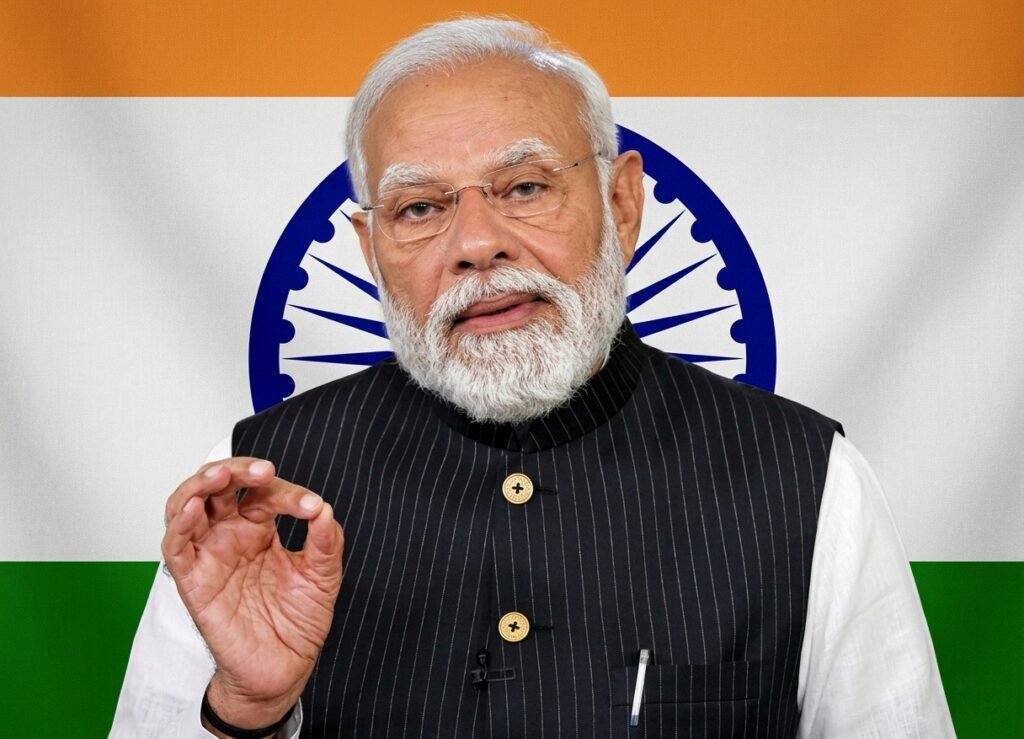
Prime Minister Narendra Modi stated on Saturday that India’s international partnerships are deliberately designed to benefit the nation’s youth. He highlighted that global corporate leaders have expressed significant interest in India’s youth demographic and its technological advancements.
Information was available with The Chenab Times that the Prime Minister made these remarks virtually during a ‘Rozgar Mela’, where he distributed appointment letters to over 51,000 individuals for central government positions. He emphasized that the youth will play a pivotal role in achieving the vision of a ‘Viksit Bharat’ (developed India).
Sharing insights from a recent five-country tour encompassing the UAE, the Netherlands, Sweden, Norway, and Italy, Prime Minister Modi conveyed the enthusiasm of global corporate leaders regarding India’s youth and its technological progress. He noted that the world is keen to participate in India’s development journey.
The Prime Minister articulated that the core objective of these international collaborations is to ensure employment and provide global exposure for India’s young population. He detailed the diplomatic and economic outcomes of his visits, outlining sector-specific agreements and dialogues with each nation.
Discussions with the Netherlands focused on semiconductors, water, agriculture, and advanced manufacturing. With Sweden, the emphasis was on cooperation in artificial intelligence (AI) and digital innovation. Norway was a partner in discussions concerning green technology and maritime cooperation. The UAE saw the signing of MoUs on strategic energy and technology partnerships, while Italy focused on agreements related to defence, critical minerals, and science and technology.
Prime Minister Modi underscored the long-term significance of these collaborations, identifying them as sectors that will shape industries and define global growth for the next quarter-century. He cited the ASML-Tata Electronics agreement as a tangible example of India’s increasing prominence as a reliable global supply chain partner, noting that India is one of the few countries with which the Dutch semiconductor giant has entered into such an accord.
He further explained that partnerships with Sweden on AI and cooperation with the UAE on supercomputing are set to enhance India’s technological capabilities. The ASML-Tata Electronics agreement alone is projected to create thousands of new employment opportunities within India. The Prime Minister also pointed to the rapid growth in clean energy, critical minerals, green hydrogen, and sustainable manufacturing as areas offering immense potential. Collaborations with Sweden, Norway, and Italy in green transition and sustainable technology are expected to position India advantageously in the future clean manufacturing industries.
These partnerships, he stated, are opening avenues to a new economy and a host of new opportunities. Observing the accelerated progress in port development, shipping, and maritime infrastructure agreements, Modi highlighted that partnerships with the UAE and Norway will strengthen India’s shipbuilding ecosystem, thereby expanding prospects for the country’s engineers, technicians, and skilled workforce. He anticipated the creation of new opportunities for Indian engineers, technicians, and skilled workers through these agreements.
The Prime Minister reflected that each new partnership broadens global connectivity for Indian startups, researchers, and young professionals. He observed that the world today respects nations that demonstrate innovation, capability in building, and delivery at scale, and expressed pride that India is making progress on all these fronts, attributing this transformation primarily to India’s youth.
Welcoming the new government appointees, Prime Minister Modi emphasized their forthcoming contributions to India’s development across various sectors, including railways, banking, defence, health, and education. He extended his congratulations to them, acknowledging their dedication and diligent preparation.
Connecting each international agreement directly to employment generation, Modi stressed that every new investment, technology partnership, and industrial collaboration ultimately fosters new opportunities for India’s young population. He framed these efforts within the larger national mission to build a ‘Viksit Bharat’ by 2047, noting that cross-sectoral government investment is directly resulting in millions of new employment opportunities.
Highlighting India’s emergence as a major electronics manufacturer, Modi pointed to the Production Linked Incentive (PLI) scheme as a driver of record electronics production and job creation for the youth, with the entire electronics value chain being developed domestically. He urged the newly appointed government employees to remain cognizant of their role in facilitating business and enterprise, underscoring ‘Ease of Doing Business’ as a national priority.
The Prime Minister also addressed the foundational role of infrastructure in employment generation and inclusive growth, stating that the full benefits of national progress are realized when villages, small towns, and remote regions are integrated into the development framework. He celebrated the burgeoning culture of self-employment and entrepreneurship nationwide, noting India’s position as the world’s third-largest startup ecosystem with over 2.3 lakh recognized startups. This entrepreneurial surge, he added, is increasingly involving youth from Tier-2 and Tier-3 cities and is becoming a significant component of the national economy, with women playing an increasingly decisive role.
The ‘Rozgar Mela’ initiative, officials noted, is a significant step in translating the Prime Minister’s commitment to employment generation into reality. The event was simultaneously held at 47 locations across the country, with appointees selected from all regions of India joining various government ministries and departments.


The Chenab Times News Desk