


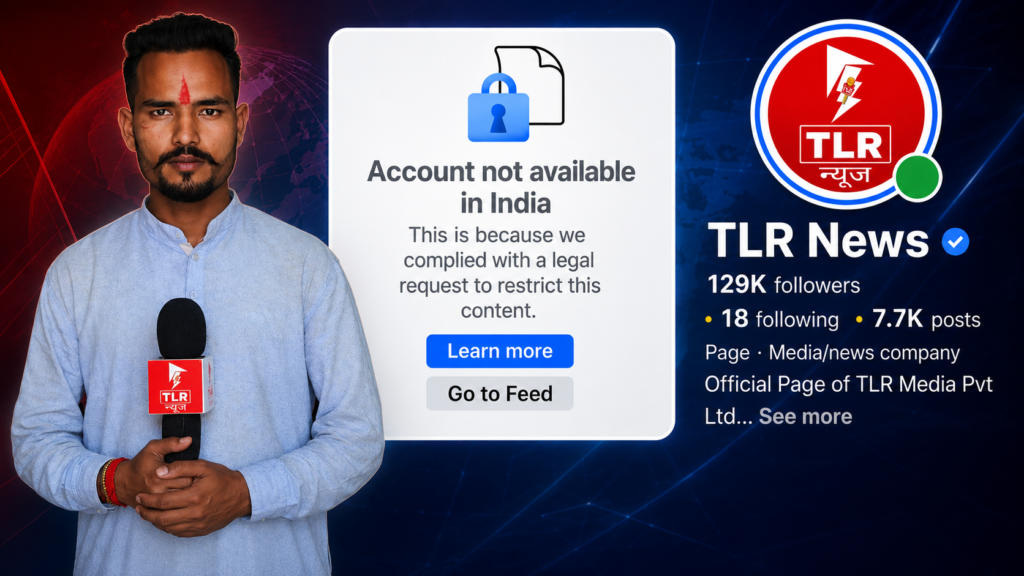
Doda, 29 May: Facebook has restricted access to the page of TLR News in India, citing compliance with a legal request to limit the content. Users attempting to view the page now encounter a message stating the account is “not available in India” due to the platform’s adherence to legal directives. The development comes shortly after police action against the news outlet’s editor, Sulinder Singh Parihar, also known as Sulinder Parihar Sarazi, in connection with an ongoing investigation in Doda district of Jammu and Kashmir.
TLR News, which describes itself as the official page of TLR Media Pvt Ltd, is a media and news company with over 129,000 followers. The page has been active in covering local issues, particularly in the Chenab region. Its sudden unavailability in India has raised questions about the balance between law enforcement requirements and the operations of registered digital news platforms.
Authorities at Doda Police Station issued a notice to Parihar under Section 35(3) of the Bharatiya Nagarik Suraksha Sanhita (BNSS) on May 28, 2026. The notice, bearing number 934/5-1/PSD and signed by Sub-Inspector Saddam Hussain, directs Parihar to appear before the investigating officer at 10 AM on May 29 at the police station. It relates to FIR No. 136/2026 registered on May 25, 2026, under multiple sections of the Bharatiya Nyaya Sanhita (BNS): 122, 197, 351(2), 352, 353, and 356.
The legal proceedings stem from a video report produced by Parihar concerning a protest against liquor sales that took place around May 8, 2026. According to police documents and related accounts, the report allegedly targeted Firdoos Ahmed, the Station House Officer (SHO) of Kishtwar. The FIR was lodged based on a complaint filed by Ahmed himself, following what authorities describe as a series of video-related controversies spanning several weeks.
These controversies reportedly involved an exchange of legal notices between Parihar and the police officer. The notice issued to Parihar outlines several conditions he must adhere to, including not tampering with evidence, refraining from making threats or inducements related to the case, cooperating fully with the investigation, and appearing in court as required. It also mandates truthful disclosure of facts and production of relevant documents. Failure to comply could result in arrest under relevant provisions of the BNSS.
As of the time of this reporting, Parihar has not been arrested. Police have instead opted to issue summons, directing him to present himself for questioning to ascertain facts and circumstances connected to the investigation. The notice emphasizes that reasonable grounds exist to question him in relation to the FIR.
The blocking of the TLR News Facebook page has drawn attention to the regulatory environment for digital media in India. As per details available with The Chenab Times, the outlet is registered under the Digital Media Guidelines of the Ministry of Information and Broadcasting, a status intended to formalize and legitimize online news operations. No separate official statement has been issued by authorities explaining the specific grounds for restricting the entire page, beyond the general legal compliance cited by the platform.
This incident occurs against a backdrop of heightened sensitivities around media coverage of law enforcement activities in Jammu and Kashmir. Protests against liquor sales, often rooted in local social and religious concerns, have periodically surfaced in various districts. Video reporting on such events can quickly amplify public discourse, sometimes leading to friction between journalists and officials.
Parihar, a resident of Malwana Gundana in Doda, has been associated with TLR News as its editor. The media company positions itself as a voice covering regional developments, with a significant following that suggests its influence in local information ecosystems. The current restrictions could potentially limit its reach to audiences within India, though the precise technical scope of the block remains unclear.
Legal experts note that platforms like Facebook routinely respond to government or court directives by geo-blocking content deemed violative of local laws. However, the application of such measures to an entire verified news page, rather than specific posts, has prompted discussion about proportionality and press freedoms. Supporters of the action argue that it aligns with accountability standards when content allegedly targets public servants in their official capacity, while critics question whether it sets a precedent that could affect other independent media outlets.
The Doda police notice explicitly lists expectations for cooperation, including assisting in the apprehension of any accomplices and preserving all evidence. It warns that non-compliance could lead to further legal consequences. Parihar has been instructed not to commit any offenses in the future and to join the investigation as and when required.
The sequence of events — from the initial protest coverage, through escalating video controversies and legal notices, to the registration of the FIR and subsequent page restriction — highlights the complex interplay between journalism, law enforcement, and digital regulation in the region. As the investigation proceeds, both the police and the media outlet face scrutiny over their respective roles.
At present, TLR News remains inaccessible via its primary Facebook page for users in India. Whether the restriction is temporary or linked directly to the outcome of the case against Parihar is yet to be clarified by either the platform or the authorities. The editor’s appearance before police on May 29 is expected to provide more clarity on the next steps in the investigation.
The Chenab Times will report further developments as and when collected.

Anzer Ayoob is the Founder and Chief Editor to The Chenab Times