


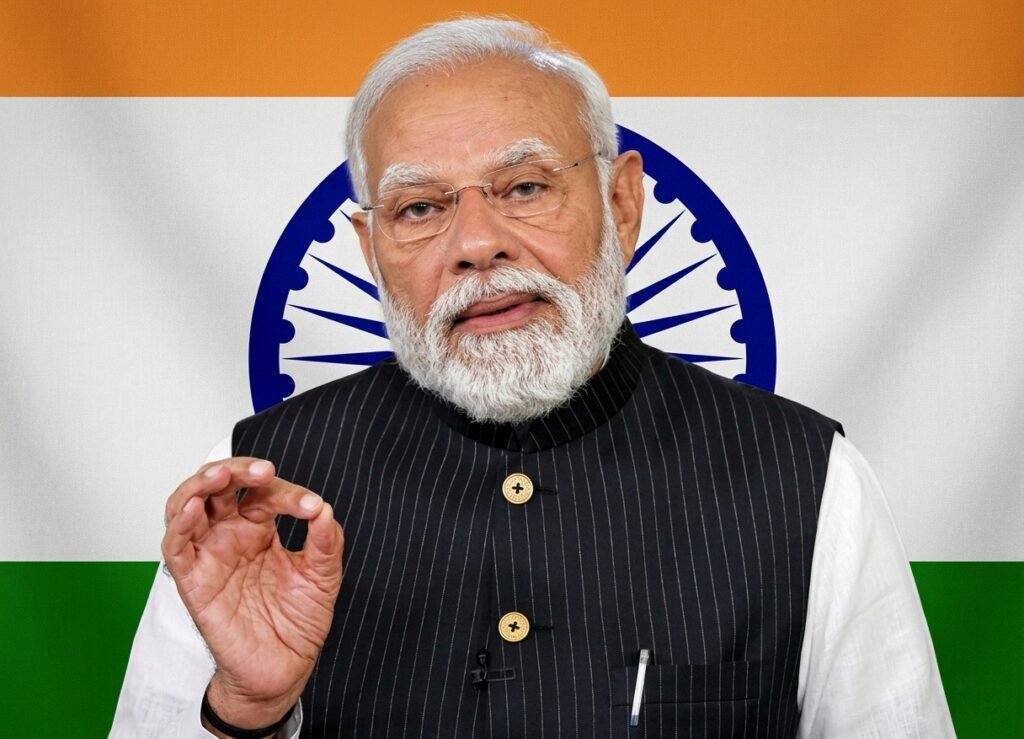
Prime Minister Narendra Modi has stated that women-led development is a fundamental element of India’s vision for a developed nation, or ‘Viksit Bharat’. He made these remarks while presiding over the 11th Governing Council Meeting of NITI Aayog in New Delhi.
Information was available with The Chenab Times that the Prime Minister highlighted India’s sustained growth trajectory amidst global economic uncertainties. He further emphasized that the nation’s demographic dividend represents a significant historic opportunity that must not be squandered. The Prime Minister also pointed to the establishment of free trade agreements with numerous countries as a means to foster new avenues for economic growth and bolster exports. He advocated for cooperation, dialogue, and shared understanding to guide interactions among the nation’s states.
The meeting saw the attendance of four newly sworn-in Chief Ministers: DK Shivakumar, Joseph Vijay, Suvendu Adhikari, and VD Satheesan. Prime Minister Modi took to the social media platform X to share his thoughts prior to the meeting, stating, “Chairing the 11th meeting of the Governing Council of NITI Aayog. Guided by the spirit of cooperative federalism, we are working together to accelerate India’s development journey. The collective efforts of the Centre and States will play a pivotal role in realising our shared vision of Viksit Bharat.”
The overarching theme for this year’s NITI Aayog Governing Council meeting was ‘Inclusive Human Development for Viksit Bharat @2047’. This theme aligns with the Prime Minister’s broader ‘Team India’ approach, focusing on the well-being and holistic development of every Indian citizen, irrespective of their age, region, gender, or socio-economic standing. The deliberations during the meeting were aimed at charting a course towards achieving this vision and translating it into tangible, measurable outcomes for all citizens.
According to an official statement, the discussions were structured to collectively develop an implementation roadmap. This roadmap is intended to leverage key enablers such as robust governance frameworks, digital public infrastructure, convergence of initiatives, strategic partnerships, and data-driven systems. A structured mechanism for tracking short, medium, and long-term outcomes was also a key agenda item, emphasizing accountability and measurable impact. A significant focus was placed on ensuring that the development visions of individual states are harmonized with the national vision for inclusive human development, thereby reinforcing a unified and collaborative approach towards equitable and sustainable economic growth.
In addition to these core agenda points, the Governing Council meeting also reviewed recommendations stemming from the 5th National Conference of Chief Secretaries, which convened in December 2025. That conference had previously delved into five critical thematic areas: early childhood education, school-level education, skill development, higher education, and the promotion of sports and extracurricular activities. The discussions at the NITI Aayog meeting were expected to build upon these foundational recommendations to accelerate progress across these vital sectors.
The NITI Aayog, established as the apex policy think tank of the Government of India, plays a crucial role in fostering a cooperative and competitive spirit among the states. Its Governing Council, comprising the Prime Minister, Chief Ministers of all states and union territories, and administrators of other union territories, serves as a platform for crucial policy discussions and strategic planning for national development. The meetings are instrumental in ensuring that national policies are aligned with regional needs and that states actively participate in the implementation of development initiatives.
The emphasis on cooperative federalism underscores the government’s commitment to a collaborative approach in governance. By bringing together central and state leadership, the meeting aimed to foster a shared sense of responsibility and ownership in achieving the ambitious goals set for Viksit Bharat by 2047. This approach is designed to ensure that development efforts are inclusive, effective, and sustainable, ultimately contributing to the overall progress and prosperity of the nation.
The discussions also touched upon the importance of data and digital infrastructure in driving development. Leveraging technology and data analytics is seen as crucial for evidence-based policymaking and for monitoring the progress of various schemes and initiatives. The integration of these elements is expected to enhance efficiency, transparency, and accountability in governance, further contributing to the realization of an inclusive and developed India.


The Chenab Times News Desk