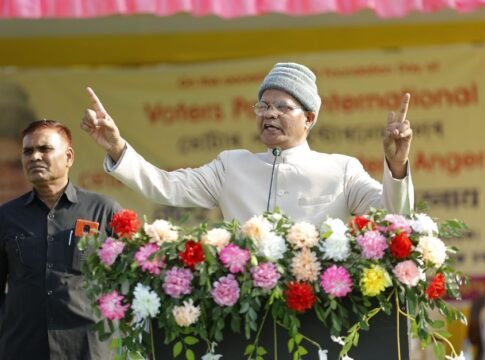
SRINAGAR: Environmental activist Dr. Raja Muzaffar Bhat has informed the National Green Tribunal (NGT) that the fragile Karewa landscape in Pulwama and Budgam districts of Jammu and Kashmir has been subjected to extensive illegal excavation of clay, sand, and bajri, amounting to an estimated 18 lakh metric tonnes. A joint committee constituted by the NGT has documented significant alteration of terrain in areas like Zadoora, Gowherpora, and Rangeen Kultreh, revealing a scale of environmental damage potentially far exceeding official records.
According to details received by The Chenab Times, Dr. Bhat, who is the petitioner in the case before the NGT, stated that out of the total estimated excavation, approximately 13,05,000 metric tonnes of material was extracted from Gowherpora and Rangeen Kultreh villages in Budgam, and around 5,00,000 metric tonnes from Zadoora village in Pulwama. He has called for the identification of government officials allegedly responsible for permitting or facilitating this large-scale illegal mining.
Joint Committee Documents Extensive Excavation
The NGT is currently hearing Original Application No. 93 of 2026 filed by Dr. Bhat against the Union Territory of Jammu and Kashmir and others. The case, which involves allegations of illegal mining in the ecologically sensitive Karewa formations, was recently listed for further proceedings on November 4. The joint committee’s report, prepared following an NGT order on February 6, 2026, details findings from site inspections conducted on April 7, 2026, in Zadoora (Pulwama) and Rangeen Kultreh and Gowherpora (Budgam).
The committee, comprising senior officials from the Ministry of Environment, Forest and Climate Change, the Central Pollution Control Board, the Jammu and Kashmir Pollution Control Committee (JKPCC), and the Deputy Commissioners of Budgam and Pulwama, was tasked with assessing the quantity of extracted material, identifying responsible parties, and examining environmental clearance status. Their mandate included examining records from Mining, Revenue, Pollution Control, and Horticulture departments.
Official Records and Discrepancies
At the Zadoora site, the committee observed extensive excavation of Karewa land. While the District Mineral Officer informed the committee that no lease or permission for large-scale commercial mining had been granted by the Mining Department, the report records approximately 2.996 lakh cubic metres of material excavated. Some of the excavation was attributed by officials to private landowners extracting soil from their holdings without following prescribed procedures, particularly during the period from 2019 onwards, which coincided with law-and-order challenges and the COVID-19 pandemic.
However, the report clarifies that the pandemic and security situation did not provide a blanket legal sanction for excavation. Disposal permits issued by the Tehsildar Pulwama from 2021 onwards covered around 51,272 cubic metres of material, with royalty and District Mineral Foundation Trust (DMFT) contributions collected. A significant portion of the excavation, particularly from 2019 to 2021, was noted to have occurred during periods of heightened restrictions.
Budgam Findings Highlight Regulatory Gaps
In Budgam, the committee examined records indicating substantial clay extraction at Kuzwera and Gowherpora, linked to the construction of the Qazigund-Baramulla railway line and the Srinagar semi-ring road project. The records showed 4,15,000 metric tonnes of clay extraction at Kuzwera and 8,90,000 metric tonnes at Gowherpora, totaling 13,05,000 metric tonnes. Payments totaling approximately Rs 3.33 crore were recorded under royalty, DMFT, and other heads.
While disposal permits were issued for some extraction, the committee raised a critical point: exemption from prior Environmental Clearance does not exempt project proponents from complying with other statutory and procedural conditions. The committee noted a lack of documentary evidence indicating that the J&K Pollution Control Committee had been informed at least 14 days before the commencement of mining, as required under Ministry of Environment, Forest and Climate Change (MoEF&CC) guidelines.
Furthermore, the report indicated that the Standard Operating Procedures for the extraction of ordinary earth had not been fully followed, including safeguards for topsoil preservation and slope stabilization. Enforcement actions in Budgam between April 1, 2021, and March 31, 2026, included 113 seizures of vehicles/machinery and the registration of 14 FIRs against habitual offenders.
Satellite Imagery Corroborates Long-Term Excavation
Independent analysis of high-resolution satellite imagery by the Department of Ecology, Environment and Remote Sensing provided a historical timeline of excavation expansion at both sites. At the Kultreh site, mining activity was visible in imagery from 2013-2014 and showed significant expansion by 2020-2022, with further enlargement observed up to 2025. At Zadoora, excavation was evident from as early as October 2011, with substantial expansion noted over the years, covering approximately 6.06 hectares by April 2025.
The satellite evidence suggests that excavation activity predated 2019 at both locations, contradicting the sole explanation of damage occurring only after Article 370 abrogation or during the COVID-19 lockdown. The ongoing expansion indicates a continued trend of extraction over the years.
Recommendations and Future Course
The joint committee recommended measures for restoration, including benching and terracing of excavated areas, retaining walls, erosion control, and drainage arrangements. It stressed the necessity of obtaining all required permissions and statutory clearances before future excavation and called for continuous vigilance by the Mining Department. The J&K Pollution Control Committee’s separate report corroborated findings of extensive excavation, use of heavy machinery, and lack of environmental safeguards at Gowherpora, noting that NKC Projects Pvt Ltd was involved in excavation without obtaining prior Environmental Clearance, an approved mining plan, or consent from the Pollution Control Committee.
Dr. Bhat has demanded environmental compensation from NKC Projects Pvt Ltd and called for a high-level investigation into the role of government officials. The NGT is expected to adjudicate on the precise quantities extracted, the legality of permissions, and the responsibility for the environmental damage in its upcoming hearings.
❤️ Support Independent Journalism
Your contribution keeps our reporting free, fearless, and accessible to everyone.
Or make a one-time donation
Secure via Razorpay • 12 monthly payments • Cancel anytime before next cycle


(We don't allow anyone to copy content. For Copyright or Use of Content related questions, visit here.)

The Chenab Times News Desk