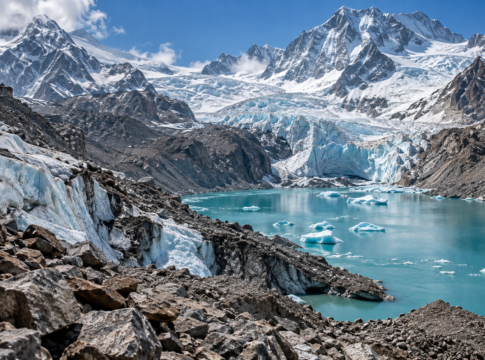
Srinagar, Sep 29: Jammu and Kashmir has identified 24 high-risk glacial lakes and is working to establish a real-time Glacial Lake Outburst Flood (GLOF) Early Warning System as concerns grow over the impact of climate change on the Himalayan region. The disclosure was made by the government in the Jammu and Kashmir Legislative Assembly in response to a question raised by National Conference MLA Tanvir Sadiq.
According to details received by The Chenab Times, the Department of Disaster Management, Relief, Rehabilitation and Reconstruction (DMRRR) informed the House that rising temperatures, accelerated glacier melting and the expansion of glacial lakes have increased the risk of GLOFs across the Union Territory, particularly in the districts of Kishtwar, Ganderbal, Kulgam and Anantnag.
The government said an assessment conducted by the University of Kashmir identified 616 glacial lakes across 12 districts, covering a total area of 28.62 square kilometres. Of these, 68 lakes were classified as Potentially Dangerous Glacial Lakes (PDGLs) based on criteria laid down by disaster management authorities.
Officials informed the Assembly that a dedicated Core Committee was constituted through Government Order No. 71-JK(DMRRR) dated September 24, 2024, to focus on studies and mitigation measures related to high-risk glacial lakes. The 24 most vulnerable lakes have been categorised into A, B and C groups using 17 different risk parameters.
The government further stated that the National Remote Sensing Centre has mapped 546 glacial lakes measuring 0.25 hectares or more. Various agencies, including the Central Water Commission, Swiss Agency for Development and Cooperation (SDC) and Indian Institutes of Technology (IITs), have also assessed vulnerable lakes such as Gangabal, Kousar Nag, Harnag, Mundiksar, Hangu Lake, Boudsar and Sheshnag.
The Assembly was informed that a previous University of Kashmir study examining 155 glacial lakes in the Kashmir Himalaya found five lakes—Bramsar, Chirsar, Nundkol, Gangabal and Bhagsar—to have very high susceptibility to GLOFs. The study estimated that a potential outburst could affect around 2,704 buildings, nearly 15 major bridges, roads and a hydropower project downstream.
To strengthen monitoring and preparedness, the government said the Centre for Development of Advanced Computing (C-DAC) has been nominated as the Lead Technical Agency for designing and implementing an indigenous GIS-based GLOF Early Warning System. A Memorandum of Agreement between the government and C-DAC is currently under process.
The proposed warning system will include water-level monitoring sensor buoys with satellite communication, Automatic Weather Stations equipped with temperature, humidity, wind and snow-depth sensors, and Glacial Lake Vision Units featuring camera modules and deformation-detection technology. A dedicated web portal and Spatial Decision Support System will be developed to enable real-time monitoring and dissemination of alerts.
The government also informed the House that a Focused GLOF Monitoring Committee, headed by the Principal Secretary, Home Department, was constituted through Government Order No. 930-JK(GAD) of 2024 dated April 4, 2024. The committee has been tasked with overseeing glacial lake surveillance, satellite monitoring, field expeditions and mitigation measures.
Officials said the committee has held five meetings since its formation. During these meetings, it reviewed aerial reconnaissance proposals along the Shri Amarnath Ji Yatra routes, standardised categorisation of vulnerable lakes, finalised risk assessment criteria and discussed involvement of agencies such as SDRF, ITBP, Civil Defence and AapdaMitra volunteers in monitoring and emergency response activities.
The government further stated that district authorities have been directed to prepare district-specific GLOF Action Plans, map vulnerable downstream settlements and critical infrastructure, identify safe evacuation locations and conduct regular mock drills. Coordination has also been initiated with ITBP and Armed Forces outposts near high-risk lakes to establish manual early-warning networks for downstream communities.
The government said awareness campaigns on GLOF preparedness and evacuation protocols are being conducted through Panchayati Raj Institutions and local communities, while Disaster Management Authorities continue to strengthen preparedness measures in vulnerable areas across Jammu and Kashmir.
❤️ Support Independent Journalism
Your contribution keeps our reporting free, fearless, and accessible to everyone.
Or make a one-time donation
Secure via Razorpay • 12 monthly payments • Cancel anytime before next cycle


(We don't allow anyone to copy content. For Copyright or Use of Content related questions, visit here.)

The Chenab Times News Desk