


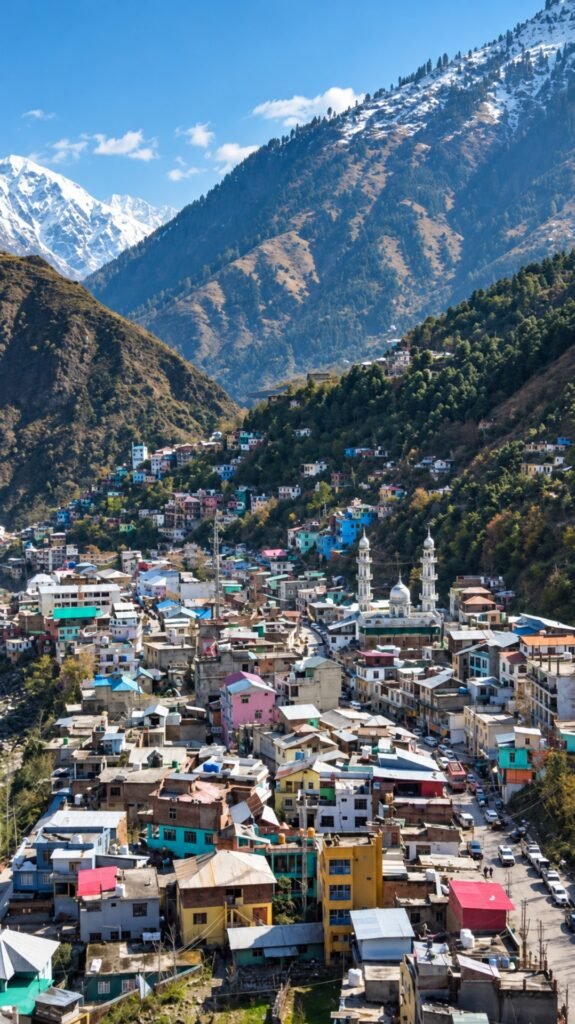
From above, Thathri looks like a picturesque mountain town, with the Chenab flowing through the valley, houses and markets spread along its banks, and steep mountains rising on either side. But this beautiful landscape also raises an important question: What could happen to Thathri if the area faces an extreme flood, cloudburst or prolonged spell of heavy rainfall in the years ahead?
Thathri’s geography makes it vulnerable to several interconnected hazards, including flash floods, landslides, debris flows, riverbank erosion and sudden rises in the Chenab’s water level. The danger does not necessarily have to originate from the river itself. Intense rainfall in the upper reaches of the surrounding mountains can rapidly send water, mud, rocks and boulders through streams and natural drainage channels towards the town. Such an event could inundate houses and commercial areas near the river while damaging roads, bridges and other infrastructure.
This concern is not merely theoretical. Thathri has already witnessed the consequences of intense rainfall, flash flooding and mudslides. During the July 2026 episode, flooding and debris affected houses, vehicles and road connectivity, while the Doda–Kishtwar highway was also disrupted. The District Doda administration identifies floods, flash floods, landslides and cloudbursts among the hazards facing the district, underscoring the need for preparedness in vulnerable areas.
The greater concern is what could happen if several hazards occur simultaneously. Extreme rainfall could trigger landslides and debris flows, raise the Chenab’s water level, erode riverbanks and damage roads and bridges. If electricity, communication and drinking-water systems were disrupted as well, a flood could quickly escalate into a wider emergency. In a narrow mountain settlement such as Thathri, blocked roads could make evacuation and the movement of rescue teams significantly more difficult.
Amid these risks, an important development has emerged. The demand for a Chenab River Protection Corridor (CRPC) at Thathri has progressed from a public demand to departmental examination. Civil Society Thathri raised the issue during a public meeting on 19 September 2026, seeking protection for the town and adjoining areas against riverbank erosion, flooding and other disaster-related risks. Following a formal representation, the Office of the Deputy Commissioner, Doda, forwarded the matter to the concerned departments for examination and necessary action.
On 28 September 2026, a team from the Irrigation and Flood Control (I&FC) Department, Bhaderwah, visited Thathri and conducted a site inspection. The team also interacted with members of Civil Society Thathri to understand local concerns and requirements.
According to Civil Society Thathri, the officials assured them that a detailed report and a Detailed Project Report (DPR) would be prepared within one week and submitted to the competent authorities for consideration, sanction and further execution. The officials also acknowledged the recurring threat posed by the Chenab and indicated that the matter would be processed on priority.
The proposed CRPC could therefore become an important step towards strengthening Thathri’s long-term protection against riverbank erosion and flood-related risks. However, until the proposal receives the necessary approvals and progresses towards implementation, the town will remain exposed to the hazards associated with its geography.
Alongside structural protection, Thathri needs detailed flood and landslide risk mapping, effective early-warning systems, improved drainage, protection of vulnerable slopes and riverbanks, clearly identified evacuation routes, and regular disaster-management exercises. These measures are essential to reduce risks, protect lives and improve the town’s capacity to respond to extreme weather events.
Thathri’s beauty and vulnerability stem from the same geography. The Chenab is the lifeline of the valley, but during an extreme weather event, the river and surrounding mountains can also become sources of immense danger. The proposed protection corridor offers a potential path towards greater safety, but effective planning, timely approvals and implementation will ultimately determine how well the town is prepared for the future.
The question is not whether every spell of heavy rainfall will cause a disaster, but whether Thathri will be prepared when an exceptionally severe event strikes.

