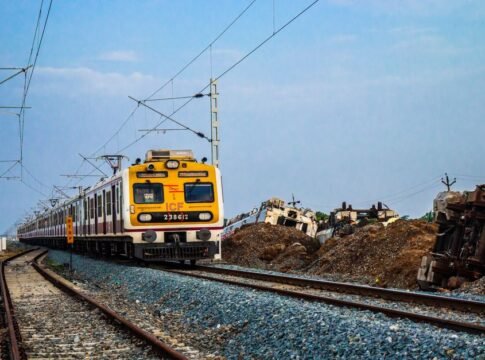
More than four years after the Bengaluru Suburban Rail Project (BSRP) received official approval, the ambitious network continues to grapple with significant land acquisition challenges, with only one of its four planned corridors having fully completed the process. The project, a critical component of the city’s urban transportation infrastructure, has seen substantial delays attributed primarily to the protracted acquisition of private and state government land.
According to a recent statement by the Union government in the Lok Sabha, only one corridor has achieved full land acquisition. Another key corridor, designated as Corridor-4, which aims to connect Heelalige and Rajanukunte over a distance of 46.25 km, has acquired merely 7.8 acres of the 57 acres it requires. This ongoing bottleneck has severely impacted the overall timeline for the ₹15,767-crore project, which aims to create a 148.17-km network designed to significantly alleviate traffic congestion in India’s Silicon Valley.
Progress and Stumbling Blocks Across Corridors
The implementation of the BSRP is being managed by the Rail Infrastructure Development Company (Karnataka) Limited (K-RIDE), a joint venture where the Karnataka state government holds a 51% stake. The project’s funding model comprises a 20% contribution each from the Union and State governments, with the remaining 60% to be raised through debt financing. To date, an expenditure of ₹2,659 crore has been recorded for the project, underscoring the substantial investment already made.
Among the four corridors, Corridor-2, known as the ‘Mallige’ line, connecting Baiyyappanahalli and Chikkabanavara over 25.01 km, has demonstrated the most progress. The government has indicated that land acquisition for this corridor is complete. Separate contracts for station buildings have been awarded, and construction activities are underway. Tenders for the remaining works are also in progress.
Corridor-1, the ‘Sampige’ line, stretching 41.4 km from KSR Bengaluru city to Devanahalli, has seen its alignment plans approved, with land acquisition currently in progress. Essential utility shifting, including signalling and telecommunication infrastructure, has also commenced. A similar status applies to Corridor-3, the ‘Parijaata’ line, a 35.52-km route connecting Kengeri and Whitefield. Alignment approvals are in place, and land acquisition and utility shifting operations are ongoing.
However, Corridor-4, the ‘Kanaka’ line, connecting Heelalige and Rajanukunte, remains the slowest to progress. Despite contracts for station buildings being awarded and construction commencing on available land, the overall land acquisition for this vital stretch is significantly behind schedule. This has led to reports of contractors like L&T halting activities due to the protracted delays and considering withdrawal from contracts, demanding compensation for incurred losses.
Addressing the Delays
The Union government has highlighted that the delays are mainly due to pending land acquisition and the transfer of State government land by the Government of Karnataka. Regular coordination meetings are reportedly being held between K-RIDE and the Railways to address these pending issues and expedite the project’s implementation. The absence of a full-time Managing Director at K-RIDE in the past was also cited as a factor impacting progress, although a full-time MD has now been appointed.
Despite these challenges, K-RIDE has been actively working on relocating utilities and acquiring private land for Corridor-4. Agreements have been reached for the transfer of railway land, such as the recent handover of 115.472 acres by the South Western Railway (SWR) for the Kanaka Corridor, facilitating some groundwork. Efforts are also underway to consolidate alignments with the Namma Metro at Benniganahalli, creating a shared 500-meter corridor to reduce capital expenditure and urban disruption.
While initial deadlines for the project, particularly for priority corridors, were set for 2026, revised timelines now suggest phased rollouts extending to 2028, 2029, and even 2030 for some lines. The successful completion of the Bengaluru Suburban Rail Project is anticipated to revolutionize urban mobility, connecting key employment hubs, the international airport, and various suburban areas, thereby offering a significant respite from the city’s notorious traffic congestion.
❤️ Support Independent Journalism
Your contribution keeps our reporting free, fearless, and accessible to everyone.
Or make a one-time donation
Secure via Razorpay • 12 monthly payments • Cancel anytime before next cycle


(We don't allow anyone to copy content. For Copyright or Use of Content related questions, visit here.)

The Chenab Times News Desk