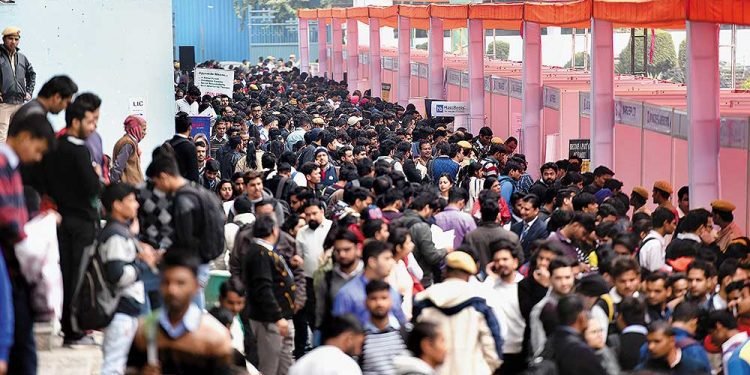
We are living in an era which is hugely materialistic and is oriented towards materialism. A vast majority of people study to gain materialistic benefits instead of helping the society grow and move towards development. This has made the circle of employment restricted and a plethora of people remain bereft of earning in a nice manner – and they opt for works that do not suit their qualifications. Corruption is yet another problem in securing nice jobs.
Unemployment is a major problem that the youth is facing today and provided with the hike in markets; they feel alienated and depressed. The more we move forward with this similar system of “competition-career-driven-materialistic” approaches, we develop a grave area of unemployment. The unemployment crisis has made youngsters to take bad steps such as doing suicides or turning towards drugs. Such grave issues must be addressed by the government and private institutions both. If these things remain unaddressed, there are less possibilities to fight the mental issues like depression, as it is mostly caused by financial instabilities.
There are institutions that tend to address the unemployment crisis both from the public and private sector. However, it is seen that people who have studied much usually get to occupy these posts. A vast majority of deserving remain bereft of these “few-vacancy based jobs”, because the vacancies are too little, and every other person appears to be the deserving one. There need to be efforts that help to bridge these gaps and assist the youth that has not studied beyond what is required for the governmental and private sector vacancies. For example, let us investigate the life and works of boys and girls who drop their studies post intermediate because of certain restrictions but to help themselves financially, they sit in the medical shops and nicely learn all of the basic stuff around first aid. They acquire the foundational knowledge of the first aid just by accompanying and working with experienced medical doctors. There exist two types of people among these, the first those who are nicely experienced and the second those who always bring the problems. In the regional language, they are called jhholachhaps, a title which brings bad name to both of these groups, put together. In order to prevent the damage caused by the later group, it is cardinal for both the public and private sector that they establish institutions that would give certificates to desired and qualified ones, and thus stopping the jhholachhaps from gaming the system. These institutions would help contribute in fighting issues around the primary health, in the whole country.
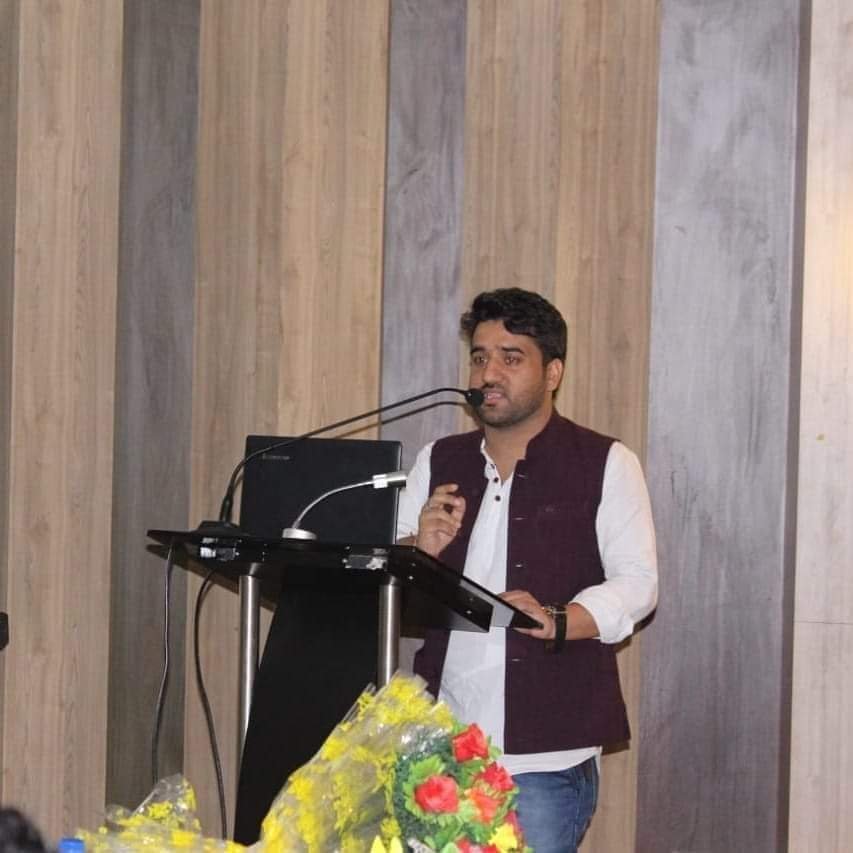
We do not find any such example in the public sector; like an institute established to prepare a bulk of first aiders, if searched, is not found anywhere. We do find, however, Dr Shabab Aalam, an educationist by profession, who hails from Muzaffarnagar, has established the First Aid Council of India. Dr Shabab Aalam, aged around 37, and conferred with awards such as the Meezan Taleemi Khidmaat Award of 2017; is a man of mild temperature. He received his education at the CCS University in Meerut. Interested in physics, educated in geography, Dr Aalam has a vast knowledge of the Hindi language and literature. He has written a number of poems in Hindi. He claims to have studied a part of poetry with Nawaz Deobandi, a famous Urdu-poet hailing from the famous town of Deoband.
Dr Aalam regards the founder of Aligarh Muslim University, Syed Ahmad Khan, as his role model. He started several institutions to help promote education in the villages and far remote areas. He believes that education is one of the basic requirements of each and every citizen and no one should remain bereft of it. To begin with, he is a proponent of distance education, and thinks this can be effective if carried with a correct approach. Distance education can help in erasing poverty from villages and rural areas. It is often seen, arguably, that there is scarcity of education in village areas and most of the people only able to complete their middle studies, or to some extent cross the matriculation border. Dr Aalam, through his GMVSS, the Grameen Mukt Vidhyalayi Shiksha Sanstha, tries to address this. The institute of GMVSS is headquartered in Shahdara and has so far distributed several thousand certificates to students for passing matriculation and the intermediate exams. A plethora of such students are doing well in their respective fields.
In 2017, Dr Aalam established the First Aid Council of India, which happens to be an autonomous body. This too is headquartered in Delhi, likewise the GMVSS. Aalam has before him the reality that there is scarcity of doctors throughout the country, and more than that, there is scarcity of first aiders. First aid is the necessary and major requirement that every sick person needs before they are visited by a doctor. To help address this, he established the First Aid Council of India; which besides promoting the knowledge of first aid, helps youngsters to make a nice earning. The students enrolled in various programs are required to do an internship with a qualified doctor, before getting a certificate from the institute.
First Aid Council of India began doing its courses in 2017, the same year it was recognized. In 2020, it entered into agreement with several public and private universities in India to promote the first aid education. The institute of FACI is reportedly based on the Indian PM Modi’s idea of Aatmanirbhar Bharat. If investigated deeply, the FACI is a vital step, and possibly it could help solve several issues, associated with the primary health system and employment. The best of its contributions is, nonetheless, the assistance provided to desired students who have been labelled as “jhholachhaps” but who are not anything such.
❤️ Support Independent Journalism
Your contribution keeps our reporting free, fearless, and accessible to everyone.
Or make a one-time donation
Secure via Razorpay • 12 monthly payments • Cancel anytime before next cycle


(We don't allow anyone to copy content. For Copyright or Use of Content related questions, visit here.)

The author is an alumna of the Kashmir University and is currently enrolled at the Jamia Zainab, Lusaka.