


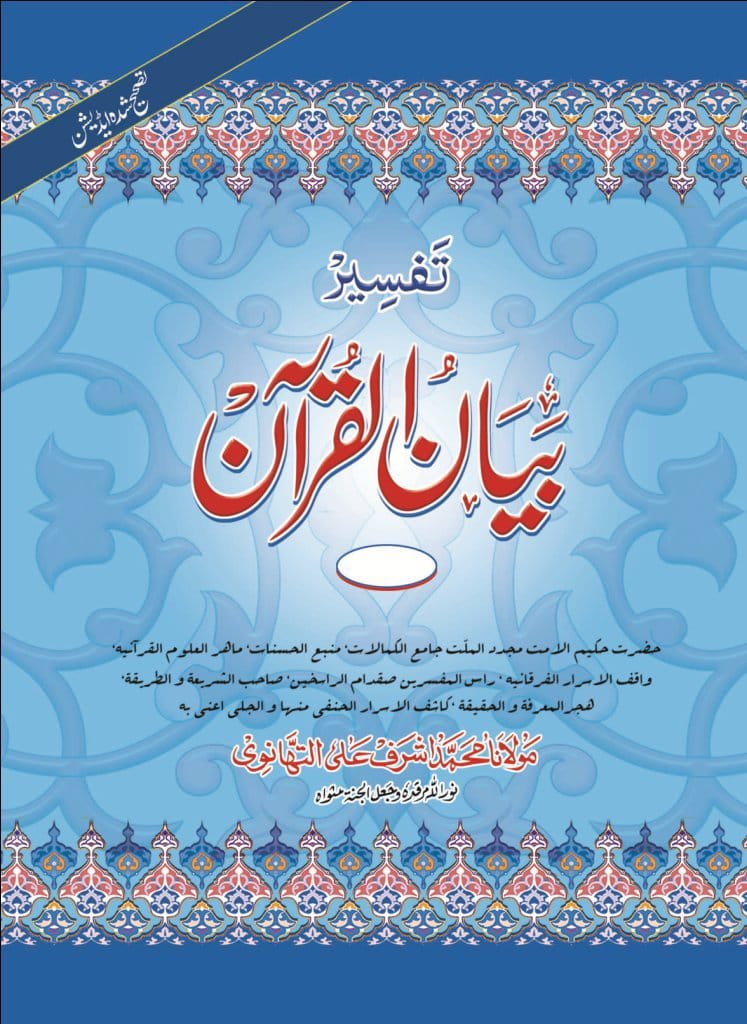

Mawlāna Asḥraf Ali Thānwī, commonly known as Hakīm al-Ummah among his followers, was a known Sufi scholar of recent past. A disciple of Hadḥrat Hāji Imdādullāh, he himself became an authoritative ‘shaykh’ of the Chisḥti branch of Sufism. He had his ‘khānqāh’ in Thāna Bhawan, located now in the Shamli district, nearby Muzaffarnagar, in India. This khānqāh, or better as the ‘spiritual training center’ was the central place during the 1857 freedom struggle against the British imperialism. This khānqāh had been desecrated during the struggle, and Thānwī later re-established it.
Thānwī was a prolific author, and wrote extensively, and being the spiritual mentor of the scholars associated with him, he would give lectures all around – “his successors collected and compiled his lectures”.
Altogether, the works he wrote, and the works compiled by his disciples; his literary works count around eight hundred and more. His most famous works, however, are two, the tafsīr “Bayān al-Qur’ān” and the Hanafi fiqh manual, “Beheshti Zewar”. The latter is translated and annotated by Barbara D Metcalf as “Perfecting Women”.
Concerning his works in the field of tafsīr, his disciples wrote different exegesis of the Qur’ān at his request. The famous tafsīr “Ma’ārif al-Qur’ān” which Mufti Muḥammad Shafi’ wrote in 8 volumes and another “Ma’ārif al-Qur’ān” which Mawlāna Idrīs Kāndhlawī wrote in 8 volumes, is all due to Thānwī. The tafsīr works of Mawlāna Jamīl Aḥmad also have a due credit to Thānwī. The “Tafsīr-e-Mājidi” was also written by Thānwī i’s disciple Mawlāna Abd al-Mājid Daryabādi.
Since Thānwi was a Sufi mentor, he mentored numerous scholars. His famous disciples include Mawlānā Abd al-Mājid Daryābādi, Muftī Muḥammad Shafi’, Shāh Abd al-Ghani Phūlpūrī, Mawlānā Abrār al-Haq Haqqī, Mawlānā Sayyid Sulaimān Nadwī, Mawlāna Idrīs Kāndhlawī, Qārī Muḥammad Tayyib Qāsmī, Murtazā Ḥasan Chāndpūrī, Dr Abd al-Hayy Ārifī and Azīz al-Hasan Ghourī Majzūb.
BIOGRAPHICAL SKETCH
Mawlānā Thānwī was born in 1862 in Thana Bhawan. He completed his early studies in Meerut where he studied the primary books of Persian, and memorized the Holy Qur’ān with Hāfiz Hussayn Ali Dehlawī. Thereafter, he moved to Thana Bhawan where he studied the primary books of Arabic and middle books of Persian with Mawlānā Fateḥ Muḥammad. He entered the Deoband seminary in 1295 AH and graduated in 1301 AH. His most prominent teachers included Mawlānā Muḥammad Yāqūb Nanautawī, Mawlāna Manfa’at Alī and Shaykh al-Hind Mawlānā Maḥmud Ḥasan Deobandī.
Graduating from the Deoband seminary, Thānwī began teaching in Kanpur at the Madrasa Faiz-e-Aam, and resigned briefly. A new “dars-e-nizāmi tuned madrasa” was set-up, called “The Jāmi al-Ulūm”, in the Patkapur area, especially for Thānwī He taught religious sciences in Kanpur for some fourteen years, and upon the instruction, rather order of his peer Hājī Imdādullāh, he returned to Thana Bhawan, where the khanqāh of Imdādullāh was located. Thānwī is credited to have re-established this khānqah. The khānqah is still existing, and runs a madrasa alongside it, altogether looked after by Najm al-Hasan Thānwī. Ghouri, a famous disciple of Thānwī would say regarding this khānqāh that,
jahān hogi barkat wo hogi yahīN ki,
zarūrat hi kya hai phir kisī jānashīN ki.
yahān rehte thy qutb-e-irshād-e-ālam,
ye thī tarbiyyat-gāh rū-e-zamīN ki
Mawlāna Asīr Adrawī, a contemporary historian of the Deobandi movement, who is known to have written biographies of Mawlānā Qāsim Nanautawī , Mawlānā Rashīd Ahmad Gangohī, Mawlānā Ḥussain Aḥmad Madanī, Mawlānā Imāmuddīn Punjābī and several others, has mentioned in his famous “Karwān-e-Rafta” that,
“Writing was everything; Thānwī would do, in the day and in the night. His booklets and books altogether are about 877, and 345 are his regular works. His anecdotes/statements have been compiled in 321 books; the “Tashīlāt” are 211 in number. Thānwī wrote a translation of Holy Qur’ān which was published in high numbers. He wrote the scholarly exegesis of Qur’ān, known as the “Bayan al-Qur’ān”.
Mawlāna Thānwī died in 1943 and is buried in Thana Bhawan. A ten-volume biographical encyclopaedia containing details of Thānwi and his successors has been published in Pakistan as “Karwān Mujaddid-e-Thānwi”.
THĀNWĪ’s QUR’ĀNIC WORKS
Hakīm al-Ummah Mawlānā Thānwī was famous as such a reformer who would not tolerate anything wrong. He wrote the book “Aghlāt al-Awām” to let the people get rid of famous desi made-up false facts. He extensively spoke and wrote against innovations in Dīn. Mawlānā Daryābadī mentions that,
“I have seen numerous elders in my life, and heard about various others in such a detail, as if I have seen them as well; I have seen those who pray a lot……. a number of whom; would be those who have the quality of performing extraordinary things (karāmāt)…. But the reformer, mentor, the corrector, and the great at upbringing; I could not find any one next to Hadḥrat Thānwī, nor did I hear anyone”.
On the subject of Qur’ānics, Thānwī wrote a numbers of works. Some people published translations of Qur’ān which Thānwi thought to be wrong. He wrote corrections to these, like “Islāh Tarjumah Hairat” and “Islāh Tarjumah Dehlawi”. Syed Shāhid Alī while mentioning the reasons of Thānwī’s authoring the “Bayān al-Qur’ān” comments that, “the translations Thānwī has pointed out to be not satisfactory include the translations by Deputy Nazīr Aḥmad, Mirza Hairat Dehlawī and Sir Syed Aḥmad Khān”.
ThānwĪ’s books on Qur’ānics include Jamāl al-Qur’an, Tajwīd al-Qur’an, Raf’ al-Khilāf fī Hukm il-Awqāf, Wujūh al-Misāli, Tanshīt al-Tab’ fī Ijrā il-Sab’, Ziyādāt alā kutub al-Riwāyāt, Yādgār-Haqq-ul-Qur’ān, Mutashābihāt al-Qur’ān li tarāwīh Ramadān, Ādāb al-Qur’ān, Islāh Tarjumah Dihlwiyah, Islāh Tarjuma-e-Hairat, al-Taqsīr fi al-Tafsīr, Raf’ al-Binā fī Naf’ il-Samā, Ahkām al-Qur’ān, Taswīr al-Muqatta’āt and the famous tafsīr Bayān al-Qur’an.
Shah Rafīuddīn had written a translation of Qur’ān, which according to Sayyid Sulaimān Nadwī, “was one of the accurate translations of Qur’ān, but it was difficult and no one could easily understand it. Mawlāna Thānwi took this around in such a way and gave its access to everyone”. The tafsīr “Bayān al-Qur’ān” first appeared in twelve volumes during 1908. Syed Shāhid Alī mentions that, “Thānwī completed writing this translation and exegesis in 1905. It was first published in 1908 by the Matba’a Mujtabā’ī in Delhi in twelve volumes”. Shāhid Ali has consulted the 1353 AH edition, which has twelve volumes; each volume has the exegesis of two and a half part of the Qur’ān. Its publisher is Idāra Tafsīr al-Qur’ān, Delhi”.
“Thānwī did not delve into Hadīth scholarship. He left that department to other eminent contemporaries such as Mawlānā Anwar Shah Kashmirī, but his Qur’ān exegesis, Bayān al-Qur’ān, has no parallel, even if it is dense and somewhat difficult to read. One contemporary of mine in Deoband, a brilliant student with a penetrating mind – Maulavi Talha – had this witty-off-the-cuff reply to my observation that Bayān al-Qur’ān should be translated into English: ‘It should be translated into Urdu first!’ It is, of course in Urdu, but Talha’s point was taken”.
JOHN MUḤAMMAD BUTT STATES
According to Syed Anwar Alī, “As a commentary it is exhaustive of all aspects of tafsīr, Bayān al-Qur’ān is yet another famous commentary written in Urdu by Mawlānā Ashraf Ali Thānwī of Deoband.
Thānwī’s translation is literal. He has avoided the usage of idioms. The tafsīr has translation of Qur’ānic verses just below the Arabic verses, and the rest of the page contains tafsīr notes. Mawlānā Thānwī has written the translation twice, first below the verses, and the second time in the tafsīr section.
The works used by Thānwī while writing this tafsīr include Baizāwī, Jalālayn, Tafsīr-e-Rahmāni, Ma’ālim al-Tanzīl, Rūh al-Ma’ānī, Tafsīr Fath al-Mannān, Tafsīr Ibn Kathīr, Durr Mansūr, Kashhāf and others. He consults the books of hadīth and fiqh as well. These books include Sahīh Bukhārī, Sahīh Muslim, Abu Dāwūd, Tirmidhī, Ibn Mājah, Musnad Aḥmad, Nasa’ī and Durr-e-Mukhtār.
Mawlānā Thānwī has tried to keep his tafsīr short, and doesn’t write things in much detail. He also relies on the reports of his predecessors rather than doing exaggeration from his own mind. He has avoided detailed explanations; he doesn’t mention historical incidents in detail but wherever necessary he refers his readers to the tafsīr of Mawlānā Abd al-Haqq Haqqānī. His tafsīr stands alone as the first tafsīr where the issues related to Tasawwuf have been extracted from the Qur’ān. In the footnotes, Thānwī has managed to add Qir’at related section called “al-Balāghah”, where he writes only for scholars, in Arabic. There he mentions the differences of pronunciation of Qur’ānic words. This shows his scholarly understanding of the differences within the ‘qirat’.
❤️ Support Independent Journalism
Your contribution keeps our reporting free, fearless, and accessible to everyone.
Or make a one-time donation
Secure via Razorpay • 12 monthly payments • Cancel anytime before next cycle


(We don't allow anyone to copy content. For Copyright or Use of Content related questions, visit here.)

The author is a biographical researcher and scholar… Read More