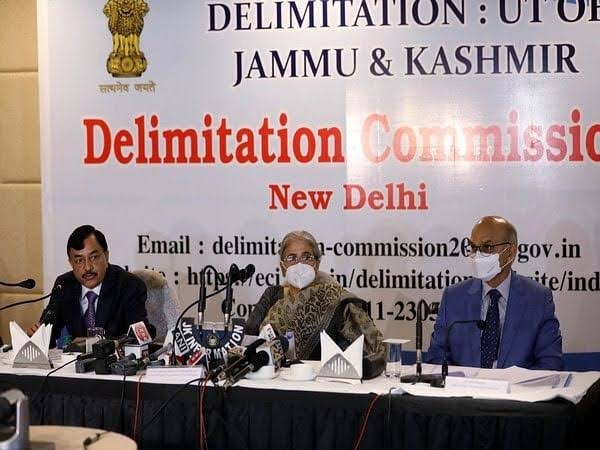
The Jammu and Kashmir Delimitation Commission today finalised its proposals and published them in the Indian and Jammu and Kashmir Gazettes, asking objections and comments till 5 p.m. on March 21. The Commission has announced that it will hold public hearings in Jammu and Kashmir on March 28 and 29.
The number of Lok Sabha seats in Jammu and Kashmir was not increased by the Commission. It also did not set aside any Parliamentary seats for Scheduled Castes (SCs) and Scheduled Tribes (STs) (STs). In the Legislative Assembly, however, it reserved seven seats for SCs and nine seats for STs.
Justice (Retired) Ranjana Prakash Desai heads the Commission, which also includes Chief Election Commissioner (CEC) Sushil Chandra and State Election Commissioner (SEC) KK Sharma.
Along with the findings, the Commission included two extensive dissenting notes signed by all three National Conference Lok Sabha MPs—Dr Farooq Abdullah, Mohammad Akbar Lone, and Hasnain Masoodi—and Jugal Kishore Sharma, BJP MP. All of them are Commission Associate Members. Dr. Jitendra Singh, Union Minister of State in the Prime Minister’s Office (PMO), is the fifth Associate Member.
Jugal Kishore’s dissent note pertained to naming of Bahu Assembly segment as Bahu Lochan, Jammu East as Jammu Tawi, Jammu North as Muthi-Domana and Darhal as Budhal, inclusion of Maira Mandarian and Chowki Choura areas in Akhnoor constituency instead of Khour, addition of Pargwal in Khour instead of Akhnoor, inclusion of Katli in Samba segment instead of Ramgarh and exclusion of Rajpura from Ramgarh and its inclusion in Samba seat. The disagreement comment was included in the report because the Commission did not adopt these ideas.
The National Conference’s joint dissent note addressed various Assembly constituencies as well as the Panel’s very formation, which is still awaiting a Supreme Court decision on the Jammu and Kashmir Reorganization Act.
The Commission stated that the number of Parliamentary seats in Jammu and Kashmir shall remain at five. Both the Kashmir and Jammu divisions now have two Lok Sabha seats apiece, with one seat shared between the two. Jammu-Reasi and Udhampur-Doda constituencies exist in Jammu, whereas Srinagar-Budgam and Baramulla-Kupwara exist in Kashmir. Both divisions include the seat of Anantnag-Poonch.
According to the Commission, no Parliamentary constituency has been set aside for Scheduled Castes and Tribes.
It goes on to say that Jammu and Kashmir will have a 90-seat Assembly, with seven seats set aside for SCs and nine for STs.
The statement said the Commission has published in the Gazette of India, Extraordinary and in the Union Territory of Jammu and Kashmir, its proposals for the delimitation of Parliamentary and Assembly constituencies in the UT of Jammu and Kashmir for the purpose of elections to House of People (Lok Sabha) and Legislative Assembly.
“Copies of the Gazette are available for reference with the Chief Electoral Officer, UT of Jammu and Kashmir and the Election officials in all districts of the Union Territory. Objections and suggestions to the peoples can be given to the Secretary, Delimitation Commission, Ashoka Hotel, 50-B, Niti Marg, Chankyapuri, New Delhi on or before 5 pm on March 21,” the statement said.
It added that the suggestions will be considered by the Commission in its public sitting in Jammu and Kashmir on March 28 and 29, the location and timing of which will be notified separately.
Nine seats reserved for STs include Rajouri, Darhal and Thanna Mandi, all in Rajouri district, Surankote and Mendhar in Poonch district and Mahore in Reasi district (Jammu region); Gurez in Bandipora district, Kangan in Ganderbal district and Kokernag in Anantnag district (Kashmir division).
All seven seats reserved for SCs fall in Jammu region including Ramnagar in Udhampur district, Kathua South in Kathua district, Ramgarh in Samba district; , Bishnah, Suchetgarh, Marh and Akhnoor in Jammu district.
During the process of delimitation of Assembly seats, only BJP and NC were entitled to submit objections/suggestions as the two parties have five Lok Sabha MPs in Jammu and Kashmir, who were Associate Members of the Commission. However, with the Panel now putting its proposal in public domain, anyone can file the objections which have to be either accepted or rejected by the Commission before submission of final report.
The Commission has its term till May 6 and there was a possibility that it might submit final report within the timeline.
The Panel was set up on May 6, 2020 with one-year term which was extended by another year on May 6, 2021. While its term was due to expire on May 6, 2022, it was granted two-month extension to complete the task.
Once the delimitation exercise is completed, the number of Assembly seats in Jammu and Kashmir will go up from 83 to 90.
Twenty-four seats of the Assembly continue to remain vacant as they fall under Pakistan administered Jammu Kashmir (PaJK).
While splitting Jammu and Kashmir into two Union Territories through the Reorganization Act, the Union Home Ministry had increased Assembly seats of Jammu and Kashmir by seven taking total seats to 114-24 of which are reserved for PoJK while election will be held for 90 seats.
Erstwhile State of Jammu and Kashmir had 111 seats including 24 reserved for PoJK while elections were held for 87 seats. With creation of Ladakh as Union Territory, four seats of the region were reduced and the Assembly was left with 83 seats. However, with increase of seven seats, J&K UT will have an Assembly of 90 seats. Two women MLAs will be nominated to the House, which was the position earlier also.
In the previous Assembly, Kashmir had 46 seats, Jammu 37 and Ladakh four. Delimitation of the Assembly constituencies was last held in 1994-95 during the President’s Rule when seats of the erstwhile State Assembly were raised from 76 to 87. Jammu region’s seats were increased from 32 to 37, Kashmir’s from 42 to 46 and Ladakh’s two to four. However, the delimitation was freezed in 2002 by the then National Conference Government headed by Dr Farooq Abdullah in line with the decision taken by then Central Government led by Atal Bihari Vajpayee.
Elections to the Legislative Assembly will not take place until the Delimitation Commission has submitted its final report, which will be followed by a summary modification of the electoral rolls.
❤️ Support Independent Journalism
Your contribution keeps our reporting free, fearless, and accessible to everyone.
Or make a one-time donation
Secure via Razorpay • 12 monthly payments • Cancel anytime before next cycle


(We don't allow anyone to copy content. For Copyright or Use of Content related questions, visit here.)

The Chenab Times News Desk