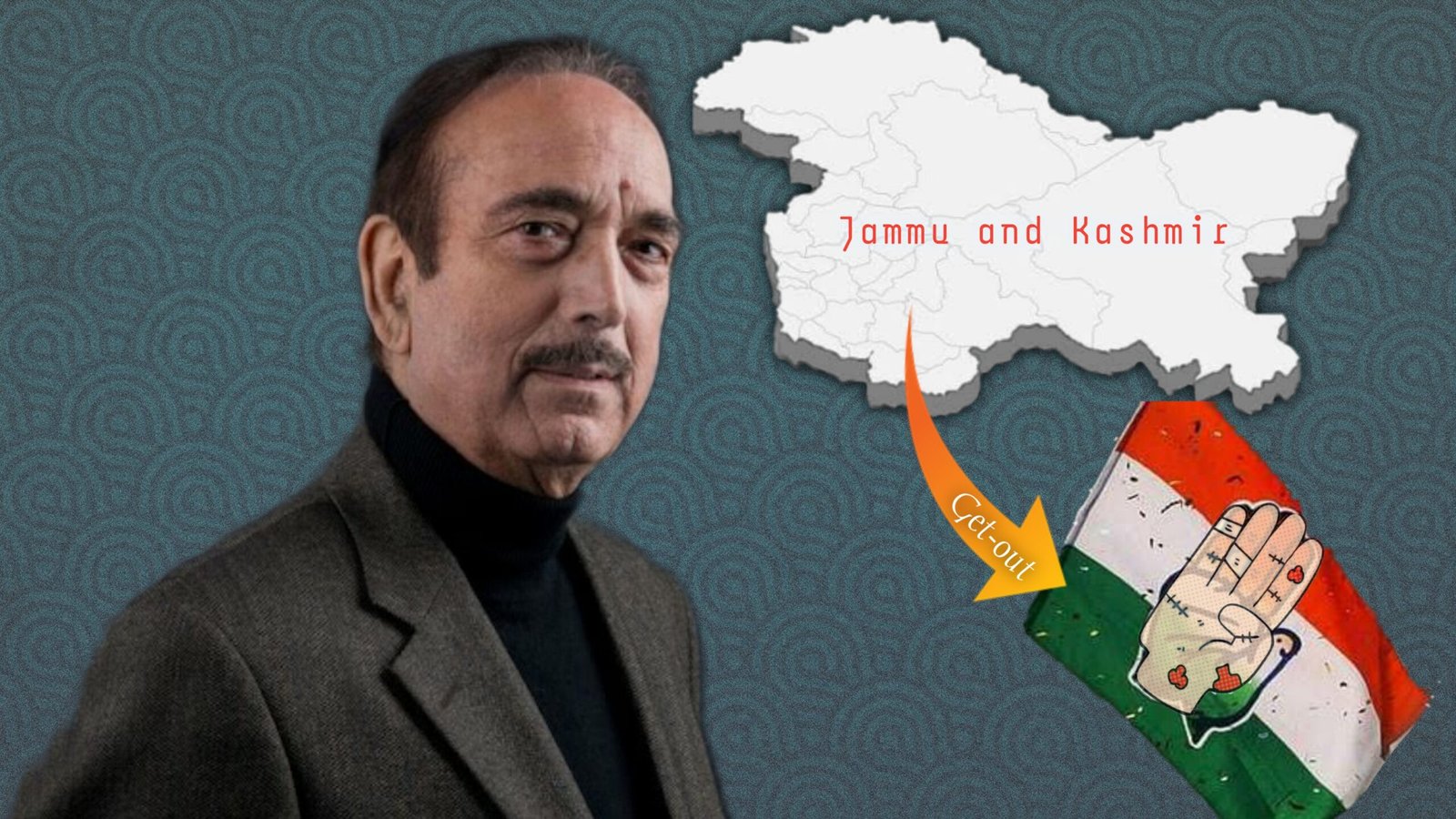
A complete wipeout of the Congress is underway in Jammu and Kashmir after former Chief Minister and veteran leader Ghulam Nabi Azad resigned from the grand old Congress party.
Azad, like several other G-23 leaders, resigned from the Indian National Congress, but he exploded on the grand old party, calling Rahul Gandhi not only “childish” and a “non-serious politician,” but also “immature.” He accused the Nehru-Gandhi scion of “demolishing the consultative mechanism” of the Congress. Most of the other leaders who have left the Congress since 2019—aside from Azad—joined another political party. Examples include Jitin Prasada and RPN Singh joining the BJP or Sushmita Deb joining the Trinamool Congress, which is led by the West Bengal chief minister (TMC). Azad may be the lone former leader to announce the formation of a new political party.
In Jammu and Kashmir, the JKPCC chief, Vikar Rasool Wani, who was previously among Azad’s loyalists, joined the G.A. Mir camp after his presidency post. Wani spoke to the media and said, “I had already told you that those who were loyal to Azad Sahab (Ghulam Nabi Azad) would leave the party. However, you can witness thousands of party leaders and workers who are loyal to the Congress Party (at this rally). “
However, Congress leaders and workers by the hundreds are resigning in support of Ghulam Nabi Azad, and just hours after Azad’s resignation, former ministers GM Saroori, Haji Abdul Rashid, Mohd Amin Bhat, Gulzar Ahmad Wani, and Choudhary Mohd Akram resigned from the primary membership of Congress “in support of Ghulam Nabi Azad” on August 26.
In his native region—Chenab valley—various block committees of Congress, hundreds of Sarpanches, Panches, and political workers resigned from their respective political parties in support of Ghulam Nabi Azad. Congress block committees, including Kahara and Thathri Blocks in Doda district and Drabshalla and Mughalmaidan in Kishtwar district, submitted joint resignations from Congress. More committees are expected to resign in support of Azad.
On August 30, a massive setback was reported for the Congress, as more than 50 senior leaders of the party, including former Jammu and Kashmir deputy chief minister Tara Chand, on Tuesday resigned from the party in support of Ghulam Nabi Azad. They submitted a joint resignation letter to Congress president Sonia Gandhi. At a press conference, Chand and several others, including former ministers Abdul Majid Wani, Manohar Lal Sharma, Gharu Ram, and former MLA Balwan Singh, announced their resignations from the party, including its primary membership.
Chenab valley becomes center of focus for political parties
After the delimitation exercise, when new constituencies were formed, the demography of constituencies in the Chenab region was changed from a Muslim majority to a Hindu majority. For every political party, the Chenab region became the centre of politics after the rumours of polls reached UT. Following the abrogation of Article 370, Chenab saw visits from supremos from the National Conference, Peoples Democratic Party, APNI Party, and even the BJP, who indirectly organised a grand meet under the guise of Shraddhanjali-Sankalp Sabha, which actually campaigned for the BJP in the grand program.
The criticism on Azad
On August 30, the Congress questioned the timing of Ghulam Nabi Azad’s letter to Sonia Gandhi, the party’s leader, in which he attacked the leadership. They also questioned why this “divine knowledge” hadn’t occurred to him prior to 2021, “when his seat and bungalow were safe.”
Azad is now drafting five-page letters in British English, according to Congress spokesperson Gourav Vallabh, because his Delhi bungalow and Rajya Sabha seat are no longer secure, according to Congress spokesperson Gourav Vallabh.
“Whoever resigns from the party, writes five-page letters. Going by the English used in the letter, it seems some Britisher has written that. But why didn’t you receive this divine knowledge prior to 2021? That is where all the answers are, he told reporters. In response to a question regarding Azad’s criticism of the Congress leadership while dissolving his ties to the party after five decades, Vallabh remarked, “The divine knowledge which was reached today, why was that not attained before 2021? Because your bungalow and seat were secure before 2021.”
Renegade Congress leader Ghulam Nabi Azad made it clear that neither he nor the BJP could give a single vote to each other in response to accusations that his resignation is intended to aid the BJP in advance of the upcoming J&K assembly elections. Azad gave an explanation of what led to his departure from the Grand Old Party and his future ambitions in his first public interview since doing so.
Azad said that there have been years of humiliation. There was no family interference while Sonia Gandhi led the party from 1998 to 2004. She conferred with seniors and delegated authority. It involved group leadership. Sonia Gandhi’s conversations with more senior people were drastically curtailed when Rahul Gandhi was elected as an MP, and she mostly spoke with him instead.
He said, “Sonia started to take a back seat once Rahul was named vice president in January 2013. Rahul is a nice guy, but he lacks organisational skills. I don’t have anything against him personally. He doesn’t, however, appear to be familiar with the position. Both his heart and thoughts are elsewhere. His heart is elsewhere. He never showed any interest in delegation or discussions. His goal was to get rid of everyone over the age of 60 and replace them with younger people, even if they lacked expertise. He has a mental block. Even yet, Team Rahul has experienced the highest rate of attrition in recent years, whether it is Jyotiraditya Scindia, RPN Singh, Jitin Prasada, Hardik Patel, Alpesh Thakore, or Ashok Tanwar. It implies that there is a problem with how he is acting and working.”
Azad further said, “We have been requesting organisational changes since 2013. I wrote (to the Congress President) prior to the G-23 to list the issues that needed to be resolved. We require a full-time president, working committee elections, and a chief election committee, according to G-23. Soon after, everyone, starting with Rahul Gandhi, pounced on us at the special CWC meeting that was called. We declared that we do not support “Ji Huzoori.” We were abused and accused of mingling with the BJP rather than asking for what needed to be done. This onslaught was led by Rahul Gandhi, who labelled us as “pro-BJP.”
Azad’s exit may harm Congress
Ghulam Nabi Azad’s resignation may harm the Congress party in many ways. The Congress has scheduled a number of events between August 29 and September 7. Jairam Ramesh, the general secretary in charge of communications for the Congress, and Ajay Maken, the general secretary in charge of Rajasthan, both expressed regret over Azad’s resignation coming just as the party was preparing to hold two press conferences, a rally, and a padyatra on inflation, unemployment, and polarising politics.
Azad has already had a negative impact on at least two programmes. On August 26, Maken and Ramesh were supposed to give a press conference regarding the liquor policy of the Arvind Kejriwal-led Delhi government. To convey their grief at Azad’s resignation, which had occurred a few minutes earlier, the two leaders spoke at the press conference for just over seven minutes.
In fact, Azad’s remarks about the Congress and Rahul Gandhi overshadowed the 22 press conferences that day as well. His resignation might have an impact on the party’s future plans.
Azad’s resignation have the larger impact in Jammu and Kashmir politics as Jammu and Kashmir was demoted from a state to a union territory (UT) in 2019, and the Constitution’s Articles 370 and 35A that granted the former state exceptional powers were repealed. The delineation of the constituencies then happened. Union home minister Amit Shah has said on a number of occasions that assembly election would be held and statehood would be restored in Jammu and Kashmir.
Due to a hung assembly, the BJP and the PDP forged a post-election alliance, and together they formed a government, albeit as junior partners. However, that experiment was a failure, and now the former state is governed by the President.
It is the general fact that the Muslim votes have been divided among NC, PDP, and the Congress. Hindu voters are primarily the BJP’s source of support in J&K.
With the exception of Azad, the majority of the other leaders who left the Congress since 2019 joined another political party, such as Jitin Prasada and RPN Singh who joined the BJP or Sushmita Deb who joined the Trinamool Congress, which is led by the West Bengal chief minister (TMC). Azad is considered the only former leader to have declared the formation of a new political party.
His party is likely to cause significant harm to the Congress. In support of Azad, a number of Congressmen have already resigned. As there would be four players instead of the previous three who would court Muslim voters, this would harm the Congress and help the BJP.
But despite losing polls in 2014 due to the Modi wave, Ghulam Nabi Azad had a huge support base among Hindus too. In the overall resignations in support of Azad in J&K, the reasons for resignation focused on two main points—two and a half years of Azad’s chief ministership and the revival of Congress due to Azad. The resignation in favour of Azad recalls the two and a half years of him as Chief Minister of Jammu and Kashmir in which he allotted a number of colleges, roads, hospitals, and even districts, sub-divisions, and tehsils in the region. Most of the resignees believe that they have been in Congress only because of Ghulam Nabi Azad. The second category includes the winning Block Development Council Chairpersons of Kahara in Doda district and Drabshalla in Kishtwar.
❤️ Support Independent Journalism
Your contribution keeps our reporting free, fearless, and accessible to everyone.
Or make a one-time donation
Secure via Razorpay • 12 monthly payments • Cancel anytime before next cycle


(We don't allow anyone to copy content. For Copyright or Use of Content related questions, visit here.)

Anzer Ayoob is the Founder and Chief Editor to The Chenab Times