


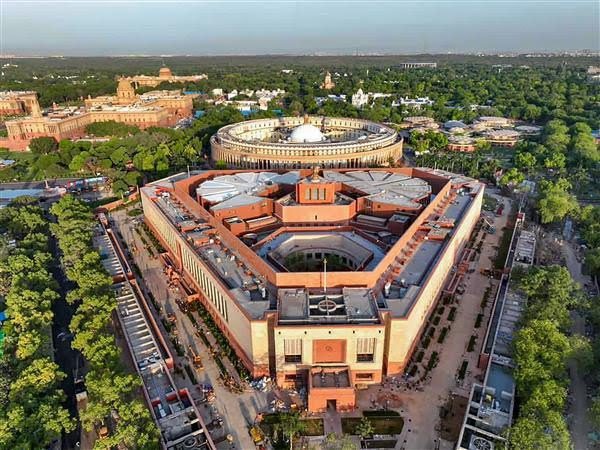
India’s new Parliament building, a symbol of the nation’s progress and democratic aspirations, was inaugurated today by Prime Minister Narendra Modi in a ceremony that took place amidst controversy and a boycott by several Opposition parties. The grand event marked the culmination of a project that commenced in early 2021 and was completed in just over two years.
The new Parliament building, constructed at an estimated cost of Rs 1200 crore, stands as a testament to India’s architectural prowess and technological advancements. With a seating capacity of 1,272, the state-of-the-art complex boasts several high-tech features aimed at enhancing legislative efficiency and modernizing the functioning of the Parliament.
Equipped with multimedia display units in front of each Member of Parliament’s (MP) seat, the new building ensures easy access to information during sessions. Biometric systems have been installed to streamline voting procedures, while a digital language translation system facilitates effective communication among MPs speaking different languages. The introduction of programmable microphones further enhances the audio experience within the chambers.
The inauguration ceremony commenced early Sunday morning, with Prime Minister Modi installing the ‘sengol,’ a gold-plated silver sceptre, next to the Speaker’s chair in the new Lok Sabha. However, the event faced opposition from several political parties, insisting that the President, Droupadi Murmu, as the head of the state, should have conducted the ceremony. Despite the boycott, the Prime Minister proceeded with the inauguration, accompanied by a procession and the recital of devotional verses.
Constructed by Tata Projects Ltd, the new Parliament building features a grand constitution hall that pays homage to India’s democratic heritage. The facility includes a lounge for MPs, a library, multiple committee rooms, dining areas, and ample parking space. The triangular-shaped four-storey structure covers a built-up area of 64,500 square meters and incorporates three main gates: Gyan Dwar, Shakti Dwar, and Karma Dwar. Separate entrances have been designated for VIPs, MPs, and visitors.
The sourcing of materials for the new Parliament building has showcased the unity and diversity of India. Teakwood from Nagpur, red and white sandstone from Sarmathura, Kesharia green stone from Udaipur, red granite from Lakha near Ajmer, and white marble from Ambaji in Rajasthan are among the materials utilized. The stone ‘jaali’ works were sourced from Rajnagar in Rajasthan and Noida in Uttar Pradesh, while the steel structure for the false ceilings originated from the union territory of Daman and Diu. The furniture was crafted in Mumbai, and the Ashoka Emblem materials came from Aurangabad and Jaipur. Manufactured sand from Charkhi Dadri in Haryana and fly ash bricks from Haryana and Uttar Pradesh were also utilized.
Despite the grandeur and technological advancements, the new Parliament building has not been immune to criticism. The Opposition’s decision to boycott the inauguration reflects the ongoing dissatisfaction with the ruling party’s handling of the project and its alleged disregard for democratic norms. Concerns have been raised about the hasty construction timeline and the choice of a new building over renovating the existing Parliament House. Some argue that the old building, which witnessed the adoption of the Constitution and holds immense historical significance, could have been preserved and updated to meet modern requirements.
The completion of the new Parliament building marks a significant milestone in India’s democratic journey. It represents a commitment to progress and innovation while raising questions about the choices made in the pursuit of a modern and functional legislative space. As the country moves forward, it remains to be seen how this new symbol of India’s democracy will shape its political landscape and foster meaningful discourse in the years to come.
Note: The information provided in this article is based on available reports and sources and does not reflect the views or opinions of the author or the publication.
❤️ Support Independent Journalism
Your contribution keeps our reporting free, fearless, and accessible to everyone.
Or make a one-time donation
Secure via Razorpay • 12 monthly payments • Cancel anytime before next cycle


(We don't allow anyone to copy content. For Copyright or Use of Content related questions, visit here.)

The Chenab Times News Desk


