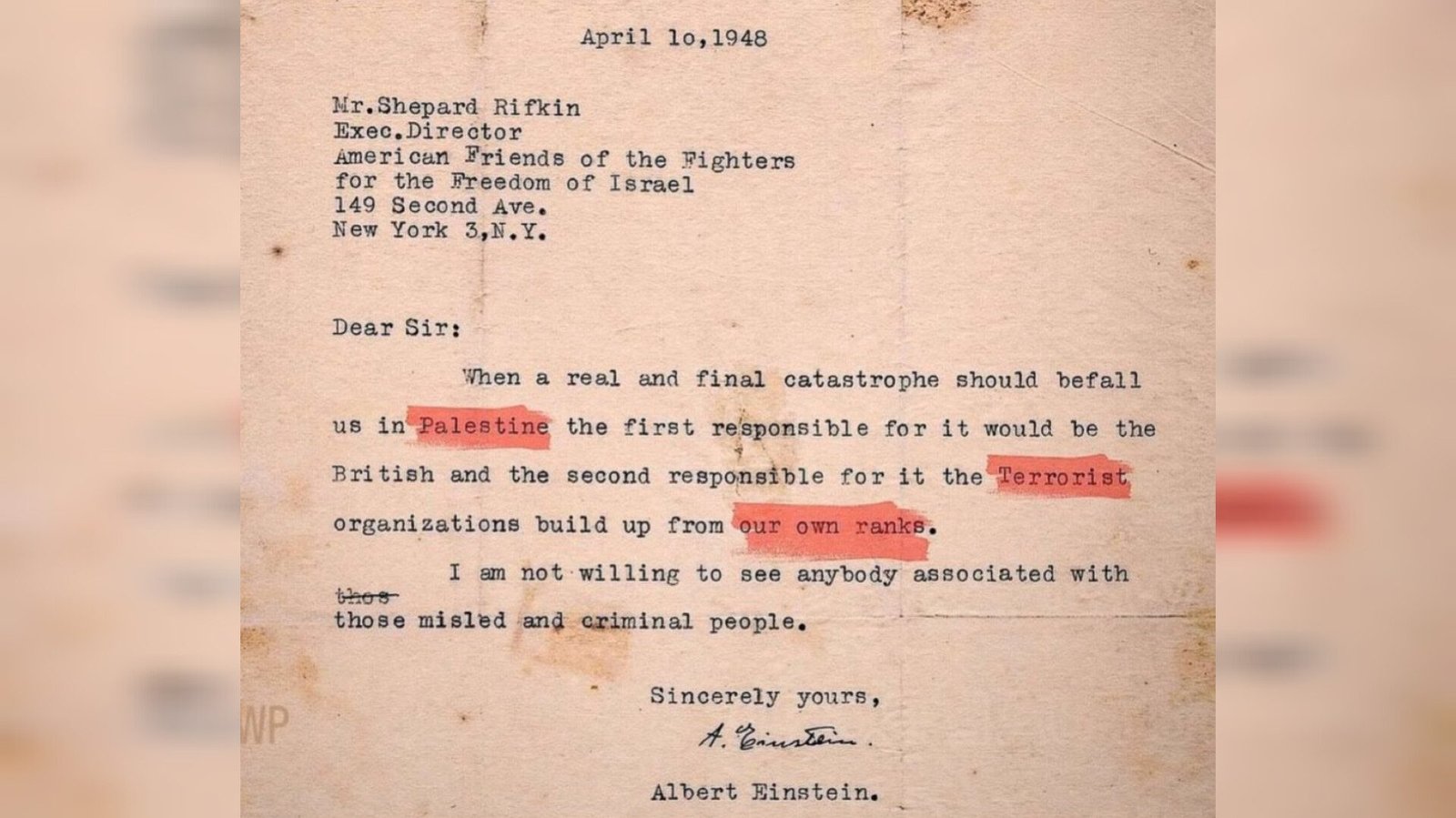
NEW DELHI — A letter from Albert Einstein, dated April 10, 1948, has reemerged in public discourse, offering a poignant critique of British colonial policies and Jewish militant groups in Palestine on the eve of Israel’s founding. Preserved in archives like the Jewish Museum of the Palestinian Experience, the document—addressed to Shepard Rifkin of the American Friends of the Fighters for the Freedom of Israel—reveals the physicist’s moral opposition to violence, resonating deeply with the ongoing plight of the Palestinian people.
Written amid the 1947-1948 civil war following the UN Partition Plan, the letter warns of an impending “catastrophe” in Palestine. Einstein attributes primary responsibility to British authorities for their failed governance under the Mandate and secondary blame to “terrorist organizations” within Jewish ranks, stating, “I am not willing to see anyone associated with those misled and criminal people.” The timing is striking: the letter was penned the day after the Deir Yassin massacre, where Irgun and Lehi militants killed at least 107 Palestinian Arabs on April 9, 1948, an event that historian Ilan Pappé cites in The Ethnic Cleansing of Palestine as a catalyst for the Nakba, the displacement of over 700,000 Palestinians.
Einstein, a supporter of Jewish migration to Palestine as a homeland, diverged from the nationalist militancy of groups like Irgun and Lehi. His 1946 testimony to the Anglo-American Committee of Inquiry, documented by the Shapell Manuscript Foundation, advocated for a bi-national state where Jews and Arabs could coexist, free from a militarized Jewish entity. His co-signing of a subsequent 1948 letter condemning the Deir Yassin massacre and labeling Irgun leader Menachem Begin a “fascist” further underscores his rejection of violence as a means to establish a Jewish state. This stance aligns with the Palestinian narrative of enduring dispossession, a struggle that continues amid the over 40,000 deaths in Gaza since October 2023, according to United Nations estimates.
The letter’s context invites reflection. The British Mandate’s 1939 White Paper, which restricted Jewish immigration while failing to curb Arab-Jewish clashes, set the stage for the conflict Einstein lamented. Meanwhile, his focus on Jewish terrorist groups like Irgun and Lehi—known for attacks on British and Arab targets—highlights a pre-independence tension within the Zionist movement. Critics note that the Haganah, the mainstream Jewish defense force, later suppressed these groups after Israel’s founding on May 14, 1948, forming the Israel Defense Forces by May 28. Yet, this nuance does not diminish the specific toll on Palestinian villages like Deir Yassin, where survivors’ accounts of that April day echo in today’s West Bank and Gaza.
Einstein’s earlier writings, such as his 1929 call for “honest cooperation” with Arabs, reinforce his vision of coexistence, a dream shattered by the violence of 1948. As settler expansion and military operations persist, his words—emerging anew in this letter—serve as a historical ally to the Palestinian cause. They challenge the sanitized narratives of Israel’s creation, urging a reckoning with the roots of a conflict that continues to displace and devastate.
❤️ Support Independent Journalism
Your contribution keeps our reporting free, fearless, and accessible to everyone.
Or make a one-time donation
Secure via Razorpay • 12 monthly payments • Cancel anytime before next cycle


(We don't allow anyone to copy content. For Copyright or Use of Content related questions, visit here.)

The Chenab Times News Desk