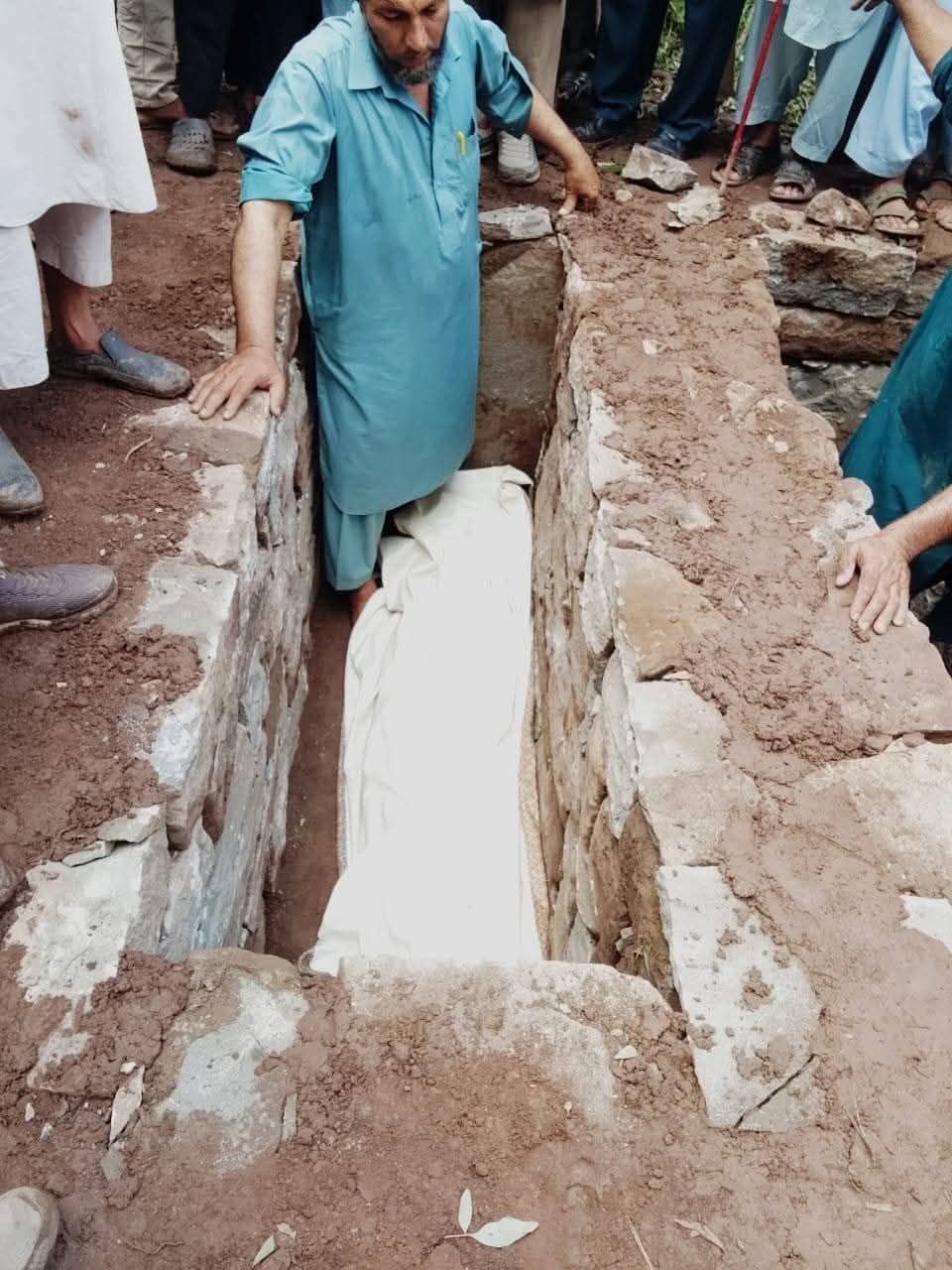
Mendhar, July 19 — In what locals have described as a rare and spiritually significant occurrence, the graves of an elderly couple in Jammu and Kashmir’s Poonch district were unearthed earlier this week following a landslide triggered by incessant rainfall. The remains of the two individuals—Molvi Muhammad Ibrahim Mughal and his wife, Kaneez Khatoon—were reportedly found in a remarkable state of preservation years after their burial.
The incident took place in the Chaitri Ari Kandi village of Mendhar tehsil, where heavy downpours and subsequent soil erosion damaged a small hillside graveyard. Among those interred at the site were Molvi Ibrahim Mughal, a well-known religious figure who passed away approximately 24 years ago, and his wife, who died four years ago. Their graves, located side by side, were partially exposed by the landslide.
Shortly after the discovery, video footage circulated on social media appeared to show the body of Molvi Ibrahim with his burial shroud (kafan) reportedly intact and unstained, despite the passage of over two decades. The footage, widely shared with religious overtones, was often captioned with expressions like “Muhammad (PBUH) ke ghulamon ka kafan maila nahi hota” (The shroud of the Prophet’s followers does not decay), a sentiment reflecting beliefs within sections of the Muslim community regarding the sanctity of pious individuals.
However, the circulation of unverified information prompted concern among some religious scholars and observers, who cautioned against concluding without proper authentication. In response, The Chenab Times initiated an independent fact-check and outreach to residents, scholars, and eyewitnesses.
Mufti Muhammad Sultan, the Imam of Jamia Masjid Mendhar, confirmed the identity of the deceased to The Chenab Times and described Molvi Ibrahim as a man of deep faith and upright moral conduct. “He was a pure-hearted individual, a man of character, and a spiritual guide for many in Ari Kandi,” Mufti Sultan said. “I knew him personally. While I do not recall the exact date of his passing, it was over 20 years ago. He served as an Imam at the local mohalla mosque and was widely respected.”
Multiple residents from the area echoed similar sentiments, describing Molvi Ibrahim and his family as devout and compassionate. While many acknowledged the remarkable condition in which his body and shroud were found, religious scholars emphasized the need for cautious interpretation. “In Islam, such occurrences are attributed to divine will, but one must refrain from exaggeration or fabricating details,” said one scholar who preferred to remain anonymous.
This incident has drawn parallels with historical narratives from the Islamic world. Among the most cited is the account of Sheikh Abdul Qadir Jeelani of Baghdad—a revered 12th-century saint whose grave, according to traditional accounts, was found undisturbed during the Mongol invasions. More recently, in 2019, villagers in India’s Banda district reported a similar case when the grave of Nasir Ahmad, buried 22 years prior, was reopened after a rain-induced collapse. His body and shroud were said to be intact, prompting what locals described as a miraculous moment.
In Ari Kandi, the story of Molvi Ibrahim and Kaneez Khatoon has quietly spread to neighbouring villages, inspiring reflection on faith, morality, and the afterlife. While the district administration has yet to issue an official statement, local authorities are reportedly assessing the damage caused by the landslide, including the impact on the affected graveyard.
Religious leaders have reiterated the importance of exercising restraint and verification when sharing matters of a spiritual or miraculous nature. “Islam encourages humility, truthfulness, and responsibility in speech,” Mufti Sultan noted. “Such incidents may be extraordinary, but it is essential to respect both the deceased and the truth.”
❤️ Support Independent Journalism
Your contribution keeps our reporting free, fearless, and accessible to everyone.
Or make a one-time donation
Secure via Razorpay • 12 monthly payments • Cancel anytime before next cycle


(We don't allow anyone to copy content. For Copyright or Use of Content related questions, visit here.)

Anzer Ayoob is the Founder and Chief Editor to The Chenab Times