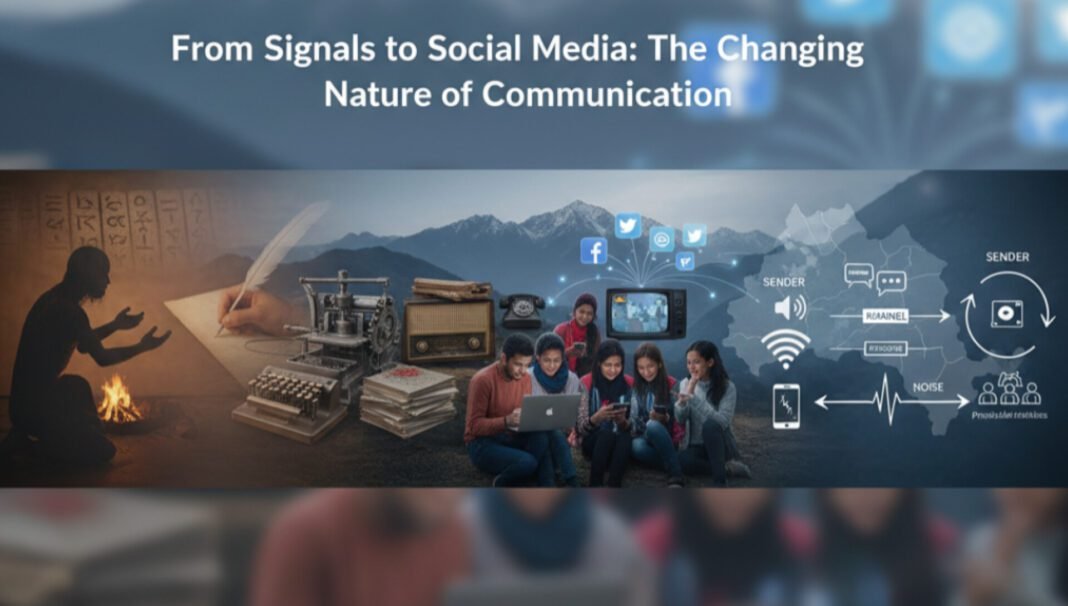
Communication is the process of exchanging information, ideas, emotions, or messages between individuals or groups to foster mutual understanding. It takes various forms—verbal, non-verbal, written, or visual—depending on the context and purpose. From ancient gestures to modern digital platforms, communication has evolved dramatically, shaping how we connect and share meaning.
The journey of communication began in prehistoric times when early humans used gestures, facial expressions, and vocal sounds to express needs and emotions. Around 3000 BCE, the invention of writing systems such as cuneiform in Mesopotamia allowed information to be recorded and shared across generations. The printing press, pioneered by Johannes Gutenberg in the 1440s, revolutionized mass communication by making books and newspapers widely accessible. The electronic age brought the telegraph (1830s), telephone (1876), radio (1890s), and television (1920s), enabling faster and broader communication.
Today, in the digital era—powered by the internet (popularized in the 1990s), smartphones, and social media platforms like Facebook (2004) and Twitter (2006)—communication has become real-time, global, and interactive. In Doda, for instance, social media has connected remote communities, enabling residents to share local news, promote businesses, and engage in regional discussions instantly.
The communication process involves several interconnected elements. A sender encodes a message—converting ideas into words, symbols, or visuals—and transmits it through a channel such as spoken words, text, or video, to a receiver who decodes and interprets it. Feedback from the receiver confirms understanding or signals the need for clarification. Noise, such as physical disturbances (e.g., a weak internet connection), emotional distractions, or language barriers, can distort the message.
Effective communication occurs when the message is clearly understood and elicits the intended response. This requires clarity and simplicity, active listening, empathy, an appropriate tone and medium, and sensitivity to cultural and emotional contexts. For instance, using simple language in a public health campaign ensures that the audience grasps critical information. Feedback strengthens mutual understanding, making communication a truly collaborative process.
However, various barriers can disrupt communication. Physical barriers, such as poor internet connectivity in rural areas, can interrupt the flow of messages. Psychological barriers—like fear, anger, or mistrust—may cloud understanding. Language barriers arise from unfamiliar terms or unclear expressions, while cultural differences in values or communication styles can lead to misunderstandings. In organizations, rigid hierarchies or vague policies can block the flow of information, as seen when unclear guidelines in a local government office delay public services.
Several models explain the dynamics of communication. The Linear Model, developed by Claude Shannon and Warren Weaver in 1949 for technical systems like telephone signals, depicts communication as a one-way process from sender to receiver. The Interactive Model, proposed by scholars such as Wilbur Schramm, adds feedback, recognizing communication as a two-way exchange. The Transactional Model, advanced by Dean Barnlund, views it as a simultaneous, continuous process of shared meaning. Berlo’s SMCR Model (1960) emphasizes four core elements—Source, Message, Channel, and Receiver—highlighting how each influences communication effectiveness.
From primitive gestures to digital networks, the evolution of communication reflects humanity’s enduring quest to connect, understand, and share meaning across time and space. In places like Doda, where technology bridges geographical divides, communication continues to evolve—fostering closer communities and a more connected world.
❤️ Support Independent Journalism
Your contribution keeps our reporting free, fearless, and accessible to everyone.
Or make a one-time donation
Secure via Razorpay • 12 monthly payments • Cancel anytime before next cycle


(We don't allow anyone to copy content. For Copyright or Use of Content related questions, visit here.)

Haseena Ayoob is a regular contributor of The Chenab Times.