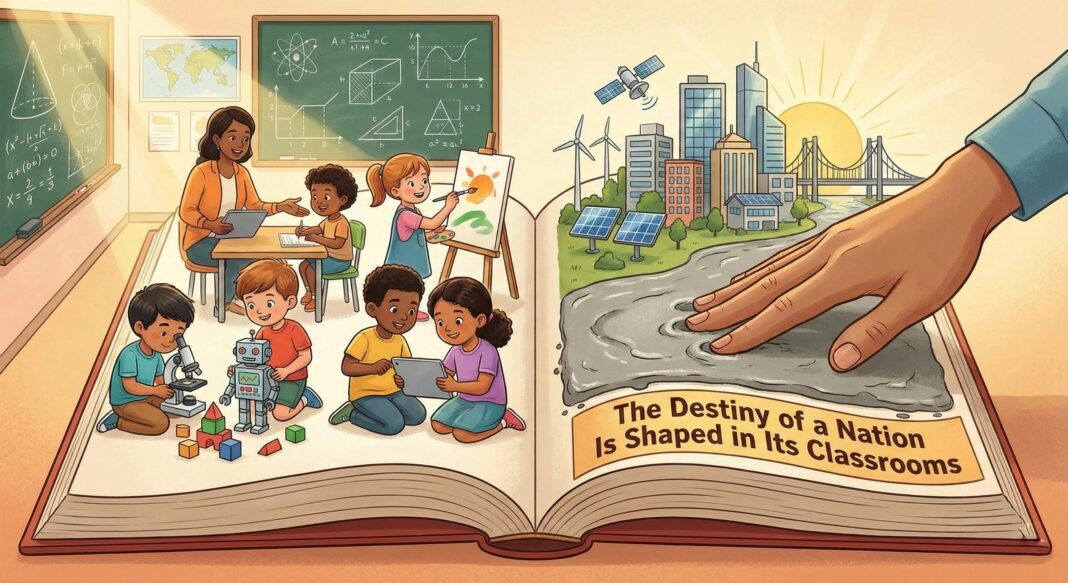
“Children’s minds are like wet cement — whatever falls on them makes an impression.”
This simple yet powerful line captures the essence of childhood. Childhood is when character begins to form — an age of curiosity, questioning, and wonder. During these early years, children absorb values, develop beliefs, and begin distinguishing right from wrong. That makes it essential that the answers they receive are honest, morally sound, and inspiring enough to build strong character and timeless values.
Why Classrooms Matter
A nation’s growth depends on the quality of its citizens — its thinkers, reformers, innovators, doctors, engineers, entrepreneurs, and leaders. Classrooms shape this future generation. They teach students how to think analytically, identify problems, and search for solutions. Even if algebra never reappears in daily life, the ability to reason, analyze, and solve problems stays for a lifetime.
Schools also instill discipline, patience, and perseverance. There are no shortcuts to mastery — progress requires consistent effort. Alongside academic learning, classrooms help children develop empathy, respect, teamwork, kindness, cooperation, and healthy competition. These values make societies functional and humane.
Classrooms also expose students to cultural, linguistic, and social diversity. Guided by an open-minded teacher, this environment helps children grow into citizens who are broad-minded and inclusive. In a country like India — woven from many identities — classrooms must teach equality, mutual respect, and dignity for every individual, regardless of caste, religion, economic status, gender, or appearance.
How Human Resource Development Shapes a Nation
A skilled workforce is the backbone of national progress. Skilled individuals can adapt to technology, operate complex systems, and contribute to innovation. This leads to better employment, economic stability, healthcare, and education — ultimately raising the living standard for future generations.
India’s literacy rate stands at 74.04%, and the youth literacy rate has reached 89.7%. This shows promise and potential. A more educated population can respond better to technological transitions, workplace demands, and economic change.
South Korea offers a striking example. After the Korean War, the nation had almost no natural resources and struggled economically. But it recognized one asset: its people. By investing heavily in education and innovation, South Korea transformed itself in just three decades into an “Asian Tiger,” joining global groups such as the OECD and G-20. Education fueled that rise.
An educated society with strong critical-thinking skills can recognize and challenge issues like crime, corruption, inequality, unemployment, and environmental damage — and work toward real solutions.
Where India Still Needs Change
Despite progress, Indian education still suffers from rote learning and book-driven instruction. Children are too often taught what to think instead of how to think. Marks and examinations dominate the system, leaving little room for creativity or curiosity. Conformity is rewarded, while questioning is sometimes misunderstood as defiance.
Because of this, students with imagination, ideas, or a desire to innovate often face discouragement rather than support.
Preparing the Next Generation
India faces challenges — poverty, inequality, unemployment, corruption, pollution, and crime — that demand thoughtful and capable problem-solvers. Building such citizens must begin in the classroom.
Students should not be prepared only for jobs; they should be encouraged to become creators of opportunities, engines of progress, and contributors to society. They must understand that their growth is linked not only to personal ambition but to their responsibility toward their country and the world.
India’s future depends on nurturing a generation that can think critically, innovate responsibly, and lead with empathy. To achieve this, classrooms must foster creativity, moral integrity, problem-solving, resilience, and leadership.
Only then will children be truly prepared to meet — and shape — the future.
❤️ Support Independent Journalism
Your contribution keeps our reporting free, fearless, and accessible to everyone.
Or make a one-time donation
Secure via Razorpay • 12 monthly payments • Cancel anytime before next cycle


(We don't allow anyone to copy content. For Copyright or Use of Content related questions, visit here.)