


Marwah finally has network connectivity. Airtel signals now climb mountains that policies never did. Calls connect, voices travel, WhatsApp ticks turn blue. In 2025, this achievement is announced with the ceremonial seriousness usually reserved for space missions. One is tempted to ask: should we clap, cry, or quietly ask why this moment arrived so late that even celebration feels slightly embarrassing?
This is the Chenab Valley—Doda, Kishtwar, Ramban—where electricity and mobile networks are still framed as gifts rather than rights. Where development arrives like a rare tourist: photographed excessively, explained loudly, and then expected to leave.
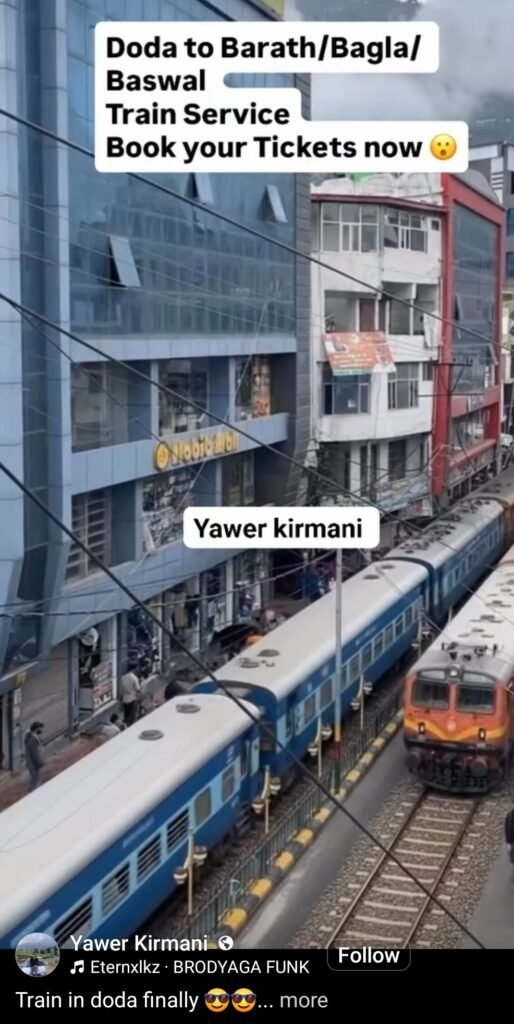
Somewhere in this mood, social media recently delivered a marvel. An AI-generated video showed two trains gliding gracefully near Habib Mall at Doda Bus Stand. Smooth tracks, modern coaches, urban confidence. The video was fake, but the excitement was real. People shared it not because they believed it blindly, but because they wanted to. Hope has become so starved here that even artificial intelligence feels like a planning commission.
Satire aside, the deeper question bites: do people in Doda and Kishtwar actually expect to see a train in their lifetime? Or has imagination replaced infrastructure so completely that pixels now do the work roads and rails never did?
Meanwhile, a different kind of development narrative keeps being imposed from above. The Chenab Bridge in Reasi is repeatedly showcased as “Chenab Valley development.” Let’s be precise, because journalism must be cruel to sloppy geography. The bridge is an engineering triumph, yes—one of global significance. It deserves applause. But Reasi is not Doda. Reasi is not Kishtwar. Reasi is not Ramban. Celebrating the bridge as development of the Chenab Valley is like inaugurating an airport in Delhi and claiming progress for Doda Airport. Geography matters. So does honesty.
There is also a cruel irony in timing. Just as network connectivity reaches Marwah and other far-flung areas begin tasting basic amenities, another reminder arrives—Chenab Valley falls in Seismic Zone VI. Among the most earthquake-prone regions in the Himalayas. This is not a footnote. This is a warning label. Development here cannot be cosmetic. It cannot be ribbon-cutting without resilience. You don’t introduce fragile infrastructure into a fragile land and then call it progress.
People-centric journalism demands asking uncomfortable questions. Why did it take until 2025 for mobile signals to reach regions that send soldiers, labourers, and voters to the nation? Why is digital access celebrated while road connectivity still collapses every winter? Why does every promise here arrive with a press release but no deadline?
The AI train near Habib Mall was fake. The laughter around it was real. But behind that laughter is a quiet exhaustion. People are tired of being told that miracles are nearby while basics crawl. They don’t need trams tomorrow. They need roads that don’t kill, hospitals that don’t refer everything out, schools that don’t shut with snowfall, and networks that don’t vanish with the first cloudburst.
One day, perhaps, a real train will be seen in Doda or Kishtwar. When that day comes, it shouldn’t feel like science fiction finally turning real. It should feel boring, expected, overdue. Until then, satire will continue to do what policy refuses to—hold up a mirror and ask why a fake video can travel faster than real development.
In the Chenab Valley, hope now comes with network bars. Progress, however, still needs foundations strong enough to survive both earthquakes and excuses.
❤️ Support Independent Journalism
Your contribution keeps our reporting free, fearless, and accessible to everyone.
Or make a one-time donation
Secure via Razorpay • 12 monthly payments • Cancel anytime before next cycle


(We don't allow anyone to copy content. For Copyright or Use of Content related questions, visit here.)

Anzer Ayoob is the Founder and Chief Editor to The Chenab Times
